Zürcher Nachrichten - Cuban municipal polls close as opposition deplores pressure

EUR -
AED 4.231847
AFN 72.006386
ALL 95.775649
AMD 434.856463
ANG 2.061985
AOA 1056.494174
ARS 1607.727961
AUD 1.62593
AWG 2.075256
AZN 1.960902
BAM 1.951921
BBD 2.322903
BDT 141.523639
BGN 1.898286
BHD 0.435009
BIF 3426.405443
BMD 1.15212
BND 1.470297
BOB 7.969403
BRL 6.015915
BSD 1.153318
BTN 106.241154
BWP 15.547505
BYN 3.400157
BYR 22581.555708
BZD 2.31962
CAD 1.569597
CDF 2509.317944
CHF 0.903952
CLF 0.026698
CLP 1047.657656
CNY 7.913857
CNH 7.926795
COP 4265.678916
CRC 543.624278
CUC 1.15212
CUP 30.531185
CVE 110.171467
CZK 24.443615
DJF 204.754659
DKK 7.47211
DOP 70.279431
DZD 151.91282
EGP 60.306922
ERN 17.281803
ETB 180.189883
FJD 2.546764
FKP 0.859588
GBP 0.862685
GEL 3.127981
GGP 0.859588
GHS 12.483212
GIP 0.859588
GMD 84.684731
GNF 10109.854806
GTQ 8.843884
GYD 241.294622
HKD 9.017932
HNL 30.612093
HRK 7.533601
HTG 151.071716
HUF 390.542276
IDR 19480.048159
ILS 3.609258
IMP 0.859588
INR 106.386375
IQD 1509.277448
IRR 1522843.662919
ISK 144.406822
JEP 0.859588
JMD 180.511238
JOD 0.816835
JPY 183.580564
KES 148.856917
KGS 100.753175
KHR 4631.523173
KMF 490.803076
KPW 1036.946415
KRW 1716.612873
KWD 0.353747
KYD 0.961115
KZT 564.523324
LAK 24695.696398
LBP 103172.362698
LKR 358.579781
LRD 211.184685
LSL 18.975841
LTL 3.401911
LVL 0.696906
LYD 7.321753
MAD 10.789573
MDL 20.027717
MGA 4804.341194
MKD 61.632171
MMK 2419.475654
MNT 4113.233943
MOP 9.298005
MRU 46.223406
MUR 52.894234
MVR 17.811978
MWK 2001.232924
MXN 20.525027
MYR 4.524315
MZN 73.625517
NAD 18.975619
NGN 1604.419758
NIO 42.305986
NOK 11.17874
NPR 169.985846
NZD 1.966915
OMR 0.442995
PAB 1.153348
PEN 3.938519
PGK 4.954981
PHP 68.50519
PKR 322.023742
PLN 4.272194
PYG 7467.223887
QAR 4.19498
RON 5.093866
RSD 117.439033
RUB 91.592772
RWF 1680.943356
SAR 4.323362
SBD 9.269017
SCR 17.435641
SDG 692.424099
SEK 10.763567
SGD 1.472899
SHP 0.864389
SLE 28.346054
SLL 24159.383559
SOS 658.435822
SRD 43.050698
STD 23846.561795
STN 24.770584
SVC 10.091855
SYP 127.744021
SZL 18.987071
THB 37.05209
TJS 11.054873
TMT 4.032421
TND 3.368511
TOP 2.774029
TRY 50.824642
TTD 7.826513
TWD 36.705408
TZS 2995.512702
UAH 51.066863
UGX 4317.456634
USD 1.15212
UYU 46.117941
UZS 14004.020407
VES 504.233742
VND 30271.957971
VUV 137.791412
WST 3.127342
XAF 654.653052
XAG 0.013524
XAU 0.000225
XCD 3.113662
XCG 2.078641
XDR 0.813146
XOF 648.064521
XPF 119.331742
YER 274.894318
ZAR 19.322381
ZMK 10370.465189
ZMW 22.404153
ZWL 370.982231
  • RBGPF

    0.1000

    82.5

    +0.12%

  • BCC

    -2.2800

    69.62

    -3.27%

  • CMSC

    -0.1000

    23.14

    -0.43%

  • GSK

    -0.8700

    54.28

    -1.6%

  • RYCEF

    -0.5500

    16.95

    -3.24%

  • BTI

    0.7300

    59.89

    +1.22%

  • NGG

    1.1200

    90.81

    +1.23%

  • RELX

    -0.5800

    34.18

    -1.7%

  • BCE

    -0.2100

    25.68

    -0.82%

  • RIO

    -1.3800

    90.7

    -1.52%

  • VOD

    -0.0900

    14.31

    -0.63%

  • JRI

    -0.0300

    12.82

    -0.23%

  • CMSD

    -0.0500

    23.1

    -0.22%

  • AZN

    -0.8100

    192.5

    -0.42%

  • BP

    0.6000

    42.16

    +1.42%

Cuban municipal polls close as opposition deplores pressure
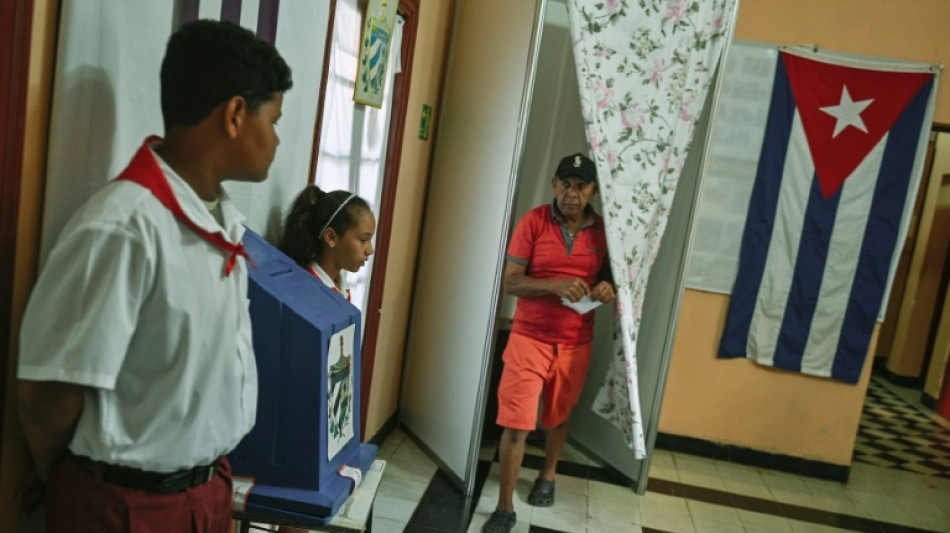
Cuban municipal polls close as opposition deplores pressure / Photo: ADALBERTO ROQUE - POOL-EFE/AFP

Cuban municipal polls close as opposition deplores pressure

Cubans voted Sunday in municipal elections amid a grave economic crisis that some feared would weaken turnout and with the opposition charging that several of its candidates faced unfair pressure.

Text size:

Polls closed at 7:00 pm (0000 GMT), one hour later than expected and after a day of voting without incident, AFP journalists reported.

Elections officials said the extension was due to requests made by polling stations and voters themselves.

As of 5:00 pm, according to the National Electoral Council, nearly 64 percent of Cuba's eight million eligible voters had cast a secret ballot, selecting more than 12,400 municipal delegates, or councilors, from the 27,000 candidates nominated by show of hands in neighborhood assemblies.

Earlier Sunday, President Miguel Diaz-Canel, fresh off a trip that took him to Algeria, Russia, Turkey and China, went with his wife Lis Cuesta to vote at a polling station in Playa, west of Havana.

He later told reporters that the electoral process confirmed the political and social stability of the island, despite the "economic suffocation" he said the United States was imposing on Cuba.

The government had mounted an intense get-out-the-vote campaign on social media, as well as in the press and on television -- both controlled by the ruling Communist Party, which oversees the election process but does not nominate candidates.

But the opposition platform known as the Council for the Democratic Transition in Cuba (CDTC), which promotes change and pluralism in the country through legal means, called on people to abstain, citing unfair pressure by the government.

- 'Political police' -

Its vice president, Manuel Cuesta, told AFP that three of the group's candidates had been prevented "by the political police" from participating in neighborhood assemblies because they appeared to have a good chance of winning.

He said a fourth candidate, Jose Cabrera, was nominated in the southeastern city of Palma Soriano but never made it to the ballot over "threats of losing his job" and other difficulties.

The Cuban government has branded opposition members as US "mercenaries."

These elections are the first step in a unique electoral system.

Councilors elected Sunday will form municipal governments that will propose 50 percent of the candidates for provincial assemblies and the National Assembly, which in turn elects the Council of State and the Cuban president from among its members.

The other 50 percent are put forward by social organizations close to the government.

In theory, the system allows any Cuban to reach parliament, but the opposition maintains that Communist Party militants have the ability to prevent any opposition member from being elected.

Adding uncertainty to the election -- the first since Diaz-Canel came to power in 2018 -- is the economic crisis that has brought shortages of food and medicine and daily blackouts to the island, fueling an outflow of migrants and potentially increasing abstentionism.

Candidates who fail to win with an outright majority this Sunday will face a runoff on December 4.

X.Blaser--NZN