The also-rans: South Korea's long-shot presidential candidates
From a wealthy businessman who wants to unify the Korean peninsula to a heavily indebted ex-autoworker offering socialism to the masses, South Koreans have a plethora of choices in Wednesday's presidential election.
Of the 12 candidates in the running, only two -- from the country's main political parties -- have a real chance of winning.
Even so, minor-party candidates refuse to give up their dreams.
The wealthy country, Asia's fourth-largest economy, has been divided from its communist neighbour North Korea since the Korean War of the 1950s, and the idea of reunification has long since ceased to be a vote-winner.
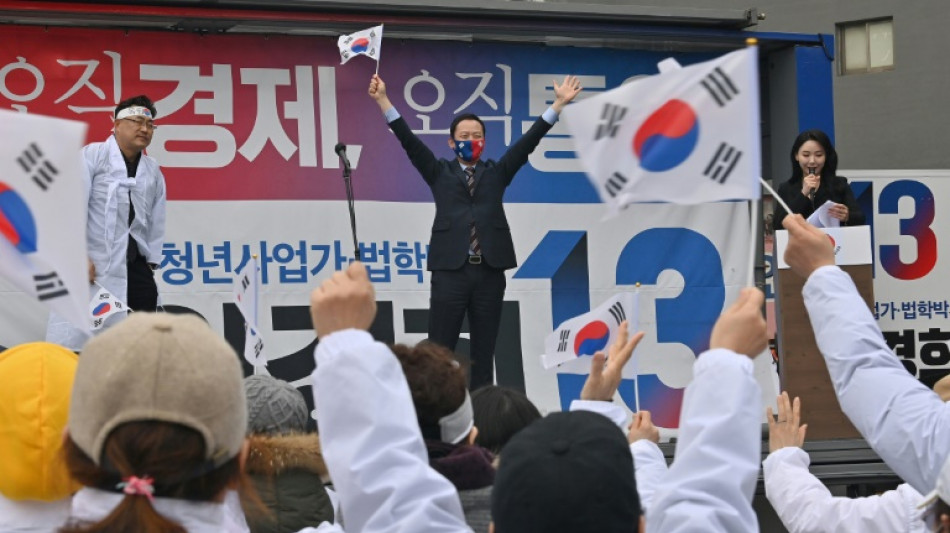
Enter presidential candidate number 13, Lee Kyeung-hee of the fringe Korean Unification Party.
For a decade, the businessman has poured billions of won into running for the country's top job, on a platform of reuniting the peninsula.
"Unification is the biggest issue," he told AFP at a small rally featuring a student dance group, saying South Korea has hit the limits of economic growth as a divided nation.
The major parties differ in their approach to North Korea, with the incumbent Democratic party in favour of dialogue and the People Power party more hawkish, but neither proposes reunification.
Under outgoing President Moon Jae-in, there was a volley of high-level diplomatic engagement with Pyongyang's leader Kim Jong Un, including three inter-Korean summits, plus summits with then US president Donald Trump.
But talks collapsed and have remained stalled since, while North Korea ramps up weapons testing.
Lee said that, should be become president, he would "hold an inter-Korean summit every Tuesday at 10 am".
- Socialism, at a price -
Lee is independently wealthy and has funded his repeated runs for office with his own cash, but candidate number 7 Lee Baek-yoon of the Labor Party told AFP he had taken out bank loans to pay for his presidential dreams.
From the "donation" each candidate must make to get on the ballot to the cost of campaign materials, running for office is expensive and, unless a candidate wins 15 percent of the vote, it is not covered by the state.
"I'm using only the minimum amount of money that I really need to spend, and I still owe a lot right now," Lee Baek-yoon told AFP, adding that he had spent all his savings on his bid to become South Korea's first socialist president.
While the People Power party runs on a small-government, fiscally conservative platform and the Democratic party is in favour of more government welfare spending, neither questions the right of South Korea's powerful chaebol -- family-run conglomerates such as Samsung -- to exist.
"An exclusive society for the top 1 percent has been created over the past few decades because of a monopoly structure centred on the chaebol," said Lee Baek-yoon, who used to work on the production line at a car factory.
His platform is wildly unpopular in the status-obsessed country; while he was being interviewed by AFP he was repeatedly heckled by angry voters telling him to "Go to North Korea".
He expects to win, optimistically, five percent of votes. But he refuses to give up, saying his key goal is simply "to inform people a little more about the new world of socialism".
- Basic income -
Candidate number 5, Oh Jun-ho of the Basic Income Party, believes highly modernised South Korea, where robots already perform a significant percentage of tasks on factory lines, is the perfect place to trial a universal basic income.
"Robots are taking our jobs," he told AFP at a rally attended by five supporters.
He wants to give every adult South Korean 650,000 won ($530) a month.
"The state must guarantee a basic income that will keep our lives strong," he said, adding it would also help overcome "polarisation and inequality".
Under the country's first-past-the-post electoral system, which all but guarantees a major-party candidate will win Wednesday's vote, it is "not a level playing field", he said.
"The sad reality of the current political and electoral structure of South Korea is that all votes that do not support the two major parties become meaningless," he told AFP.
Even though he has almost no chance of winning, Oh said his candidacy was "essential for the development of democracy".
Shin Yul, political science professor at Myongji University, said the minor-party candidates would be better off focusing their attention on parliamentary, rather than presidential, elections.
In parliament, "small parties can play a very important role", Shin said, adding: "It's almost impossible for minor-party candidates to win the presidential elections."
N.Zaugg--NZN