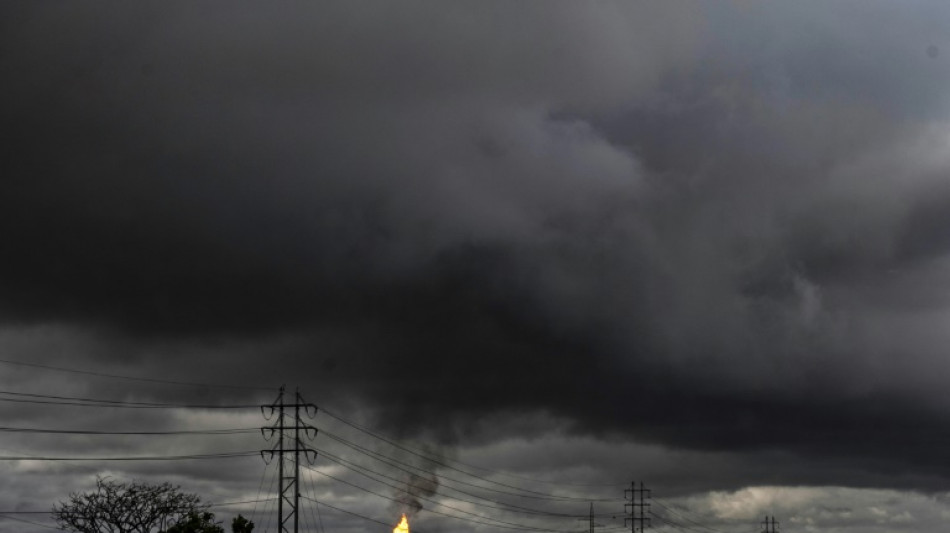
Venezuela unlikely to make up for banned Russian crude: experts
Its once-flourishing oil industry decimated by corruption, poor management and US sanctions, Venezuela's vast crude reserves are unlikely to make up for banned Russian oil even if Washington eases measures against Caracas, experts say.
Eyebrows were lifted last weekend when a US delegation held a hushed meeting with Venezuela's controversial leader Nicolas Maduro, whose very legitimacy as president it disputes.
It came as Washington scrambled to replace Russian oil and gas imports which it banned over Moscow's brutal invasion of Ukraine in a bid to choke off revenues for President Vladimir Putin.
The United States now has to make up an import shortfall of 700,000 barrels per day while also seeking to stabilize prices by boosting supply on the international market.
Venezuela -- a close Russia ally -- sits on the world's largest proven reserves of crude, and the United States was its biggest client until just a few years ago.
But oil economist Rafael Quiroz of the Venezuela Central University said Washington was in for disappointment if it was looking to the South American nation for relief.
"It is not an option," he told AFP.
"For Venezuela to be an option it would need to have the ability to increase production."
Venezuela was once one of the world's 10 largest oil producers.
By 2008, the then-Latin American economic heavyweight was producing 3.2 million barrels of oil a day.
Just 13 years later, it can muster only about 500,000 to a million barrels per day amid a grinding economic crisis marked by years of recession and hyperinflation.
The country now struggles even to satisfy domestic demand and commitments to China, India and other countries.
Matters were not helped by US sanctions imposed in 2014 and intensified by Donald Trump in 2019 as part of a bid to force Maduro from office.
Washington and dozens of other countries view Maduro's 2018 re-election as fraudulent, and recognize opposition leader Juan Guaido as Venezuela's legitimate leader.
- Pie in the sky -
Maduro appeared bullish after the unexpected US talks, declaring on Wednesday: "This year we will reach two million barrels a day come rain, thunder or lightning."
The country produced 755,000 barrels a day in January, according to the Organization of Petroleum Exporting Countries (OPEC).
Venezuelan Oil economist Carlos Mendoza Potella said it would take "four or five years" to reach the level eyed by Maduro given the degree of investment required to bring the industry back up to speed.
Experts say Venezuela needs millions of dollars in foreign investment, a change to hydrocarbon laws, legal protections for private companies targeted by expropriations in the past, and sanctions easing.
Luis Vicente Leon, a political economist with the Datanalisis polling firm, said a full lifting of sanctions was unlikely given Venezuela's pariah status.
"We will see focused negotiations to licence oil production within the sanctions framework," he said.
- 'Most aggressive competitor' -
Leon believes the United States would want Venezuela to supply oil to Gulf of Mexico countries that turned to Russian oil after sanctions were imposed on Caracas.
This would stabilize fast-rising prices due to supply fears.
But to do so, Venezuela would have to end sales to another close ally, China, and other countries it supplies at reduced black market rates, with Moscow's backing.
In the medium term, the economist added, Venezuela could compensate for part of the Russian oil shortfall.
And the reopening of business with the United States would be tempting for Maduro, who freed two Americans from jail after the petroleum talks, likely in the hopes of political and economic rapprochement.
"Putin may be very friendly with Maduro, but now he is going to be his most aggressive competitor" for oil sales on the black market, said Leon.
Until now, Washington has refused to negotiate with Maduro, insisting the controversial leader must instead talk to Guaido.
And Washington's recent approach to Caracas was widely scorned at home, even from Democrats such as senator Bob Menendez of the Senate Foreign Relations Committee.
"The democratic aspirations of the Venezuelan people, much like the resolve and courage of the people of Ukraine, are worth more than a few thousand barrels of oil," he said.
Maduro has expressed "strong support" for Putin and has slammed Western sanctions against Moscow.
On Thursday, Venezuelan Vice president Delcy Rodriguez met Russian Foreign Minister, Sergei Lavrov -- who Rodriguez described as a "good friend" -- in Turkey.
T.Furrer--NZN