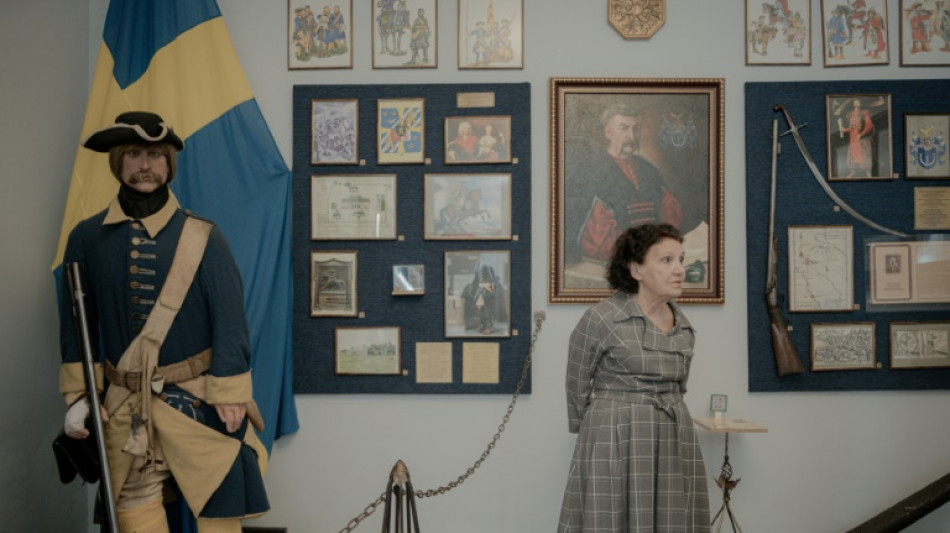
Ukrainian museum moves to 'decolonise' history / Photo: Ivan SAMOILOV - AFP
The quiet and echoing rooms of the museum in Poltava, dedicated to an 18th-century battle in central Ukraine, belie a struggle in the war-torn country on how far to go in recasting Russia's role in history.
The Russian invasion has seen Ukraine step up sweeping "de-colonisation" measures, including the removal of symbols of tsarist and Soviet domination.
Kyiv's efforts to remove Soviet monuments and symbols began in 2014, when Russian forces annexed the Crimean peninsula and backed armed separatists in the east of the country.
But new laws passed in the second year of Russia's full-scale invasion seek to go even further, forcing the Poltava museum to respond to claims it has not gone far enough to revise Kremlin-supported narratives.
The sleepy city, around 350 kilometres (220 miles) east of Kyiv, was the scene of a decisive June 1709 battle when the forces of Russian Tsar Peter the Great defeated the troops of Swedish King Charles XII in what is widely seen as the moment when Russia became a major European power.
"Over more than 300 years, a complex myth has been created around the Battle of Poltava," said Lyudmyla Shendryk, a guide who has worked at the museum for over 40 years.
In the years following the battle, the Russian empire captured more Swedish territory and Russia became the dominant power in eastern Europe.
- Hero or traitor -
Peter the Great spent vast sums to present the victory in Poltava as the result of a "genius" ruler selected by God, Shendryk said.
The Swedish king was allied with Ukrainian Cossack leader Ivan Mazepa, who had previously backed the tsar before going over to Sweden, and was presented by Russia as the ultimate traitor.
In 1828, in a famous poem, "Poltava," the Russian poet Alexander Pushkin depicted Mazepa as a pitiful and evil old man, reinforcing this negative legend in Russian culture.
Other Ukrainians were also fighting on the side of Peter the Great, Shendryk said, but under Soviet leader Josef Stalin the USSR embraced an "imperial narrative" in which the "brother peoples" of Russians, Ukrainians and Belarusians fought a "partisan war" against "Swedish interventionists" and Mazepa's "exploiters".
The museum presented this interpretation of history until Ukraine's independence from the USSR in 1991, after which it was transformed, she said.
Today, Mazepa, who was educated in Europe, spoke numerous languages and was a fervent patron of the arts, is presented in the museum as a national hero who wanted to preserve the independence of Ukrainian Cossacks against Russian expansionism.
In 2020, the museum created a display disproving "10 Russian myths" about Poltava, including the "treachery" of Mazepa.
"Mazepa wasn't a traitor to his own people," said Volodymyr, 25, a history teacher in Poltava.
But a decolonisation campaign can succeed only when it steps out of the archives and libraries and reaches young people via social media, he added.
- 'Act of genocide' -
Nor has the campaign gone far enough for some Ukrainians.
In 2024, one of the country's most widely read newspapers, Ukrainska Pravda, published an article accusing the museum in Poltava of continuing to glorify "Russian arms".
It accused the museum of not giving enough details of a massacre carried out by Russia in 1708 in the capital of Mazepa's realm, Baturyn, that led to thousands of deaths, calling it "an act of genocide".
A statue of Peter the Great in front of the museum was wrapped up in black plastic in June 2022 and then taken down in February.
The director of the museum, Nataliya Bilan, does not hide her dismay at such attacks, while acknowledging that decolonisation requires for her staff "a profound reinterpretation" of the facts.
Thousands of Ukrainian soldiers pass through Poltava trains to the front, and many stop by to visit the museum, Bilan said. In the vestibule, under a flag signed by fighters, a message thanks the museum for maintaining the "Сossack spirit".
Museum guide Shendryk said she sees her mission as analysing the causes of the "catastrophe" in Poltava, so it does not happen again.
"We need to be brave, not remain silent or close our eyes to the complex or disagreeable pages in our history," she said.
"And one of these disagreeable pages is, above all, our lack of unity."
N.Fischer--NZN