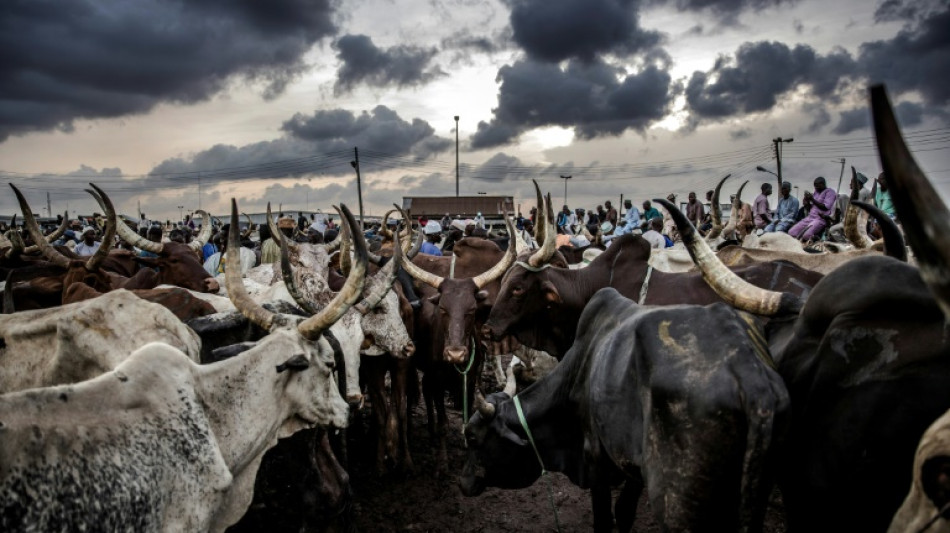
Livestock theft is central to jihadist economy in west Africa / Photo: Luis TATO - AFP/File
Musa was asleep in the village of Dusuman in northeast Nigeria when he was awoken by a sharp burst of gunfire and Boko Haram stole his main source of livelihood -- his livestock.
"They came at about one in the morning and started firing in the air," said the Fulani herdsman, whose name AFP has changed for security reasons.
"My family and I fled into the bush. The jihadists took 36 of my cows and 40 sheep," he added.
Livestock theft provides Boko Haram with a major source of revenue, as members resell some of the animals at local markets to support their operations in the Lake Chad region.
The method of criminal financing is also used by other jihadist groups in the Sahel region, where livestock is a coveted resource.
"It's an economy that feeds the conflict," Flore Berger, a researcher with the Global Initiative against Transnational Organized Crime (GI-TOC), told AFP.
In Burkina Faso, sources in the Ansarul Islam group "have declared earning, depending on the period, between 25 and 30 million CFA francs ($41,100 to $49,400) a month through livestock theft in the regions where they operate", Berger said in a study.
Nigeria and Mali, which are the leading and second-leading livestock exporters in the region ravaged by jihadist violence, are particularly affected, she added.
Mali recorded nearly 130,000 thefts in 2021, more than the total combined from the three preceding years, according to the authorities in the Mopti region of central Mali quoted in the study.
- 'Laundered' -
"The practice has been happening for centuries across the Sahel," added the study, noting that the thefts were once "almost cultural" and widely accepted.
But in the last 15 years, jihadists have got in on the act and thefts have become violent operations in which livestock farmers have sometimes been kidnapped or killed.
In Niger last year, "more than 600" animals were stolen by jihadists in a hamlet in the Ouallam region, near the Malian border, and an owner was killed, a local source told AFP.
In the Lake Chad basin of northeast Nigeria, Boko Haram is the main perpetrator of thefts.
Its splinter group, the Islamic State West Africa Province (ISWAP), instead prefers to impose taxes on local livestock farmers, said Nigerian GI-TOC researcher Kingsley Madueke.
In the central Sahel -- Mali, Niger and Burkina Faso -- the Al-Qaeda-linked Group for the Support of Islam and Muslims (JNIM) dominates the illicit trade due to the vast territory under its control and its local networks.
Stolen livestock is then sold through well-established channels involving agents, intermediaries, transporters, traders, butchers or "corrupt" local officials, Berger said.
"Through these 'commercial partners', the jihadists have access to intelligence and sustain themselves in the forests," said William Assanvo, a researcher from the South Africa-based Institute for Security Studies.
Some of the livestock is sold at local markets, with the rest exported.
Stolen animals from Mali, for example, are "laundered" by being mixed with herds of legal livestock then sent to countries such as Ivory Coast, Burkina Faso or Niger, Berger said.
- 'Slow-going' -
As such, Madueke said there was a need to target auxiliary networks.
The cross-border nature of the illicit trade also requires regional cooperation that is not always easy given the geopolitical situation in west Africa.
Mali, Niger and Burkina Faso have all withdrawn from the Economic Community of West African States (ECOWAS) bloc to form the Alliance of Sahel States (AES).
"We sent at least three letters to the Malian authorities in 2024, as we recorded an increase in the influx of livestock from Mali," an Ivorian security source said.
"We need collaboration to block the network. For the moment, it's slow-going."
According to the researchers, armies in the Sahel, bandits, civilian militia and rebel groups in Mali also steal livestock.
burs-bdi/pid/phz/kjm
A.Wyss--NZN