Vital European defence startups still facing hurdles / Photo: ARMIN WEIGEL - AFP/File
Opportunities and investment have surged for European defence startups since Russia's invasion of Ukraine, industry players say, with shifts by governments and investors shaking up a sector long a byword for ponderous development.
Research published in February by the NATO Innovation Fund (NIF) and market analytics firm Dealroom found that venture capital going into European "defence, security and resilience" startups leapt 30 percent in the two years to 2024, reaching $5.2 billion.
That reflected a shift already under way before Russia's full-scale assault in early 2022 as "underlying technologies" began to be adapted for battlefield use, NIF partner Patrick Schneider-Sikorsky told AFP.
He named "additive manufacturing, AI, RF (radio frequency) technologies, battery technologies" as ingredients already attracting investment before "sheer necessity" supercharged their use and evolution on Ukrainian battlefields.
But the urgent need to develop state-of-the-art battlefield tech -- a constantly moving target in the crucible of Ukraine -- continues to run into hurdles.
Among the most stubborn is getting investors -- from sovereign wealth funds and public banks to pension funds or family offices of wealthy individuals -- to pump cash into defence, which is often lumped in with "sin stocks".
- 'Like gambling and drugs' -
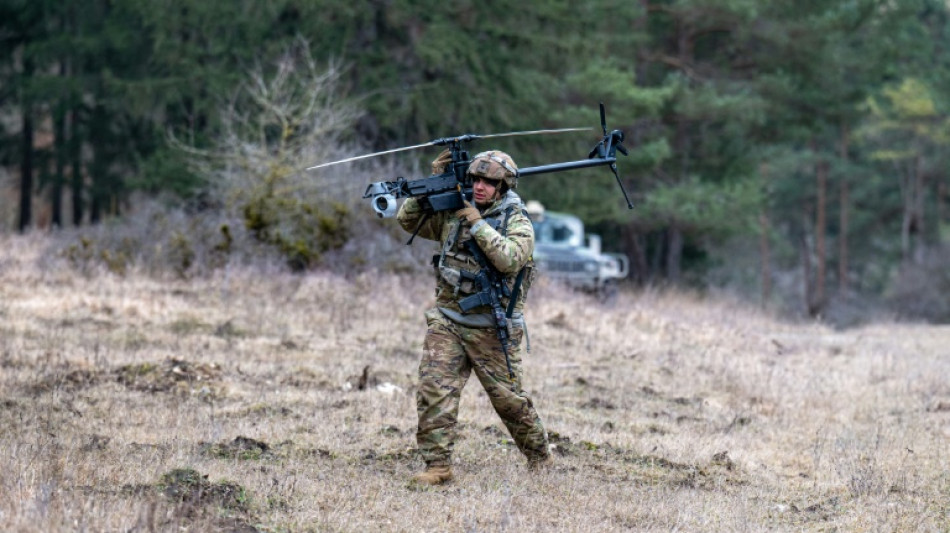
One company that has run into this problem is German startup Donaustahl, which has rapidly evolved from making accessories for sports pistol shooting to developing armed drones.
Although it attracted widespread interest at last year's Berlin air and space trade fair, "Donaustahl, as a weapons company, has just been shut out from financing and the capital markets so far," founder Stefan Thumann told AFP.
It was "just like gambling and drugs", he complained.
While Thumann said he is now in talks with prospective investors, he also took the rare step of going directly to fans of his company, and via a social media presence, to raise cash by issuing digital bonds.
Getting around restrictions on defence or so-called "dual-use" technologies -- those with both civilian and military applications -- would require revising existing agreements on how funds can deploy investors' cash, or setting up altogether new funds, NIF's Schneider-Sikorsky said.
There have been some signs of movement from public institutions.
The European Investment Bank agreed last year to remove a requirement that "dual-use" companies it finances make at least 50 percent of revenue from civilian customers.
Looking from east to west among European governments, "you do see this very distinct gradient of appetites from more offensive things to more defensive things, from a tech perspective," said Jack Wang, UK managing director for venture capital company Project A.
For instance, Russia-neighbouring Estonia last year announced the creation of a 50-million-euro ($54.1 million) fund to invest in both defence and dual-use tech.
Pia Santavirta, chief executive of Finland's public investment fund Tesi, last month named "defence tech" among "future growth sectors" it was eyeing.
And private investors are scenting opportunity from the hundreds of billions in potential spending trailed especially by Berlin and Brussels in recent weeks, with Germany amending its constitution to enable more borrowing to fund defence.
- 'Out in the cold' -
On the other end of the chain from investment is the end customer, where defence startups are confronted with military procurement systems used to taking years over deals.
"Most VC (venture capital) funds have got used to investing in software to sell to small businesses or consumers," Project A's Wang said, expecting their backing to "convert to revenue... within one-and-a-half, two years".
"The military sales cycle doesn't operate like that".
"Both cultures are going to have to change," said NIF's Schneider-Sikorsky.
Defence ministries may in future "have a defence tech company that is almost on contract with the military to produce and continuously upgrade capabilities, as opposed to just selling a bit of hardware that's going to be stockpiled," he added.
"Some countries just need to get away from their specific gold-trimmed solutions," Donaustahl chief Thumann urged.
"We don't have the time... I hope the German army will modernise its procurement system and do away with some super-complicated hurdles in tendering that leave small firms out in the cold."
O.Meier--NZN