US aerospace industry anxious as tariffs loom / Photo: Daniel SLIM - AFP
US airlines and aerospace manufacturers insist they have no use for tariff protections, warning that the proposed Trump administration levies could eat into the healthy trade surplus the sector has enjoyed for more than 70 years.
At the request of President Donald Trump, Commerce Secretary Howard Lutnick's department launched an investigation on May 1 to determine whether to impose tariffs of between 10 and 20 percent on civil aircraft and parts, including engines.
The US industry those tariffs were crafted to protect swiftly let the administration know it was not interested.
"Imposing broad tariff or non-tariff trade barriers on the imports of civil aviation technology would risk reversing decades of industrial progress and harm the domestic supply chain," the Aerospace Industries Association (AIA) said in a letter addressed to Lutnick and obtained by AFP.
The interested parties were given until June 3 to communicate their positions.
The very next day, Lutnick announced that Washington aimed to "set the standard for aircraft part tariffs" by the end of this month.
"The key is to protect that industry," he said, adding: "We will use these tariffs for the betterment of American industry."
But AIA and the Airlines for America (A4A) trade association voiced fear that far from helping, the tariffs would end up harming US manufacturers.
- No fix needed -
"Unlike other industries, the civil aviation manufacturing industry prioritizes domestic production of high-value components and final assembly," AIA pointed out.
According to the organization, US aerospace and defense exports reached $135.9 billion in 2023, including $113.9 billion for civil aviation alone.
This allowed the sector to generate a trade surplus of $74.5 billion and to invest $34.5 billion in research and development, it said.
The sector employs more than 2.2 million people in the United States across more than 100,000 companies, which in 2023 produced goods worth nearly $545 billion.
In its response to Lutnick, the A4A highlighted how beneficial the international Agreement on Trade in Commercial Aviation (ATCA) had been by helping to eliminate tariffs and trade barriers over nearly half a century.
"The US civil aviation industry is the success story that President Trump is looking for as it leads civil aerospace globally," it insisted.
A full 84 percent of production was already American, it said, stressing that Washington "does not need to fix the 16 percent" remaining.
"The current trade framework has enhanced our economic and national security and is a critical component to maintaining our national security moving forward," it said.
For manufacturers, the potential tariffs would act like sand jamming a well-oiled machine that has been running smoothly for decades, experts warned.
They would also throw off balance an ultra-sensitive supply chain still recovering from the Covid-19 pandemic.
- 'Competitive disadvantage' -
"To avoid the situation getting worse, we advocate to keep aerospace outside of trade wars," Willie Walsh, head of the International Air Transport Association (IATA), told the organization's general assembly last week.
AIA meanwhile stressed that "aircraft and parts are already in high demand and have a limited supply."
"Integrating new suppliers and expanding capacity is complex, timely, and costly," it warned, pointing out that finding suppliers capable of meeting rigorous safety certifications could "take up to 10 years."
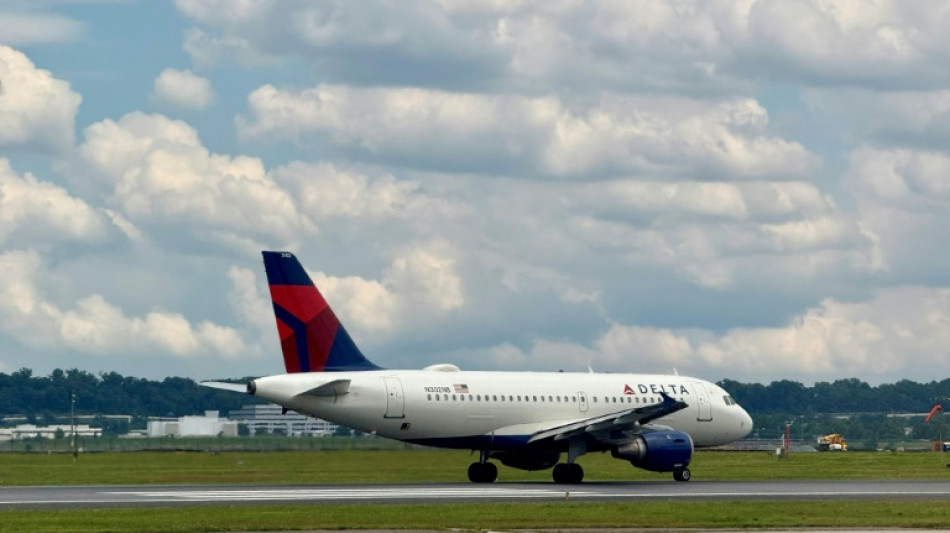
Delta Air Lines also argued for sticking with the status quo, cautioning that the proposed tariffs "would hinder Delta's ability to maintain its current trajectory."
"If component parts incur tariffs upon entering the United States, Delta will be at a competitive disadvantage to foreign competitors," it said.
"The action would also impose an unexpected tax on Delta's purchases of aircraft contracted years in advance."
Delta chief Ed Bastian insisted in late April that the airline "will not be paying tariffs on any aircraft deliveries we take," adding that it was "working very closely with (European group) Airbus" to minimize the impact.
Delta pointed out in its letter to Lutnick that it currently had 100 aircraft on order from Boeing, and that it was demanding that its Airbus A220s be produced primarily in Mobile, Alabama.
But if the tariffs are imposed, it warned, "Delta would likely be forced to cancel existing contracts and reconsider contracts under negotiation."
A.Senn--NZN