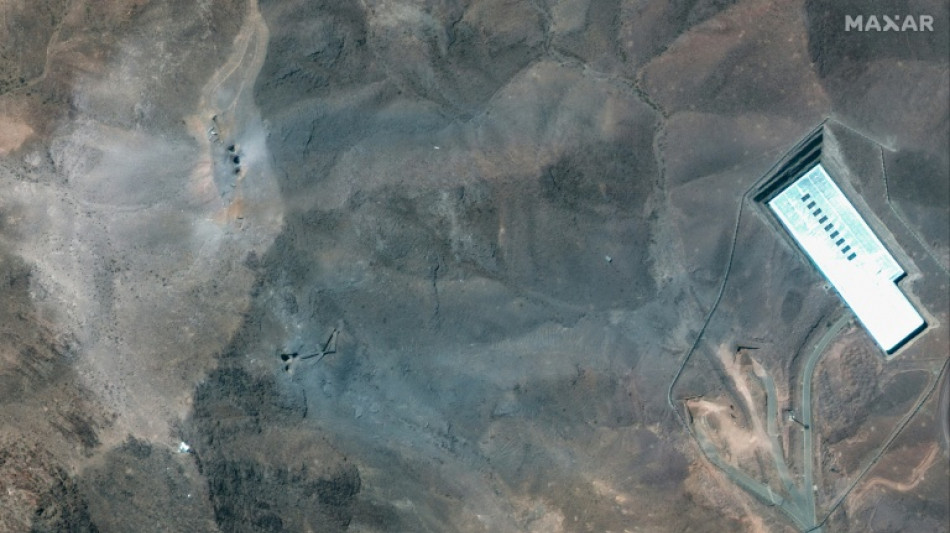
Where is Iran's uranium? Questions abound after US strikes / Photo: - - Satellite image ©2025 Maxar Technologies/AFP
After President Donald Trump bragged US strikes had "obliterated" Iran's nuclear capabilities, officials cautioned it was still too soon to assess the impact on the country's nuclear programme.
Many questions remain after Sunday's strikes, especially about the whereabouts of Iran's sensitive stockpile of uranium enriched to 60 percent -- a short step from the 90 percent required for a nuclear weapon.
- Where is Iran's enriched uranium? -
The US attacks, carried out by B-2 stealth bombers, targeted three Iranian nuclear sites: Isfahan and Iran's main enrichment plants in Fordo and Natanz.
While significant damage has been reported, the International Atomic Energy Agency (IAEA) has voiced concern about Iran's stockpile of near-weapons-grade uranium.
Tehran has an estimated 408.6 kilogrammes of uranium enriched to 60 percent, according to the UN nuclear watchdog, whose inspectors last saw that stockpile on June 10.
That material, if further refined, would theoretically be sufficient to produce more than nine nuclear bombs.
IAEA head Rafael Grossi on Monday demanded access to Iran's nuclear sites, saying the agency needs to "account for" the uranium stockpile.
Concerns about the fate of the sensitive stockpile have loomed large. On June 13, the day Israel began its Iran offensive, Iranian Foreign Minister Abbas Araghchi sent a letter to the IAEA, announcing the implementation of "special measures to protect nuclear equipment and material".
Days before the US attacked, satellite imagery showed vehicles near Fordo's entrance.
Prime Minister Benjamin Netanyahu said Israel had "interesting intelligence" on the matter, declining to elaborate.
Israel announced Monday it had carried out strikes to block access routes to Fordo.
"It will be difficult if not impossible to track down all of Iran's 60 percent enriched uranium, stored in small canisters that are easily transportable by car," Kelsey Davenport, an expert with the Arms Control Association, told AFP.
"They (Iranians) no longer have the capacity to turn that stockpile of highly enriched uranium to weapons-grade uranium, and that was really the goal there," US Vice President JD Vance told ABC News.
He added the Trump administration would deal with the uranium "in the coming weeks".
- Can Iran still make a nuclear bomb? -
Analysts have been treading carefully when addressing this issue.
Before the attacks, Iran had about 22,000 centrifuges -- the machines used to enrich uranium. Many of them were damaged when Natanz was hit, the IAEA head said.
Grossi also said "very significant damage" is expected to have occurred at Fordo, "given the explosive payload utilised and the extreme vibration-sensitive nature of centrifuges".
Experts however say that it is unclear how many centrifuges Iran has, with some of them believed to be stored at unknown locations.
With "60 percent enriched uranium and a few hundred advanced centrifuges, Iran still has the capability to weaponise, and now there is more political impetus to dash for a bomb", said Davenport.
- What are the proliferation risks? -
Before the conflict, the IAEA said it had "no indication" of the existence of a "systematic programme" in Iran to produce a nuclear weapon. But without access to nuclear sites, the agency no longer has oversight.
Grossi warned Monday that the "global non-proliferation regime that has underpinned international security... could crumble and fall", urging parties to return to diplomacy.
Iran ratified the nuclear non-proliferation treaty (NPT) in 1970, committing it to declare its nuclear material to the IAEA. But it has recently begun preparing the grounds for a possible withdrawal from the treaty, accusing the agency of acting as a "partner" in Israel's "war of aggression".
Reza Najafi, Iran's ambassador to the IAEA, said Monday the "unlawful act of aggression" by the United States had "delivered a fundamental and irreparable blow" to the non-proliferation regime.
"I do think there is a major risk that Iran withdraws from the NPT and expels inspectors, or simply does not provide them with access to key sites," said Eric Brewer of the US research institute Nuclear Threat Initiative (NTI).
He added that Iran could also "over time, build (a) covert" programme like North Korea, which withdrew from the NPT in 2003 and went on to become a nuclear-armed power.
A.Ferraro--NZN