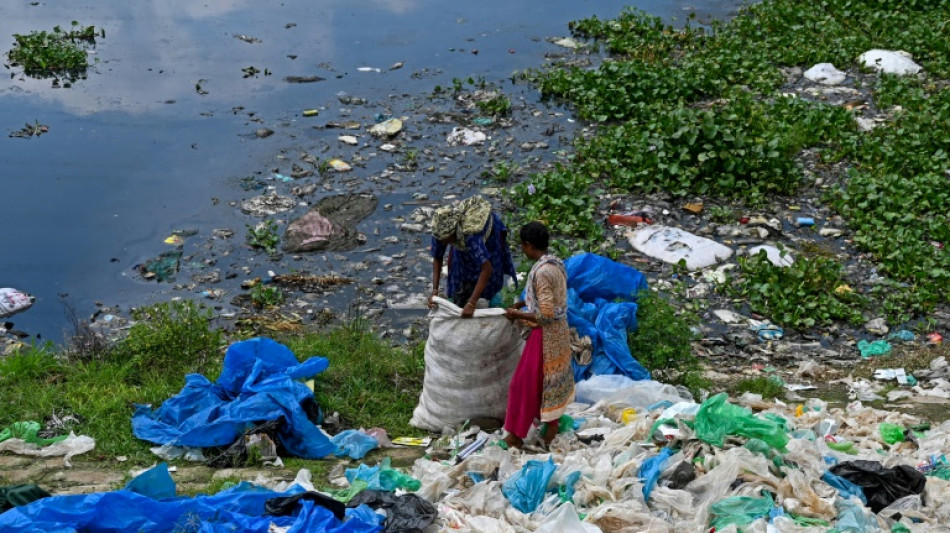
Plastic pollution plague blights Asia / Photo: Munir UZ ZAMAN - AFP/File
Kulsum Beghum sorts waste at a landfill in Dhaka. Her blood contains 650 microplastic particles per millilitre, according to an analysis funded by a waste pickers' union.
"Plastic is not good for me," she told AFP through a translator during an interview in Geneva, where she came to bear witness on the sidelines of 184-nation talks to forge the world's first global plastic pollution treaty.
"It started 30 years ago" in the Bangladeshi capital, the 55-year-old said, supported by her union.
At first, "plastic was for cooking oil and soft drinks", she recalled. Then came shopping bags, which replaced traditional jute bags. "We were attracted to plastic, it was so beautiful!"
Today, in one of the most economically fragile countries on the planet, plastic is everywhere: lining the streets, strewn across beaches, clogging the drains.
Alamgir Hossain, a member of an association affiliated with the International Alliance of Waste Pickers, showed photos on her phone.
Beghum wants non-recyclable plastics banned, pointing out that she cannot resell them and they have no market value.
"No one collects them," she said.
- 'Disaster for the environment' -
Indumathi from Bangalore in southern India, who did not give her full name, concurs: 60 percent of the plastic waste that arrives at the sorting centre she set up is non-recyclable, she told AFP.
This includes crisp packets made of a mixture of aluminium and plastic, and other products using "multi-layer" plastic. "No one picks them up from the streets and there are a lot of them," she said.
Scientists attending the treaty negotiations at the United Nations in Geneva back her up.
"Multi-layer plastic bags are a disaster for the environment," said Stephanie Reynaud, a polymer chemistry researcher at France's National Centre for Scientific Research.
"They cannot be recycled."
Indamathi was also critical of what she described as public policy failures.
After single-use bags were banned in her country in 2014, for example, she saw the arrival of black or transparent polypropylene lunchboxes, which are also single-use.
"We're seeing more and more of them on the streets and in landfills. They've replaced shopping bags," she said.
According to a recent OECD report on plastic in Southeast Asia, "more ambitious public policies could reduce waste by more than 95 percent by 2050" in the region, where plastic consumption increased ninefold since 1990 to 152 million tonnes in 2022.
- Plastics 'colonialism' -
Consumer demand is not to blame, argues Seema Prabhu of the Swiss-based NGO Trash Heroes, which works mainly in Southeast Asian countries.
The market has been flooded with single-use plastic replacing traditional items in Asia, such as banana leaf packaging in Thailand and Indonesia, and metal lunch boxes in India.
"It's a new colonialism that is eroding traditional cultures," she told AFP. According to her, more jobs could be created "in a reuse economy than in a single-use economy".
Single-dose "sachets" of shampoo, laundry detergent or sauces are a scourge, said Yuyun Ismawati Drwiega, an Indonesian who co-chairs the International Pollutants Elimination Network NGO.
"They are the smallest plastic items with which the industry has poisoned us -- easy to carry, easy to obtain; every kiosk sells them," she told AFP.
In Indonesia, collection and sorting centres specialising in sachets have failed to stem the tide, mostly shutting down not long after opening.
In Bali, where Ismawati Drwiega lives, she organises guided tours that she has nicknamed "Beauty and the Beast".
The beauty is the beaches and luxury hotels; the beast is the back streets, the tofu factories that use plastic briquettes as fuel, and the rubbish dumps.
M.J.Baumann--NZN