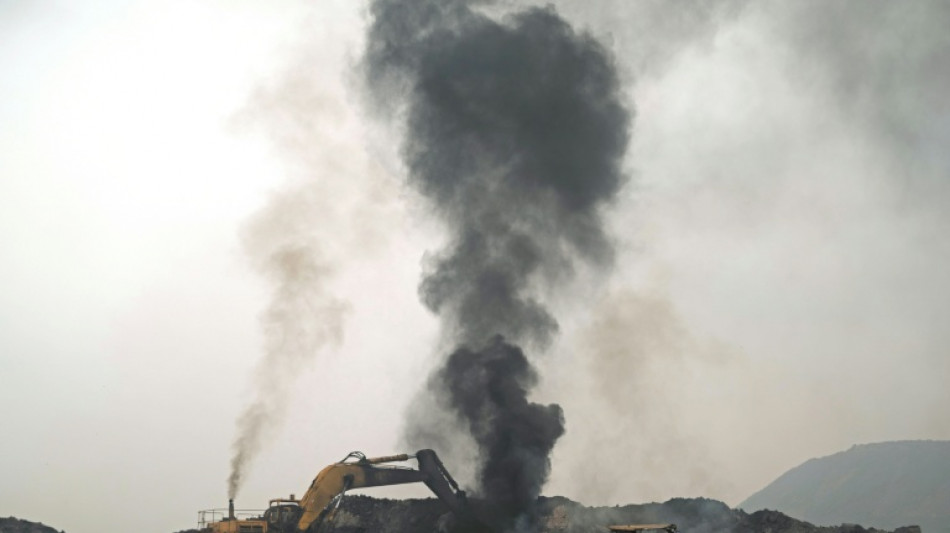
India celebrates clean energy milestone but coal still king / Photo: Vishal kumar singh - AFP
Non-fossil fuels now account for half of India's installed energy capacity -- years ahead of schedule -- but the third-largest greenhouse gas polluter remains deeply reliant on coal for electricity generation.
"A landmark in India's energy transition journey," Minister of Renewable Energy Pralhad Joshi proclaimed after the world's most populous nation released figures in July.
"Five years early," he added, referring to India's 2030 target under the Paris Agreement, and marking a step to the country's stated goal of reaching net-zero emissions by 2070.
But while the 50 percent milestone is significant, climate expert Avantika Goswami says the figures -- which refer only to potential energy production -- tell just part of the story.
"Overall, actual generation from renewable sources is still quite low," Goswami told AFP from the New Delhi-based Centre for Science and Environment (CSE).
The reason is stark: nearly three-quarters of electricity continues to come from heavily polluting coal-burning power plants.
- Coal paradox -
The challenge becomes even more apparent when examining India's continued dependence on coal.
Far from decreasing its usage, the globe's second-largest consumer of coal pushed up production of the dirty fossil fuel by five percent last year, mining one billion tonnes, according to the coal ministry.
"Coal remains crucial," the ministry said.
The stance highlights the practical challenges of India's energy transition.
Coal is needed to fulfil power demands while storage capacity lags behind the surge in renewable sources of power.
"The coal sector remains a crucial contributor to India's energy mix, powering over 74 percent of the country's electricity and sustaining key industries like steel and cement," the coal ministry said, celebrating what it dubbed "India's coal boom".
This reliance places India in a challenging position globally. The country ranks behind only China and the United States for carbon emissions overall.
But analysts point out that in a country of 1.4 billion people, per capita emissions are only one-third of the global average, according to official figures.
"Looking at India's per capita emissions, the effort it is making, India is doing pretty well," said activist Harjeet Singh, head of the Satat Sampada Climate Foundation.
India has set itself the daunting challenge of reducing emissions by 45 percent by 2030.
At the same time, electricity needs are expected to more than double by 2047, according to the country's Center for Science and Environment.
Supplying some of that demand "is likely to be met by the addition of renewables", Goswami said.
- 'Waste that energy' -
Half of India's 484.8 GW installed capacity is from non-fossil fuel sources.
The majority comes from solar, totalling 119 GW -- the third-largest level globally.
India is building one of the world's largest solar and wind energy farms, spread over a desert the size of Singapore.
It is followed by hydro and wind, and also nuclear power -- which makes up less than two percent of the total mix.
But solar and wind create steady power only when the conditions are right, and India's storage capacity is a meagre 505 MWh -- far lower than it can generate.
The storage bottleneck was not lost on the renewable energy minister.
Speaking at the inauguration of a battery storage systems plant in June, Joshi said India's renewable energy potential was "growing fast" and "adding 25–30 GW every year".
He added: "But without storage, we will either waste that energy or fall back on coal when renewables dip."
Building storage based on batteries requires rare earth metals, with rival and neighbour China controlling 70 percent of the world's supplies.
"We still remain dependent on China," said Harjeet Singh, the climate activist.
Chinese Foreign Minister Wang Yi was in New Delhi for talks on Tuesday, with the supply of rare earth metals on the agenda.
One solution India is considering is pump-hydro energy storage projects. When wind and solar plants produce excess energy, water is pumped into high reservoirs. That stored energy can then be released to generate power when demand surges.
But Goswami believes the transition to cleaner power requires a multi-pronged approach.
The transition to cleaner power must come from "emission intensity reduction" of often inefficient coal plants, combined with better integrated renewable energy in the grid that "will actually make the shift happen".
W.O.Ludwig--NZN