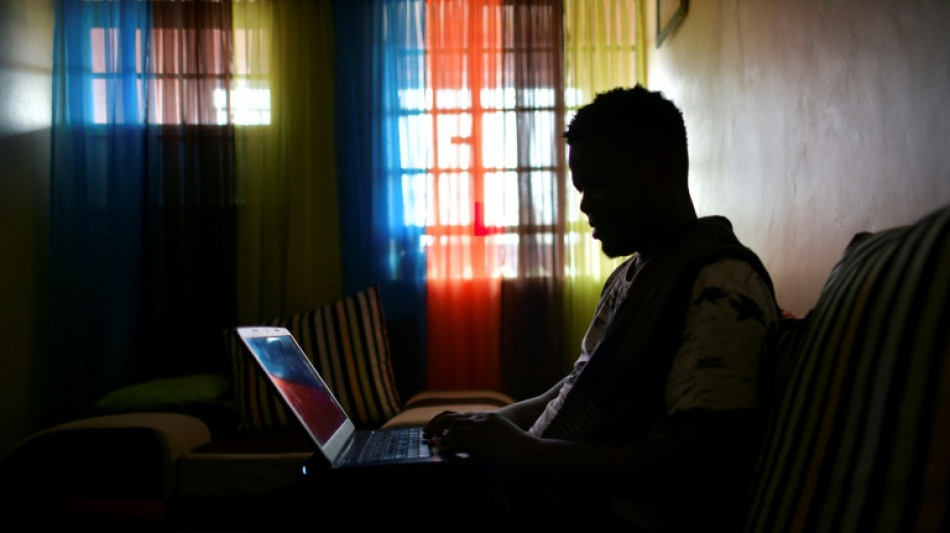
Weaponising the feed: Inside Kenya's online war against activists / Photo: TONY KARUMBA - AFP
When software developer Rose Njeri created a pro-democracy tool to help Kenyans object to a contested finance bill, she was thrown in jail and targeted by an online smear campaign.
Njeri is the latest victim of a sophisticated online apparatus that targets and harasses government critics in Kenya, where rights groups warn of an escalating crackdown on public dissent.
"I got to sleep in a cell for four days," the 35-year-old told AFP. "I was just making tools that aligned with my beliefs."
The east African country has seen a wave of deadly protests against President William Ruto and police brutality that have left dozens dead and thousands of businesses destroyed.
Although Njeri's arrest in May sparked outrage, prompting a wave of solidarity under the hashtag #FreeRoseNjeri on X, she also became the subject of foreign-agent conspiracies.
Around the same time, two human rights campaigners, including Kenya's Boniface Mwangi -- a long-standing critic of Ruto -- were detained in Tanzania, where they were attending the treason trial of opposition leader Tundu Lissu.
Held incommunicado for several days before being dumped at the border, both activists alleged torture and sexual assault by security forces.
Tanzanian President Samia Suluhu Hassan, who prior to Mwangi's release spoke of "ill-mannered activists" interfering in the country's affairs, seemingly received praise online, with the hashtag #AsanteSamia (#ThankyouSamia) amassing roughly 1.5 million views.
Some of these posts falsely claimed that Njeri had trained in "ethical hacking" in Estonia and linked her to a Russian cyber-operations group. Others alleged Mwangi had been re-abducted and falsely reported that videos of his assault had leaked.
Another hashtag, #DogsOfWar, accused the deported activists of being part of a "digitally coordinated, foreign-funded disruption" financed by American philanthropist George Soros.
These were two of seven hashtags identified by AFP's fact-checking team ahead of deadly protests in June 2025, when coordinated online disinformation campaigns targeting activists surged on X.
Such campaigns manipulate hashtags to manufacture the illusion of widespread public sentiment.
"There is evidence of coordinated amplification due to the multiple posts being published at the same time or within seconds of each other," Moffin Njoroge, data analyst and disinformation expert at Code for Africa, told AFP.
- 'Automated behaviour' -
Dissidents initially held the upper hand on social media during Kenya's landmark 2024 anti-tax protests, which culminated in parliament being breached on June 25 and resulted in the deaths of dozens during clashes with police.
But they now face growing opposition online.
In April, following the BBC documentary Blood Parliament, which exposed police brutality during last year's protests, the hashtags #BBCForChaos and #ToxicActivists garnered 5.3 million and 365,000 estimated views.
Posts framed activists, including Mwangi, as "paid puppets" pushing "donor-funded anarchy".
Right before the anniversary of the June 25, 2024, protests, the hashtags #PaidActivism, #CommercialActivismKE and #ShunFakeActivismKE recycled claims that activists were exploiting the youth-led movement "for cameras and grants".
Njoroge noted "automated behaviour", with some accounts posting "over 100 posts under a hashtag in a day".
For instance, the accounts @essy_2128 and @tonymkenya7 posted 226 and 140 posts respectively under #AsanteSamia, while the account @darsil254 published 104 times with #ShunFakeActivismKE.
According to Njoroge, some of the "patient zero" accounts for these narratives have a history of pushing "pro-government hashtags".
One such account, @MurimiJeff_, which started #ToxicActivists, previously published hashtags such #BoldRuto backing the Finance Bill 2025.
Past Kenyan disinformation campaigns have relied on fake graphics with false quotes, altered newspaper covers and fabricated articles attributed to local media outlets.
Now, AI-generated propaganda videos and doctored news bulletins are part of the arsenal.
For instance, #DogsOfwar contained a fake video of CNN's Fareed Zakaria commenting on the "foreign-funded" activists deported from Tanzania, while #AsanteSamia pushed a clip mimicking a major Kenyan media outlet's anchor reporting on Mwangi's alleged re-abduction.
- 'Authoritarian playbook' -
Drawing parallels from his past research on Kenyan state-sponsored disinformation, Alphonce Shiundu, Africa Check's Kenya editor, believes these campaigns are state-affiliated.
"You just have to look at the political rhetoric, the statements by senior government officials and the online chatter. There's always a confluence," Shiundu told AFP.
True to this, the digital offensive coincided with government warnings against "coup attempts", the filing of terror charges against protesters and a proposed bill requiring mandatory social media user ID verification.
Authorities also allocated a $1.15 million spyware budget to the Directorate of Criminal Investigations to boost social media surveillance.
Irungu Houghton, Amnesty International Kenya executive director, described these tactics as the "oldest game in the authoritarian playbook".
"Disinformation is designed to discredit human rights defenders and deflect the concerns they raise. Characterising activists as 'paid' erodes their authenticity and calling them 'anarchists' frames them as destructive," Houghton told AFP.
For Shiundu the "paid" narrative is a "low-hanging trope".
"The tactic here is to create a bogeyman as being behind the organic campaigns for accountable and transparent governance. It becomes easier to attack activists as threats to national interest and blunt the high-handed government response to legitimate protests," he said.
- 'I do not feel free' -
Shiundu noted that tracking disinformation networks has become "harder and more expensive" due to platform changes and the defunding of fact-checking and media literacy.
With elections approaching, Njoroge anticipates more "pro-government campaigns targeting opposition politicians and activists".
Mwangi has previously defended activism as a "holy calling done out of love", dismissing the "paid activist" narrative as "government propaganda".
For Njeri, too, the costs are personal.
"I have been getting followed by people who I can only suspect are state operatives. I do not feel free," she said.
Still, she soldiers on.
"Why is it that they want me silent? What are they so afraid of? Let me continue until Kenya is free from this current tyrannical system," she said.
O.Hofer--NZN