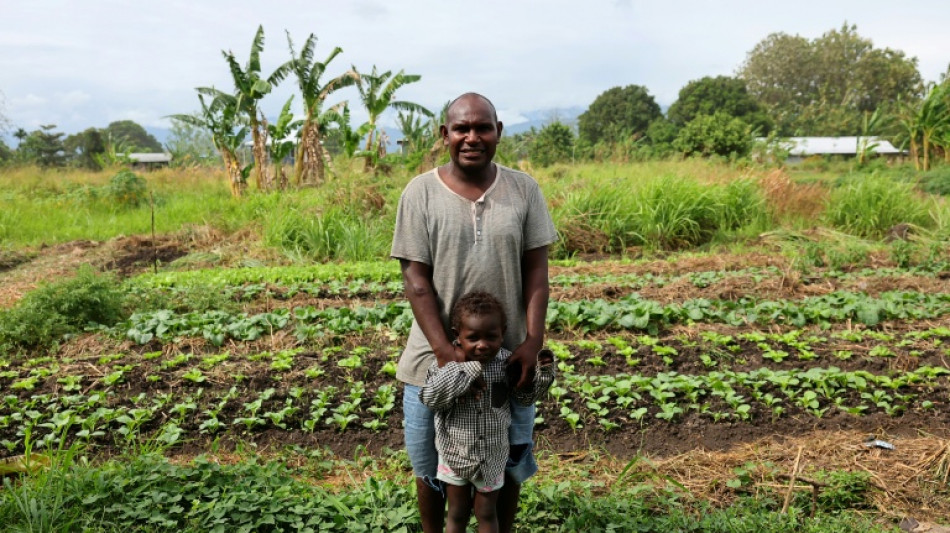
'Backyard fireworks' of WWII bombs still litter Solomon Islands / Photo: Ben STRANG - AFP
Solomon Islander Dennis Phillip was ploughing his soil by hand when he heard an unusual clunk -- one of the countless unexploded bombs still scattered across the small Pacific nation decades after World War II.
Japanese and Allied forces waged a savage campaign across the Solomon Islands from 1942 to 1945, in which tens of thousands were killed.
They left behind bombs now buried under homes, schools, businesses, football fields and Phillip's vegetable garden.
Records are patchy, but estimates suggest dozens have been killed and many more wounded by ordnance littered across the otherwise idyllic landscape.
Bernadette Miller Wale remembers playing with bombs when she was a young girl growing up outside the Solomons capital, Honiara.
"You'd see items, you'd touch it, move it, you weren't really aware of the dangers that it posed," she told AFP.
She and her friends would even set them off on purpose -- they called them "backyard fireworks".
These days Miller Wale spends her days trying to educate Solomon Islanders about the dangers of unexploded ordnance, work sparked by a deadly explosion near her home in 2021.
"It was a Sunday afternoon. I was just sitting with my daughter and a few of my in-laws, and then we heard the explosion," she said.
The blast killed two close friends who had been cooking with a backyard bonfire, a staple of life in the Solomon Islands.
"The bomb was close to the surface, but no one realised," she said.
This is not a problem the Solomons can tackle alone, activists say, and nor should it, given who is responsible.
Of the 50,000 bombs found and destroyed in the past 14 years, well over two-thirds were of American origin.
A further 17 percent were Japanese, while three percent were from Britain, Australia, New Zealand or other countries.
- 'Everyone' affected -
One group trying to help is The Halo Trust, a global NGO focused on bomb clearing.
Their operations in the Solomon Islands are small, but dedicated.
The group is working to map the Solomons and identify the biggest hot spots for unexploded ordnance.
Red areas show places that have been mapped and unexploded ordnance found.
Yellow dots are locations where bombs have been found and then destroyed by the police -- more than 50,000 since 2011.
It is hard to move more than 100 metres in Honiara without finding another yellow dot on the map, like seashells on a beach.
And that is just the beginning.
"Everybody knows someone that has been affected," Emily Davis, who leads The Halo Trust's operation in the Solomon Islands, told AFP.
"They've either found something in their back garden, their children have, or they know somebody that was injured or someone who sadly died as a result of an item exploding."
- 'Saturated' -
At Bloody Ridge, outside Honiara -- the site of one of the deadliest clashes between Japanese and American soldiers -- efforts to set up the country's first national park have been complicated by the sheer number of bombs.
Bjorn Svensson from the Solomon Islands' Ministry for Culture and Tourism said the area is "saturated".
Just a few weeks before AFP's visit, he said, workers digging found three hand grenades buried in the ground.
"They're basically 10 centimetres under," he explained.
"These are the smaller calibre, because it was closer, hand-to-hand fighting," he said.
"But down in the valley, there are a lot of larger calibre artillery shells."
Solomon Islands Prime Minister Jeremiah Manele has said the issue is "dear to me" and raised it with regional leaders at the recent Pacific Islands Forum in Honiara.
Halo's efforts in the Solomon Islands are being assisted by the US State Department, with current funding due to end in June 2026.
"We're working to provide a report that shows the scale of the problem and then work with Solomon Islands government and the police force to see how our work could, in the future, help tackle this issue," Halo's Davis said.
She concedes it is a far smaller operation than her previous work in Laos, where more than 1,500 staff operate throughout the Southeast Asian nation.
"But it's growing," Davis said.
"You never know, one day we could have that many staff working throughout the Solomon Islands."
X.Blaser--NZN