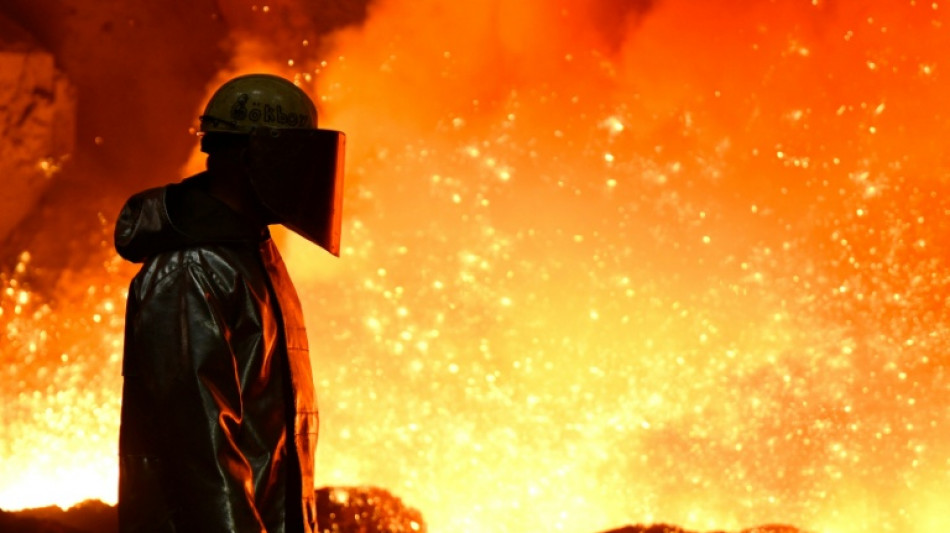
German steel industry girds for uncertain future / Photo: Ina FASSBENDER - AFP
Hammered by surging energy costs and a flood of cut-price Chinese imports, Germany's steel industry has been mired in deep crisis for several years.
Chancellor Friedrich Merz on Thursday convenes talks with key industry players in Berlin in an effort to help the sector. Here are some questions and answers on the subject:
Why is steel important for Germany?
German's strength as a leading industrial nation is strongly linked to steel production, which rose in tandem with the construction of the railways, military build-ups during two world wars, and the economic revival of the 1950s.
The country remains Europe's top steel producer, and the seventh largest in the world, according to the World Steel Association.
Steel is widely used in many sectors in Europe's biggest economy, from construction to automotive and mechanical engineering, and is an essential component of exports.
The sector directly employs only around 80,000 people, according to German industry federation WV Stahl, with many working in the traditional industrial heartland of the Ruhr.
But steel-intensive sectors employ around four million people, accounting for two out of three industrial jobs, according to the federation.
Why is the sector in crisis?
China, the world's top producer, has for years been flooding world markets with large quantities of steel at knock-down prices, undercutting German and European producers.
Problems worsened for the power-hungry sector when Russia's 2022 invasion of Ukraine sent energy costs surging. While they have since come down, they remain well above levels seen before the war.
In recent times, steel production in Germany has languished at 10 to 15 percent below 2022 levels.
A growing number of steel plants in the country are being mothballed: a quarter were temporarily shuttered in 2024, according to the Agora Industrie think tank.
The sector's traditional giants meanwhile are sliding into crisis. Thyssenkrupp plans to cut around a third of its steel division's workforce and slash production by around 30 percent by 2030.
What are the solutions?
The talks convened by Merz will bring together the country's top producers as well as leaders from states where the industry is a major employer, in a bid to "increase competitiveness and the future prospects" of the sector, a government spokesman said.
The meeting is a key step in "paving the way" to come up with measures to help the industry, he said.
One key aim is to clarify Berlin's position on the European Commission's radical plans to protect the continent's steel industry from cheap foreign imports.
In early October, it proposed hiking levies on steel imports to 50 percent and slashing the volume allowed in before tariffs apply by 47 percent.
It mirrors a strategy embraced by US President Donald Trump, who has imposed 50-percent tariffs to keep out cheap metals from China.
Germany's leading industrial union IG Metall considers the EU's proposals "fair", a spokesperson told AFP, urging the government to "clearly defend" them.
Berlin is also planning to begin a scheme in January to subsidise power costs for industry, which Economy Minister Katherina Reiche said will be "key to the competitiveness of steel".
A green future?
The talks will address the issue of decarbonisation, with the sector betting on the production of "green" steel -- produced using hydrogen derived from renewable energies -- to meet climate goals.
But the shift is challenging as it requires huge investments from steel companies with already strained finances.
Thyssenkrupp's plans to produce green steel at its historic site in the western city of Duisburg were originally scheduled for 2027 but they are now hanging in the balance.
Indian group Jindal, which recently made a takeover bid for Thyssenkrupp's steel unit, has pledged to advance the group's green ambitions if it takes control.
Merz has in the past faced criticism for questioning whether green steel can be produced competitively on a large scale.
Agora Industrie director Julia Metz urged the government to "send clear political signals" and "create investment security" for the shift to green steel.
E.Schneyder--NZN