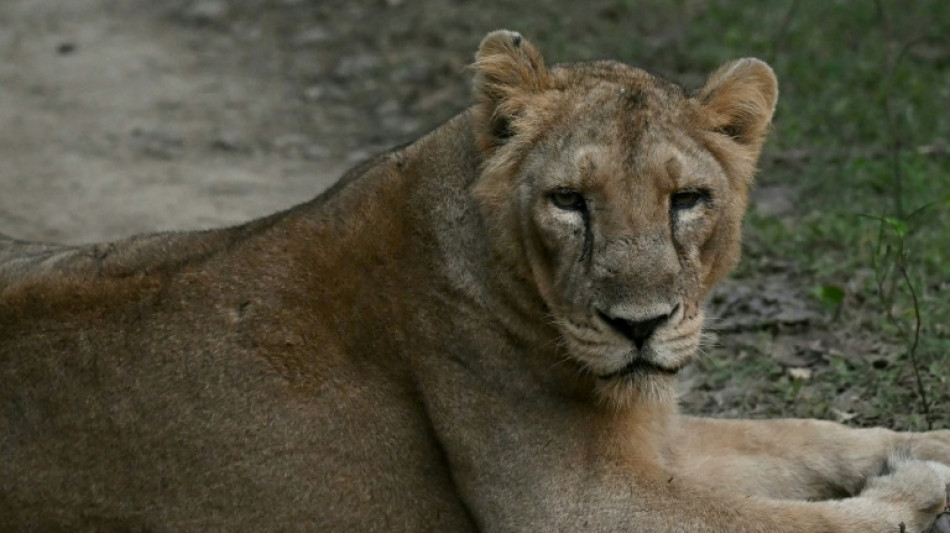
Indian pride as Asiatic lions roar back / Photo: Indranil MUKHERJEE - AFP
A powerful roar rocked the forest before the silhouette of a lioness appeared at an Indian reserve, a potent image of how conservation efforts have brought the creatures back from the brink.
In Gir National Park, Asiatic lions reign over a 1,900-square-kilometre (735-square-mile) expanse of savannah and acacia and teak forests, their last refuge.
For a few minutes, cameras clicked wildly from safari jeeps, but as night falls and visitors leave, the mighty cat has still not moved a paw.
Gir's success stems from more than three decades of rigorous conservation to expand the lions' range, which now raises questions about the future of coexistence with humans.
Park chief Ramratan Nala celebrates the "huge success": lion numbers have risen by a third in five years, from 627 to 891.
"It's a matter of pride for us," Nala said, the head of government forests in the sprawling Junagadh district of the western state of Gujarat.
The Asiatic lion, slightly smaller than their African cousins, and identified by a fold of skin along its belly, historically roamed from the Middle East to India.
By the early 20th century, only about 20 remained, nearly wiped out by hunting and habitat loss.
"They've been resurrected from the brink of extinction," said wildlife biologist Meena Venkatraman.
- 'Our lions' -
After India broke free from British rule in 1947, a local prince offered "his" lions sanctuary.
In recent decades, the authorities have invested heavily by protecting vegetation, securing wells and roads, and even building a hospital.
"The thing about lions is that if you give them space, and you protect them and you give them prey, then they do extremely well," said Andrew Loveridge, from global wild cat conservation organisation Panthera.
In 2008, they were removed from the IUCN Red List of species threatened with extinction, and moved to the category of merely "endangered".
Unlike in Africa, poaching is virtually absent.
"The local people support the conservation of Asian lions," Nala said, reporting zero cases of poaching for more than a decade.
"These are our lions," his deputy Prashant Tomas said. "People are very possessive about them".
- 'Secret to success' -
Local communities fiercely protect the lions for cultural, religious and economic reasons, because they attract tourists.
Loveridge said that people accepted some livestock would be lost.
"In general, they're less likely to kill the lions in retaliation for livestock losses, which is something that is very prevalent in many sites in Africa," he said.
"Indian wildlife managers have managed to contain that conflict, to a large degree -- in many ways, that's their secret to success."
But rising numbers mean lions now roam far beyond the park.
About half the lion population ranges across 30,000 km2, and livestock killings have soared, from 2,605 in 2019–20 to 4,385 in 2023–24.
There are no official figures on attacks on humans, though experts estimate there are around 25 annually.
Occasionally, an attack hits the headlines, such as in August, when a lion killed a five-year-old child.
- 'Spread the risk' -
As lions move into new areas, conflicts grow.
"They are interacting with people... who are not traditionally used to a big cat," said Venkatraman.
And, despite their increasing population, the species remains vulnerable due to limited genetic diversity and concentration in one region.
"Having all the lions in a single population may not be a good idea in the long term," she added.
Gujarat has resisted relocating some lions to create a new population, even defying a Supreme Court order.
Nala pointed out that Gir's lions are separated into around a dozen satellite populations.
"We cannot say that they are all in one basket," he said.
Loveridge accepted that it "is starting to spread the risk a little bit".
But he also warned that "relatively speaking, a population of 900 individuals is not that large", compared with historic numbers of tens of thousands.
Long-term security of the species remains uncertain, but momentum is strong -- and protection efforts are having a wider impact on the wildlife across the forests.
Venkatraman described the lions as a "flagship of conservation".
"That means because you save them, you also save the biodiversity around."
J.Hasler--NZN