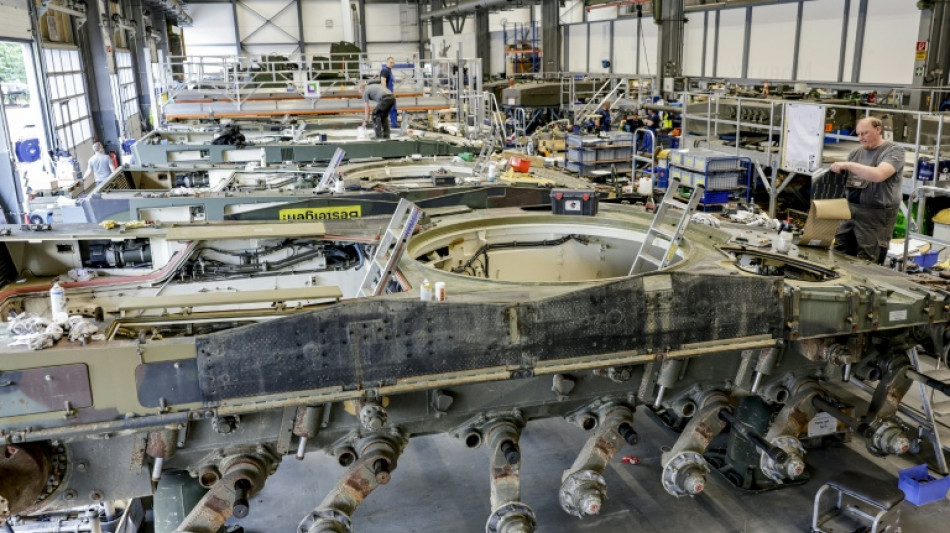
German defence giants battle over military spending ramp-up / Photo: Axel Heimken - AFP/File
Defence giants are drawing battle lines as Germany rearms, with the old guard arguing for traditional heavy weaponry while start-ups push for more modern kit such as AI-enabled drones.
Chancellor Friedrich Merz has vowed to create Europe's strongest conventional army with outlays of hundreds of billions of euros, accelerating a build-up that began after Russia's 2022 full-scale invasion of Ukraine.
The rush to rearm, mirrored across Europe, has been fuelled by pressure from US President Donald Trump for NATO allies to spend more on defence as well as worries about American commitment to the continent's security.
But where these funds should flow is hotly debated.
A crop of German tech defence start-ups argue the Ukraine war -- much of it now contested in the skies with unmanned aerial vehicles -- has shown that relatively inexpensive, mass-producible equipment like drones powered by artificial intelligence will be key for future conflicts.
So far, some argue, too much spending has focused on time-tested but expensive weaponry such as tanks and armoured vehicles, which are vulnerable to being targeted by the new, cheaper airborne armaments.
"Clearly there's been an overly strong focus on traditional platforms," Gundbert Scherf, one of the heads and founders of German defence technology company Helsing, told AFP.
"Spending patterns have to change as the world around us changes."
Scherf, whose Munich-headquartered start-up was founded in 2021 and supplies strike drones to the Ukraine military, sees signs that attitudes are shifting.
"I am hoping we are going to see the spending pattern change from a 99 percent focus on traditional systems and one percent on autonomous systems, to a more even balance."
Helsing, backed by Spotify founder Daniel Ek's investment firm and reportedly worth 12 billion euros ($14 billion), recently carried out successful tests with the German military, striking targets multiple times.
- Pressure to 'keep pace' -
German tech defence start-up Stark -- which was founded just 18 months ago and has also had its drones tested with the German military -- echoed Helsing's cautious optimism.
"Procurement in Germany is changing, and that is really positive," said Josef Kranawetvogl, a senior executive at the firm, which counts among its investors Silicon Valley tech billionaire Peter Thiel.
But he worried that the shift was not moving fast enough.
"We are really good in Europe at writing strategic papers -- but we have to execute more. We have to keep pace, we have to be fast," he said.
On the other side of the debate is Rheinmetall, Germany's biggest weapons manufacturer and a key supplier of military vehicles and ammunition whose sales have been dramatically boosted by the Ukraine war.
CEO Armin Papperger recognises drones are increasingly important -- Rheinmetall also makes them and is investing more -- but argues they are just one of many systems that will be vital in future.
"Without armoured vehicles, it would not be possible to defend a country or repel an aggressor if they invade," Papperger, whose company is valued at around 70 billion euros, recently told a media briefing.
"If there were a war involving NATO, it would look very different from what we currently see in Ukraine," he said.
"Drones would play a less significant role than they do now."
- 'Lagging behind' -
Drones also figure in the government's planning, with Defence Minister Boris Pistorius saying in October that Berlin was planning to invest 10 billion euros in the technology in the coming years.
But there are indications of a continued focus on time-honoured war gear.
News outlet Politico recently reported the government had laid out 377 billion euros worth of desired arms purchases -- much of it earmarked to go to establishment defence titans.
A defence ministry spokesman declined to comment on the report while stressing that drones had been part of military operations for some time.
But the spokesman, who declined to be named in line with standard German government practice, added that "battle tanks, armoured personnel carriers and combat aircraft will continue to be needed in the future", working in combination with unmanned systems.
Germany's rearmament marks a major transformation for a country with a long-standing pacifist tradition shaped by its painful World War II history.
But like the start-ups, some observers worry the build-up is moving too slowly -- and at serious risk of misfiring.
The military's "planning is lagging behind the inexorable rise of unmanned and autonomous systems", prominent British historian Niall Ferguson and Moritz Schularick, President of the Kiel Institute for the World Economy, wrote in a blistering critique recently.
They warned those in charge were too focused on "the weapons of the last war -- not the next".
R.Schmid--NZN