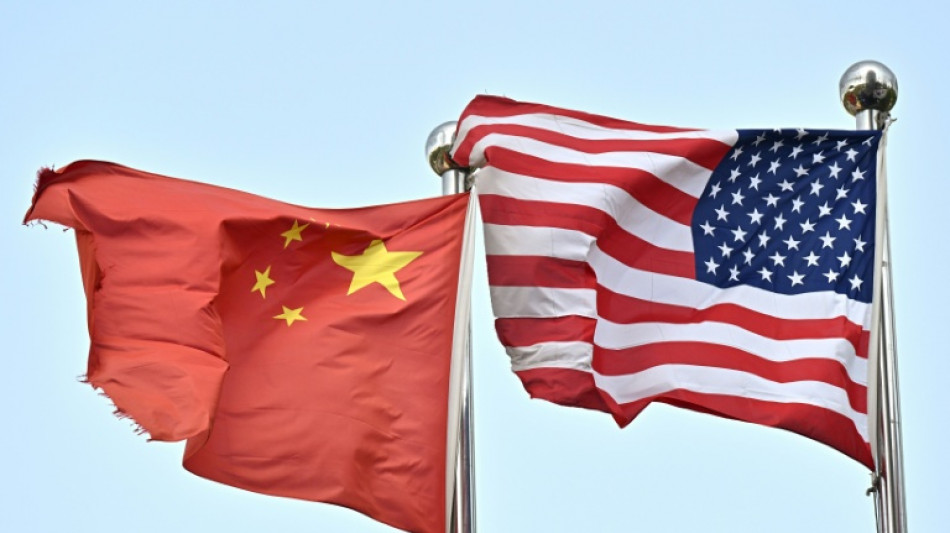
US says China 'massively expanded' nuclear arsenal / Photo: Pedro Pardo - AFP/File
The United States on Monday accused China of dramatically swelling its nuclear arsenal, and doubled down on claims that Beijing had conducted secret nuclear tests, demanding again it be part of any future arms control treaty.
Washington said the lapsing earlier this month of New START -- the last treaty between top nuclear powers the United States and Russia -- presented the possibility of striking a "better agreement" including Beijing.
Christopher Yeaw, the US assistant secretary of state for arms control and non-proliferation, told the Conference on Disarmament in Geneva that New START had been seriously flawed and "did not account for the unprecedented, deliberate, rapid and opaque nuclear weapons build-up by China".
"Despite its claims to the contrary, China has deliberately and without constraint, massively expanded its nuclear arsenal without transparency or any indication of China's intent or end point," he charged.
Chinese ambassador Shen Jian told the conference that his country "firmly opposes the constant distortion and smearing of its nuclear policy by certain countries", insisting that Beijing would not "engage in any nuclear arms race, with any country".
- Parity -
But Yeaw said US officials "believe China may achieve parity within the next four or five years", without elaborating on what he meant by parity.
Both Russia and the United States have more than 5,000 nuclear weapons, according to the Nobel Peace Prize-winning campaign group ICAN.
But New START, which expired on February 5, restricted the United States and Russia to 1,550 deployed nuclear warheads each -- a number Washington charges Russia has passed and China is fast approaching.
"Beijing is on track to have the fissile material necessary for more than 1,000 nuclear warheads by 2030," Yeaw said.
China's Shen insisted that "China's nuclear arsenal is not in the same league as the countries possessing the largest nuclear arsenals".
"It is not fair, reasonable or realistic to expect China to participate in the so-called trilateral talks."
But some discussions are underway, said a senior US State Department official, who asked not to be identified.
A "preparatory" meeting had taken place with a Chinese delegation in Washington the day after New START expired, and a more "substantive" meeting was scheduled in Geneva on Tuesday, the official told reporters.
The expiration of New START marks the first time in decades that there is no treaty to curtail the positioning of the planet's most destructive weapons, sparking fears of a fresh arms race.
Yeaw welcomed the lapsing of the treaty, insisting its numerical limits on warheads and launchers were "no longer relevant", given Russia's alleged violation of the treaty.
He also accused Moscow of helping "boost Beijing's capacity to increase its arsenal size".
- Chinese test claim -
The United States is not "walking away from or ignoring arms control", Yeaw said, insisting: "Quite the opposite is true."
"Our goal, is a better agreement toward a world with fewer nuclear weapons."
Yet Trump said last October that the United States planned to resume nuclear testing to match alleged secret explosions by China and Russia.
Yeaw, who last week indicated that Trump was serious about returning to testing on an "equal basis", doubled down Monday on US accusations of Chinese secret nuclear tests.
He provided more details on a low-yield test Washington says Beijing conducted in 2020 and accused China of preparing more explosions with larger yields.
Yeaw told the conference that data gathered in nearby Kazakhstan showed China conducted a 2.75-magnitude explosion underground on June 22, 2020 at 0918 GMT.
"The estimated yield of the event was a 10 tonne nuclear explosion, or five tonnes conventional equivalent, which assumes the explosion was fully coupled in hard rock below the water table," he said.
And "there have been others", the senior US official said, charging that "China has planned to conduct tests with designated yields in the hundreds of tonnes".
In a recent report, the Center for Strategic and International Studies did not find conclusive evidence of an explosion, saying satellite imagery did not show unusual activity at Lop Nur, China's historic testing site in the western region of Xinjiang.
Shen slammed "groundless (US) accusations that China has conducted a nuclear test", accusing Washington of using its claims "as a pretext for itself to resume nuclear testing".
M.Hug--NZN