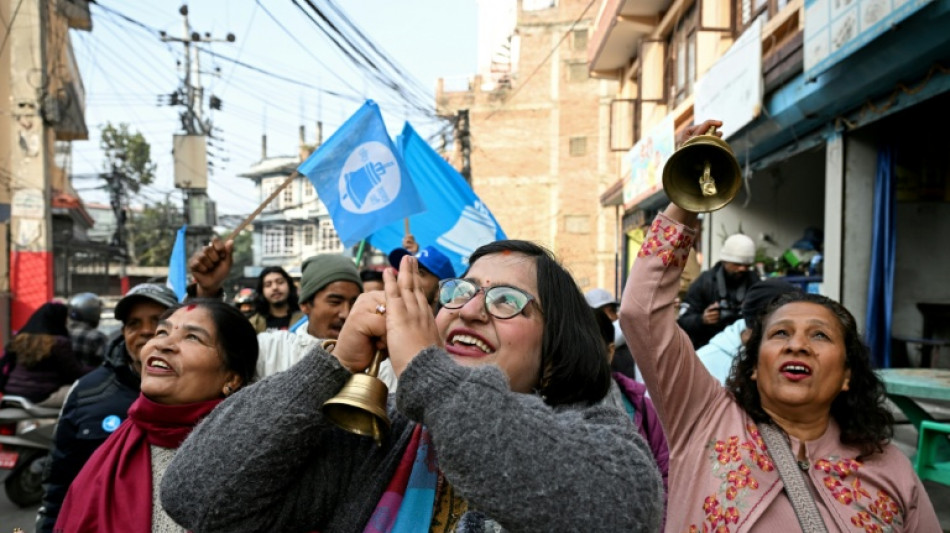
Nepali women still sidelined in post-uprising polls / Photo: Prakash MATHEMA - AFP
Nepali women risked their lives in last year's deadly anti-corruption protests that toppled the government.
But when the country votes on Thursday, they will be largely absent from the ballot as candidates.
The September unrest demanded the end of an entrenched political elite and the rise of a new generation of leaders, ultimately ousting four-time prime minister KP Sharma Oli.
Former chief justice Sushila Karki, 73, has since led Nepal as its first woman prime minister. Yet when she steps down after the polls, parliament is again expected to be dominated by men.
Voters will elect 275 members of the House of Representatives, the lower chamber of parliament -- 165 through direct contests, and 110 through a party-list proportional representation (PR) system.
Just 10 percent of the more than 3,400 candidates running in the direct vote are women.
Ranju Darshana is one of them, campaigning door-to-door in the capital Kathmandu for the Rashtriya Swatantra Party (RSP) while heavily pregnant.
"It is about issues of half of the population," said Darshana, 29, who has been active in politics since she was a teenager.
"It is important that we build policies through the lens of women."
Sita Gurung, 49, was among nine women who won a seat for the Nepali Congress party in 2022 polls, but was not nominated this time around.
"No matter which revolution, we do not see a change," she said.
- 'Deny them chances' -
Nepal's constitution mandates that at least one-third of parliamentary seats be held by women.
Those provisions were introduced after the 2006 popular uprising that followed a decade-long civil war and paved the way for the abolition of the monarchy.
Women make up a significant proportion of the 110 seats allocated according to party vote share.
But critics say the arrangement has allowed parties to sideline women from directly elected races.
"It gives political parties an excuse that women will be included through the PR system, and deny them chances to contest," said former lawmaker Bidhya Bhattarai, who is not running this election.
"The situation is changing for women, so they can stand up and say that they will contest in the election," the former education minister in Oli's Marxist-led government added.
"But the numbers are low... We have to foster an environment that will encourage women to contest."
- 'Own revolution' -
Male politicians continue to wield greater influence in negotiating party tickets, reflecting deeply embedded gender biases in society.
Kunti Devi Pokhrel, contesting from the Rastriya Prajatantra Party, described the uphill battle many women face.
"We have to struggle to be a candidate in the party... They do not trust women, so we have to struggle and prove ourselves," she said.
Even those who are able to contest must confront gendered stereotypes, biased media coverage and online abuse.
Political analyst Sucheta Pyakurel pointed to deep structural barriers.
"There is no lens to view women as a viable and legitimate political actor," she said. "The same scenario is repeated in every election. The core issue is we have unequal citizenship status."
For Gurung, the moment calls for a new kind of mobilisation.
"Women are just not accepted," she said. "Perhaps it is time that we women lead our own revolution for change."
O.Krasniqi--NZN