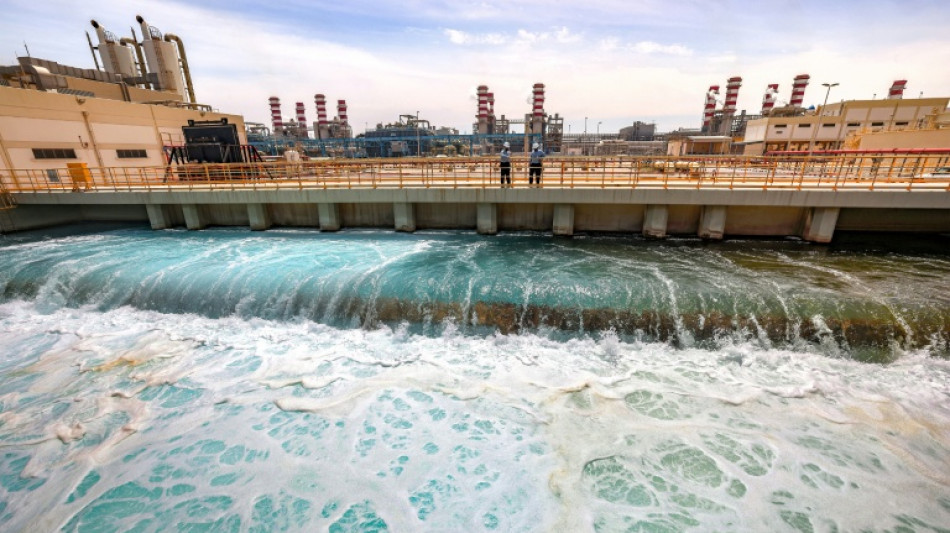
Water emerges as a dangerous new war target / Photo: Fayez Nureldine - AFP/File
Attacks on water systems are uncommon in wartime, but they have appeared in the war in the Middle East with strikes on desalination plants -- critical infrastructure for millions of people in the arid region.
- Who was targeted? -
Bahrain's interior ministry said Sunday that an Iranian drone attack damaged a water desalination plant, accusing Tehran of "randomly" targeting civilian infrastructure.
Bahrain's national communication office later said the Iranian attack on a water desalination facility has had no impact on water supplies or network capacity.
The strike came a day after Iran accused the United States of setting a precedent by attacking a desalination plant on Qeshm Island which supplies 30 villages.
Iran's Revolutionary Guard force said the United States attacked Qeshm from a base in Bahrain.
Such attacks have been limited so far, but "the first side that dares to attack water triggers a war far more enormous than the one we have today", water economist Esther Crauser-Delbourg told AFP.
- Why does desalinated water matter? -
The Middle East is among the driest regions in the world, with water availability about 10 times lower than the global average, according to the World Bank.
That makes desalination plants essential to the economy and drinking water supplies in the region.
About 42 percent of the world's desalination capacity is located in the Middle East, according to a study published in the journal Nature.
Desalinated water provides 42 percent of drinking water in the United Arab Emirates, 70 percent in Saudi Arabia, 86 percent in Oman and 90 percent in Kuwait, according to a 2022 report from the French Institute of International Relations think tank.
"Over there, without desalinated water there, there is nothing," said Crauser-Delbourg.
The supply is particularly strategic for large cities such as Dubai and Riyadh.
As far back as 2010, the CIA warned that disrupting desalination facilities in most Arab countries "could have more serious consequences than the loss of any other industry or commodity".
A 2008 US diplomatic cable published by WikiLeaks said Riyadh might have to evacuate within a week if the Jubail desalination plant or its pipelines were severely damaged.
- What threats do the plants face? -
Besides military strikes, desalination plants are vulnerable to power outages and contamination of seawater, including oil spills, according to experts.
"We have strengthened access security and controls in the immediate vicinity of the plants," said Philippe Bourdeaux, regional director for Africa and the Middle East at French firm Veolia.
The company supplies desalinated water to regions including Jubail in Saudi Arabia and Muscat, Sur and Salalah in Oman.
"The recent events are of course prompting us to be extremely vigilant," Bourdeaux said.
"In some countries, authorities have placed missile batteries around the largest plants to counter the drone or missile threat," he added.
Operators also have tools to limit damage from oil spills.
- What are the precedents? -
There have been few other attacks on desalination facilities over the past decade.
Iran-backed Houthi rebels in Yemen have targeted desalination plants in Saudi Arabia in the past, while a Saudi-led coalition has struck back at water infrastructure in Yemen, according to the Pacific Institute, which tracks water-related conflicts.
Israeli strikes have hit water infrastructure in the Gaza Strip, according to the Pacific Institute, which tracks water-related conflicts.
Before 2016, similar attacks date back to the Gulf War in 1991.
- What if attacks escalate? -
The impact could range from short disruptions to far more severe consequences if outages last.
"We could potentially see major cities facing an exodus. And rationing," Crauser-Delbourg said.
Water shortages could also ripple through the economy, hitting tourism, industry and data centres that consume large amounts of water for cooling.
Some safeguards exist, Bourdeaux said. Desalination plants are often interconnected, which can limit the impact if one facility shuts down.
Most also hold reserves equivalent to two to seven days of water consumption -- enough to prevent shortages as long as disruptions are not prolonged.
E.Leuenberger--NZN