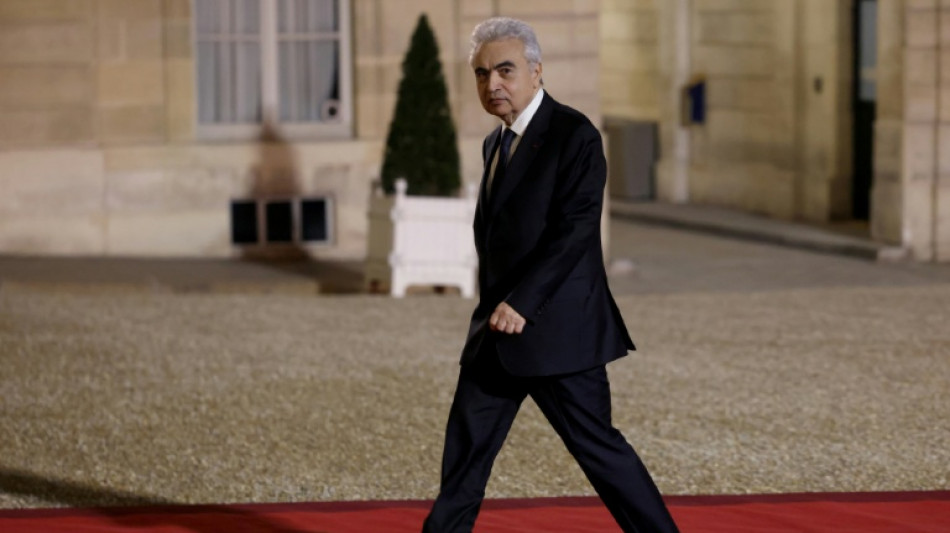
G7 inches closer to tapping oil reserves to tackle price rise / Photo: Ludovic MARIN - AFP
The Group of Seven advanced economies inched closer Wednesday to tapping strategic oil reserves to tackle the rise in crude oil prices due to the Middle East war as energy ministers said they stood ready to take "all necessary measures".
The announcement came before G7 leaders were set to discuss the widespread economic fallout from the US-Israeli war with Iran, now into its second week, at a video conference meeting chaired by French President Emmanuel Macron.
On Tuesday, member states of the Paris-based International Energy Agency held crisis talks to assess the security of supply and the potential release of emergency stocks as the conflict rocks the markets.
"In principle, we support the implementation of proactive measures to address the situation, including the use of strategic reserves," energy ministers of the G7, of which France currently holds the rotating presidency, said in a statement on Wednesday.
They said they were coordinating within the group, with IEA member countries and beyond.
"We agreed to stand ready to take all necessary measures in coordination with IEA Members," they said.
The crude market has been hit by wild volatility since the United States and Israel began striking Iran at the end of last month, with Tehran retaliating by attacking targets across the oil-rich Gulf and effectively shutting down the Strait of Hormuz.
French Finance Minister Roland Lescure said on Wednesday that no decision had been taken "at this stage" but the meeting of the G7 leaders would "no doubt discuss this issue of strategic reserves".
"We need to send a very clear message, which is that if we cannot reopen the Strait of Hormuz, we will replace it with other oil that will come from elsewhere and circulate around the world," he said in a broadcast on BFMTV/RMC.
G7 finance ministers met on Monday and G7 energy ministers on Tuesday to hold talks.
- 'Pumping less oil' -
Citing officials familiar with the matter, the Wall Street Journal reported Tuesday that the IEA had proposed its largest-ever release of oil reserves to counter soaring crude prices driven by the war.
The release would exceed the 182 million barrels of oil that IEA member countries released in 2022 when Russian leader Vladimir Putin invaded Ukraine, the newspaper said.
The IEA did not immediately respond to a request for comment from AFP.
"The G7 reckons the promise of action is as good as actually releasing the reserves, given most of the nations in the IEA aren't actually facing a shortage of crude yet," said Neil Wilson, an investor strategist at Saxo Bank.
"Obviously the equation changes the longer there is a shut-in of refinery output in the Gulf."
Ipek Ozkardeskaya, a senior analyst at Swissquote, said that even if 300-400 million barrels were to be released that amount would be "meagre" compared with the roughly 45 million barrels that IEA countries consume every day.
"It would therefore be a temporary fix," she said, adding the announcement helped keep oil prices in check on Wednesday. "The Middle East is now pumping less oil – around 6 percent less – in reaction to the Iran war."
Asian equities extended gains Wednesday while oil stabilised after the WSJ report.
Countries around the world have been left scrambling in response to the oil price spikes. Bangladesh has deployed the army to guard oil depots, India has imposed tighter controls over natural and cooking gas and French officials are set to conduct random inspections at petrol stations to ensure prices are not being inflated.
The 32 members of the IEA hold over 1.2 billion barrels of public emergency oil stocks, with a further 600 million barrels of industry stocks held under government mandates.
The organisation was created to coordinate responses to major supply disruptions after the 1973 oil crisis.
In order to ensure energy security, the IEA imposes on its members an obligation to hold emergency oil stocks equivalent to at least 90 days of net oil imports.
hrc-are-slb-fff-as/ekf/sbk
J.Hasler--NZN