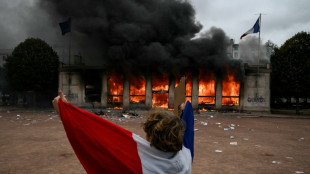
Strategic oil reserves, a crisis cushion / Photo: Thibaud MORITZ - AFP
The 32 member countries of the International Energy Agency (IEA) decided on Wednesday to unlock 400 million barrels of oil from their reserves to ease the impact of the Middle East war.
The sixth release of oil from the strategic petroleum reserves is the biggest such release ever.
It is equivalent to around 20 days of supplies that transit through the Strait of Hormuz, which has been effectively shut down due to Iranian attacks on ships, according to Simone Tagliapietra at the Bruegel think tank.
Strategic oil reserves act as a cushion in case of economic shocks or disruptions. Here is an explainer on how and why they came about.
- Why store oil? -
Oil powers cars, boats and planes. Covering around one third of global energy needs, oil is also the primary resource making up a raft of plastic-based daily items.
That makes it essential to the economy and oil also plays a crucial role in times of conflict, as Yves Jegourel, co-director of the CyclOpe think tank, pointed out in January.
Sufficient supplies of oil, along with other raw materials such as aluminium, are necessary for conducting a war.
Countries, especially those which do not produce oil, usually build up a reserve supply in the event of geopolitical upheaval or supply chain disruption.
- What role for the IEA? -
The role of the IEA, set up in 1974 following the first oil shock of 1973, is to ensure the secure supply of energy.
Around 30 countries are members, including Australia, Austria, Belgium, Canada, Denmark, France, Germany, Italy, Japan, Mexico, New Zealand and the United States.
Each member has "an obligation to hold oil stocks equivalent to at least 90 days of net oil imports," that can be mobilised if a crisis arises.
That "may include stocks held exclusively for emergency situations as well as stocks held for commercial purposes," be they crude oil or refined products, according to the IEA.
The aim is to "mitigate the negative economic impacts" of shortages or disruptions to supply.
- Precedents -
The IEA must agree on collective action once it has assessed the disruption and current market conditions.
It has previously acted on five occasions: in the run-up to the Gulf War in 1991, after hurricanes Katrina and Rita in 2005, during the Libyan civil war in 2011 and twice since Russia's invasion of Ukraine in 2022.
The price of a barrel of crude of US benchmark West Texas Intermediate raced first past $100 and then $110 in recent days, before slipping back.
- How much in current stocks? -
IEA members hold more than 1.2 billion barrels of public emergency stocks, the organisation says, as well as some 600 million additional barrels of stocks which governments oblige the industry to hold.
Britain announced it will release 13.5 million barrels of its 76.6 million in reserve.
Germany said it plans to release 12 percent and Italy roughly the same.
France has a little more than 100 million barrels in its reserves.
Global stocks last year topped 8.2 billion barrels, providing a "significant safety cushion against potential disruptions," according to the IEA.
The global oil market has been in surplus since the beginning of 2025, it added.
The planet consumes around 100 million barrels of oil daily.
- What of non-members? -
In Asia, which relies more heavily upon Middle Eastern oil imports, the situation may be more concerning.
According to Bloomberg, China asked key refiners in early March to suspend their exports of diesel and gasoline.
A huge consumer of oil, particularly from the Middle East, China has accumulated significant crude reserves of around 1.2 billion barrels over recent years, according to intelligence analysis from Kpler.
This amounts to "around 115 days of its crude oil imports by sea".
Another large-scale consumer, India, has obtained a US waiver to buy 30 days of Russian oil supplies normally subject to international sanctions.
Bangladesh has begun rationing petrol to maintain its stocks while Myanmar has imposed restrictions on driving.
Danish shipping giant Maersk told the daily Le Monde that it is worried about obtaining fuel for its vessels in the Middle East and Asia due to limited supplies.
A.Ferraro--NZN