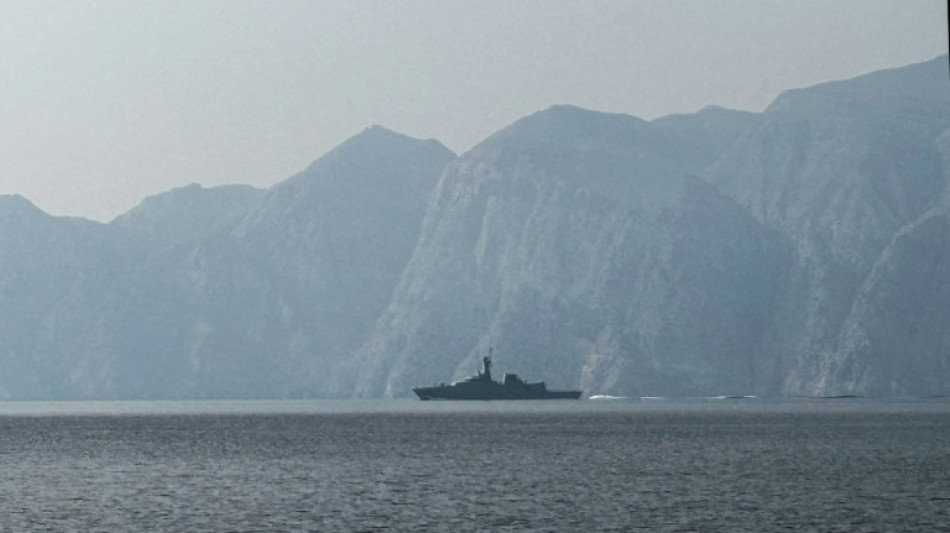
Iranian sea mines: the West's waterborne nightmare / Photo: Sahar AL ATTAR - AFP/File
Tehran is seeking to choke the vital Strait of Hormuz to oil traffic following US and Israeli strikes against Iran, with fears it could be using sea mines to do so.
US forces have struck 28 Iranian mine-laying vessels, President Donald Trump said Wednesday, more than a week into the Middle East war.
Any Iranian mining of the key shipping lane, as its forces did in the 1980s, would be a nightmare for Western demining teams.
Here's an explainer:
- What are sea mines? -
"Mines are the weapon of the poor," a former senior officer with the French navy and specialist on the subject told AFP on condition of anonymity.
Yet "they pose a fundamental threat to maritime trade and to the freedom of action of naval forces," he said.
- How many does Iran have? -
Elie Tenenbaum, a researcher at the French Institute for International Relations (IFRI), said Iran was estimated to have some 5,000–6,000 naval mines, including "drifting mines that are extremely difficult to intercept".
Contact mines can drift around on the surface with the current or can be moored to an anchor on the sea floor. They explode when they come into contact with a ship's hull.
"It's the most rudimentary mine, the cheapest one, and the main threat in the Strait of Hormuz," said the former high-ranking member of the navy.
The Iranians also had influence mines adapted to the Gulf's shallow waters, which are sown on the seabed and explode when a large ship is detected overhead, he said.
The Iranians could also use speedboats to attach limpet mines to the hulls of ships, which would be set to explode at a certain time, he added.
The Iranians can rapidly deploy all these mines "in the Persian Gulf and Strait of Hormuz using high-speed small boats equipped as minelayers", the US Defence Intelligence Agency (DIA) said in a 2019 report.
"Iran has equipped many of its Ashoora small boats with mine rails capable of holding at least one mine," it added.
But, said the ex-navy official, you could also convert another small boat to do the job more discretely.
- Have they been used before? -
Tehran used deployed sea mines during its conflict with Iraq in the 1980s during the so-called "tanker war", forcing the United States to escort commercial ships.
During the Gulf war in 1991, Iraqi forces deployed 1,300 mines, badly damaging two US navy ships, including the USS Princeton, which it cost about $100 million to bring back on line, according to US researcher Scott Truver, who has taught at the Naval War College.
"It took the multinational coalition forces more than two years of intensive mine-countermeasure operations to declare the northern gulf mine free," he wrote in 2012.
- What of demining? -
Western nations have the means to demine the Strait of Hormuz should it be necessary, but such an operation would be long and complicated.
In January, the United States withdrew from service four Avenger-class mine hunters based in the Gulf state of Bahrain.
They are to be replaced by the same number of combat ships equipped with mine countermeasure capabilities, but not designed for that purpose.
"Strategically placed sea mines could become the Achilles heel of US naval operations," the Center for Maritime Strategy said last year, warning Iran but also China and Russia had acquired the cheap munition.
Yet "the navy is dismantling its already-limited mine countermeasures capability without fielding proven replacements," it added.
Tenenbaum, of IFRI, said European capabilities were superior to that of the United States, but still "totally inadequate to confront this threat today".
Britain in December withdrew the last of the four mine hunters it had stationed in the Gulf since 2003.
France only has eight such specialised ships, down from 13 previously. They have not been sent to the Gulf in a while.
Belgium and the Netherlands are considered to be experts in the field, but are still waiting on a delivery of state-of-the-art ships to deploy mine-seeking drones to identify and defuse sea mines at a safe distance.
As for Gulf countries, they do have demining scuba divers, the former navy officer said.
"But to neutralise mines, you have to find them first," he said.
L.Muratori--NZN