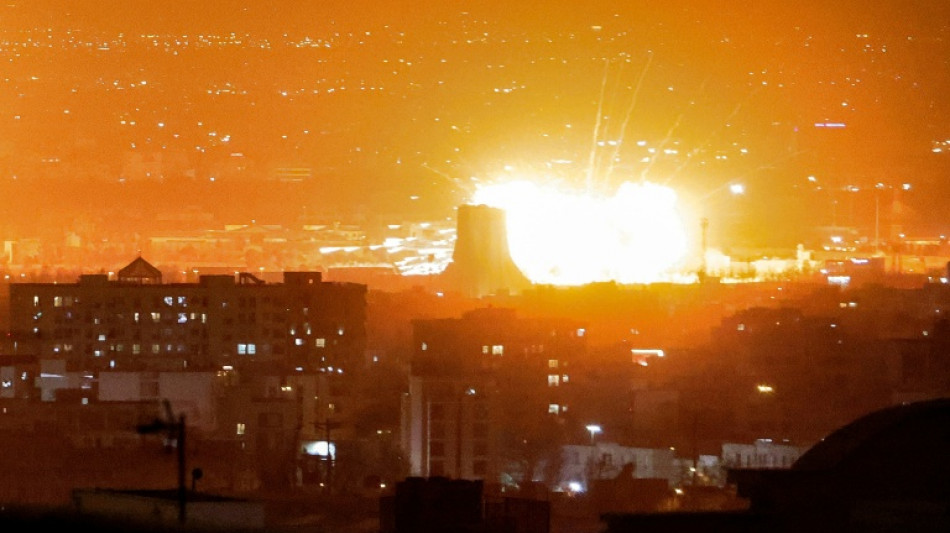
Few easy ways out for US as war with Iran drags on / Photo: ATTA KENARE - AFP
US-Israeli strikes killed Iran's leader but have not toppled the government, which now, from its perch on the Strait of Hormuz, has put the entire world economy on the war's frontlines.
The initial US victory in killing supreme leader Ali Khamenei has given way to a conflict that Washington cannot completely control, sharply limiting President Donald Trump's options.
Two weeks into a bloody air war, Iran holds many cards as it chokes the world's oil supply and strikes US allies in the Middle East, including Gulf states who had for years staked their reputations on political and economic stability.
It makes for a drastic turn from the early hours of April 28, when the first clouds of black smoke rose over Tehran.
Amid smouldering ruins of a housing complex in the Iranian capital were Khamenei and dozens of top-ranking officials, killed in strikes that took years of espionage and planning.
The government had been decapitated.
And yet -- such strategies have "never been effective" in state-versus-state warfare, writes American professor Robert Pape in his book "Bombing to Win", a study of military air campaigns.
And Iran itself is no stranger to history.
"We've had two decades to study defeats of the US military to our immediate east and west," Iran's foreign minister, Abbas Araghchi, said recently.
"We've incorporated lessons accordingly."
The government quickly put in place a new supreme leader, while its decentralised "mosaic defence" allowed the military to retaliate without losing much of a step.
The military doctrine was developed in 2005, after the United States toppled the governments of Iraq and Afghanistan, French researcher Elie Tenenbaum, of the French Institute of International Relations (IFRI), said.
It was meant to help a decentralised military command evade a debilitating loss of top leadership, and "the regime seems pretty intact, despite the fact that it has lost some very senior leaders," said Ali Vaez, Iran project director at International Crisis Group.
That allows Tehran to roll out a "three-part strategy," Vaez said: "First, ensure survival. Second, keep enough retaliatory capacity to be able to stay in the fight. And then third was to prolong the conflict" so that "you can end it on your terms."
All of which spells trouble for Trump as the war draws in US allies and drives up the cost of living at home and abroad.
- Worldwide fallout -
With its missiles and a vast supply of relatively cheap drones, Iran has struck a marina in Dubai and oil tankers at sea, expanding the war to US allies in the Gulf, Turkey, Cyprus and and elsewhere.
Meanwhile in Lebanon the Iran-backed armed group Hezbollah is trading missile fire with Israel, and Iranian forces have all but closed the Strait of Hormuz, a vital artery that normally hosts a fifth of the world's crude oil traffic.
Oil and petrol prices have spiked or sparked rationing in countries from the United States to Bangladesh to Nigeria.
Air traffic has slowed and foreigners are fleeing the Gulf, whose image of business-friendly stability has taken a huge hit.
Oil importing countries around the world have released some 400 million barrels of strategic fuel reserves, though it has hardly eased the pain.
In Kenya, tea sellers are watching stocks pile up unsold as maritime trade lines come under pressure and shipping insurance spikes.
Bangladesh has rationed fuel and deployed the military to ward off unrest.
"We knew that this will open up a Pandora's box of chaos," said the Gulf International Forum's Aziz Alghashian, a Saudi analyst.
He also said there was "anger" among Gulf states that had put "so much investment in" diplomacy with Iran.
- False confidence? -
The worldwide fallout has sparked questions over Washington's strategy.
Trump has called for Iran's "unconditional surrender," while Defence Secretary Pete Hegseth has said the operation's goals are "laser focused," as the administration dodges questions over the war's ill-defined, shifting objectives.
"There is a stark difference between the operational superiority that we have over Iran -- we know where everyone (is) and where we can hit them -- and the strategic understanding of Iran," said Danny Citrinowicz, a senior fellow at Israel's Institute for National Security Studies.
Jonathan Paquin, a political science professor at Canada's Universite Laval, told AFP: "The American administration was undoubtedly presumptuous in believing it held all the cards."
There were reasons Washington could find a way to assure itself of such confidence, Paquin noted: a US operation toppled the Venezuelan government of Nicolas Maduro at the beginning of the year.
The government in Iran, meanwhile, has been struggling through US sanctions, and was shaken by major demonstrations in December and January, sparking a security crackdown that killed thousands.
- US elections, Iranian defections -
Yet in the short term, Tehran still has plenty of pressure points it can hit via oil and shipping threats, including via Yemen's Huthi rebels, who previously disrupted shipping through the Red Sea with their own missile attacks.
Iran is taking "the global economy hostage" as a means of "putting pressure on Trump," said Crisis Group's Vaez.
All the while, Iranian missiles launched at US allies are eating up American interceptors, including expensive Patriot and THAAD systems.
And domestically, Trump -- who ordered the surprise strikes without seeking public support for a war -- is facing upcoming congressional elections.
As price-sensitive voters prepare to head to the polls, "certainly Republican representatives and senators calling the White House to say they risk losing their districts," said Paquin, the political science professor.
Not that Iran -- facing its own political, military and economic upheaval from the war -- is without its own long-term difficulties.
"I think the most likely scenario is that of a zombie state," said IFRI researcher Clement Therme -- a government that maintains its security apparatus but struggles to fulfil functions such as revenue collection or oil exportation.
"They are already struggling to pay public salaries this month," he noted.
Even ensuring the loyalty of the security forces isn't a given: there were notable defections by police during the January massacres of protesters, he added.
The popular uprising called for by Trump to replace the government amid the bombardment seems a far way off -- though Therme noted "it's still too early to judge" the effects of the war on potential protests down the line.
- No exit? -
With no easy exit, Trump is likely to "revise the concept of victory, setting aside the prospect of surrender or regime change" and claiming that the Iranian should rise up on their own, said Paquin.
But while Trump might want to walk away boasting of killing Khamenei and degrading the Iranian military, "Iran might not give him that off-ramp," said Nate Swanson, of the Atlantic Council.
The remaining options seem increasingly bloody.
Iran could keep up the hostilities even after the United States lays down its arms.
Or, Trump "doubles down. We put some form of troops on the ground," whether for special operations or long-term fighting.
The last possibility, worried Swanson, is that the war is "outsourced into an ethnic conflict" by Washington and Israel arming Iranian opposition groups.
For now, the missiles continue to rain down, inside Iran and increasingly further afield.
P.E.Steiner--NZN