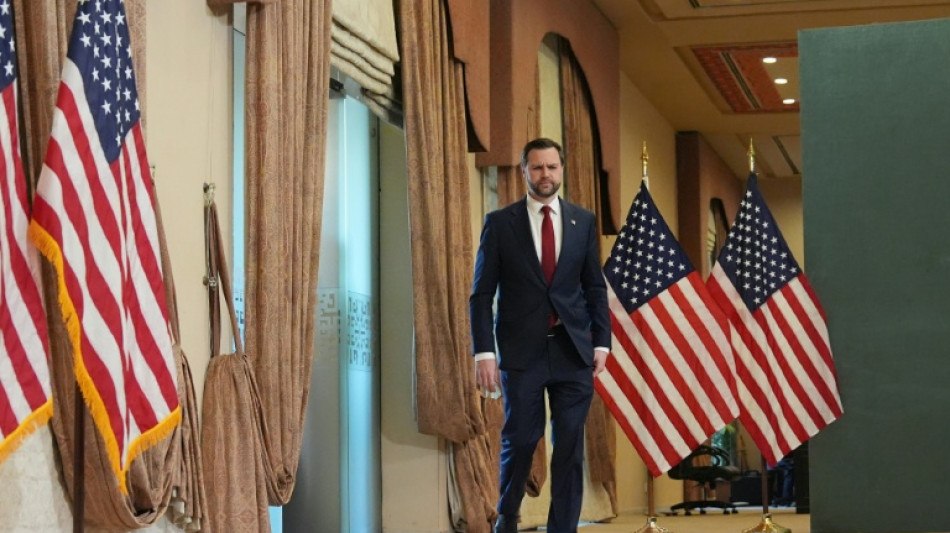
US-Iran talks fail as world urges respect for truce / Photo: Jacquelyn MARTIN - POOL/AFP
Iran and the United States failed to strike a deal Sunday to end the war in the Middle East, but there was no immediate return to hostilities and world leaders quickly urged both sides to pursue the diplomatic route to peace.
US Vice President JD Vance left Pakistan after the talks -- the highest-level meeting between the two sides since the 1979 Islamic revolution -- and warned that Washington had made Tehran its "final and best offer" for a deal.
"We leave here with a very simple proposal," he said. "We'll see if the Iranians accept it."
During a refuelling stop in Germany's Ramstein Air Base for Air Force 2, a US official told reporters that no members of the US negotiating team stayed behind in Islamabad, including chief negotiators Steve Witkoff and President Donald Trump's son-in-law Jared Kushner.
Iran's parliamentary speaker Mohammad Bagher Ghalibaf said his negotiating team had "put forward constructive initiatives but ultimately the other side was unable to gain the trust of the Iranian delegation in this round of negotiations".
Iranian and US reports said the two sides were unable to agree on who would control the Strait of Hormuz skipping lane nor whether Tehran would have the right to enrich uranium under any deal.
The failure of the talks will raise concerns that a return to fighting could drive world energy prices higher and further damage shipping and oil and gas facilities in the Gulf, while civilians in the region were concerned that air strikes could resume with no political endgame in sight.
"We feel despair and hopelessness. We are tired of this uncertainty," said Nahid, a 60-year-old housewife in Tehran, contacted by AFP.
Saudi Arabia's energy ministry said Sunday its key east-west oil pipeline was back in service after it was damaged in earlier strikes, and Qatar's transport ministry said it was lifting some restrictions on Gulf shipping.
Pakistan, which hosted the talks and whose leadership had ushered the rival sides to the table, said it would keep facilitating dialogue and urged both countries to continue respecting the temporary truce.
"It is imperative that the parties continue to uphold their commitment to ceasefire," Foreign Minister Ishaq Dar said.
- Uranium stockpile -
UK Prime Minister Keir Starmer called the Sultan of Oman, Haitham bin Tariq, and both leaders agreed it "was vital there was a continuation of the ceasefire, and that all parties avoided any further escalation".
An EU spokesman said diplomacy would be "essential" to securing peace and hailed Pakistan's mediation efforts, while Russia's President Vladimir Putin called Iran's President Masoud Pezeshkian to offer his services to the diplomatic effort.
"Vladimir Putin emphasised his readiness to further facilitate the search for a political and diplomatic settlement to the conflict, and to mediate efforts to achieve a just and lasting peace in the Middle East," the Kremlin said, in its readout of the call.
The United States and Israel attacked Iran on February 28, sparking retaliation from Tehran that has plunged the Middle East into conflict and shaken the global economy.
Iran and the US had entered the talks mediated by Pakistan with maximalist positions, with Washington piling pressure by saying it had sent minesweeping ships through the vital Strait of Hormuz maritime route.
Signs of strain in the negotiations appeared when Iranian media accused the United States of making "excessive demands" over the strait, through which one-fifth of the world's oil transited before its effective closure by Iran during the war.
- Leverage -
Iran's demands for any agreement to end the war include unfreezing sanctioned Iranian assets and ending Israel's war against Hezbollah in Lebanon. The opening of the Strait of Hormuz has also presented a friction point.
Throughout the war, Iran has wielded global economic leverage by asserting control of the maritime route, sending oil prices soaring and piling political pressure on Trump as US fuel costs rose.
The US military said Saturday that two Navy warships transited through the strait to begin clearing it of mines and ensure it is a "safe pathway" for tankers.
The Iranian military denied that any American warships had entered the waterway and threatened to respond if they do so.
The Revolutionary Guards' Naval Command said Iranian promises of safe passage during a two-week ceasefire applied only to "civilian vessels under specific conditions".
- Lebanon violence -
A complicating factor has been Israel's assertion that the ceasefire does not affect Lebanon, where the Israeli military has launched strikes and a ground invasion in response to rocket fire from Hezbollah, the Iranian-backed movement.
Lebanese authorities said Israeli strikes on the country's south on Saturday killed 18 people, bringing the death toll from Israel's operations since the war broke out past 2,000.
Israel and Lebanon will hold their own talks next week in Washington. Israeli Prime Minister Benjamin Netanyahu said on Saturday that he wanted a peace deal with Lebanon that "will last for generations".
But Israel has ruled out a ceasefire with Hezbollah, signalling it will instead seek to pressure the historically weak central government in Beirut.
burs/dc/ser
A.Weber--NZN