Zürcher Nachrichten - World Bank chief economist warns of hunger risk from war in Iran

EUR -
AED 4.201449
AFN 75.506302
ALL 93.798237
AMD 417.59215
ANG 2.048106
AOA 1050.218578
ARS 1689.747935
AUD 1.640184
AWG 2.059251
AZN 1.94939
BAM 1.955763
BBD 2.301457
BDT 140.857352
BGN 1.964878
BHD 0.430892
BIF 3398.836106
BMD 1.144028
BND 1.475372
BOB 7.921063
BRL 5.845647
BSD 1.142679
BTN 109.960933
BWP 15.559707
BYN 3.306338
BYR 22422.958479
BZD 2.298057
CAD 1.604558
CDF 2585.50481
CHF 0.924345
CLF 0.026859
CLP 1057.100128
CNY 7.748791
CNH 7.754786
COP 3688.130668
CRC 518.590251
CUC 1.144028
CUP 30.316755
CVE 110.262927
CZK 24.219889
DJF 203.476175
DKK 7.477416
DOP 66.968741
DZD 152.243926
EGP 57.772914
ERN 17.160427
ETB 184.430333
FJD 2.565198
FKP 0.850906
GBP 0.85099
GEL 3.003121
GGP 0.850906
GHS 13.185752
GIP 0.850906
GMD 84.658515
GNF 10021.811603
GTQ 8.717836
GYD 239.055506
HKD 8.969584
HNL 30.601425
HRK 7.535835
HTG 149.347192
HUF 362.932043
IDR 20526.674049
ILS 3.475044
IMP 0.850906
INR 110.15336
IQD 1496.871861
IRR 1573039.179393
ISK 143.415853
JEP 0.850906
JMD 181.006597
JOD 0.811161
JPY 185.842898
KES 147.627225
KGS 100.045731
KHR 4619.913152
KMF 490.788624
KPW 1029.625722
KRW 1702.234755
KWD 0.353562
KYD 0.952182
KZT 540.049848
LAK 25783.515305
LBP 102324.576436
LKR 383.992781
LRD 206.816112
LSL 18.857046
LTL 3.378019
LVL 0.692012
LYD 7.294863
MAD 10.661
MDL 20.093622
MGA 4862.908584
MKD 61.633841
MMK 2401.667468
MNT 4104.262355
MOP 9.227727
MRU 45.546144
MUR 53.941376
MVR 17.687113
MWK 1981.362753
MXN 20.066951
MYR 4.685831
MZN 73.115293
NAD 18.857046
NGN 1578.633909
NIO 42.04921
NOK 11.036905
NPR 175.937693
NZD 1.956106
OMR 0.439442
PAB 1.142679
PEN 3.876027
PGK 5.106904
PHP 70.556857
PKR 317.714827
PLN 4.339358
PYG 6925.869803
QAR 4.176721
RON 5.231686
RSD 117.357794
RUB 89.558316
RWF 1682.56837
SAR 4.301488
SBD 9.233868
SCR 15.340312
SDG 686.993316
SEK 11.036104
SGD 1.477632
SHP 0.854133
SLE 27.885738
SLL 23989.713905
SOS 652.987725
SRD 43.028099
STD 23679.080038
STN 24.499539
SVC 9.997812
SYP 126.451869
SZL 18.842646
THB 38.4741
TJS 10.558102
TMT 4.01554
TND 3.374037
TOP 2.754546
TRY 53.932368
TTD 7.759854
TWD 37.081514
TZS 3016.643291
UAH 51.040641
UGX 4221.920634
USD 1.144028
UYU 45.929137
UZS 13723.742012
VES 829.237389
VND 30082.229245
VUV 136.096559
WST 3.137696
XAF 655.944669
XAG 0.02047
XAU 0.000285
XCD 3.091795
XCG 2.059361
XDR 0.815785
XOF 655.944669
XPF 119.331742
YER 272.969304
ZAR 18.336432
ZMK 10297.633379
ZMW 20.824609
ZWL 368.376708
  • CMSC

    -0.0700

    22.03

    -0.32%

  • NGG

    1.4800

    83.99

    +1.76%

  • JRI

    -0.0600

    12.94

    -0.46%

  • RBGPF

    0.0000

    67.35

    0%

  • RIO

    -0.5200

    90.15

    -0.58%

  • RYCEF

    -0.7700

    17.9

    -4.3%

  • CMSD

    -0.0500

    22.26

    -0.22%

  • AZN

    -0.3900

    168.9

    -0.23%

  • BCC

    -2.9500

    77.19

    -3.82%

  • GSK

    -1.0100

    51.76

    -1.95%

  • RELX

    -0.3200

    33.7

    -0.95%

  • BTI

    -0.3200

    62.84

    -0.51%

  • BCE

    -0.3000

    21.84

    -1.37%

  • VOD

    0.1200

    15.74

    +0.76%

  • BP

    0.8200

    41.9

    +1.96%

World Bank chief economist warns of hunger risk from war in Iran
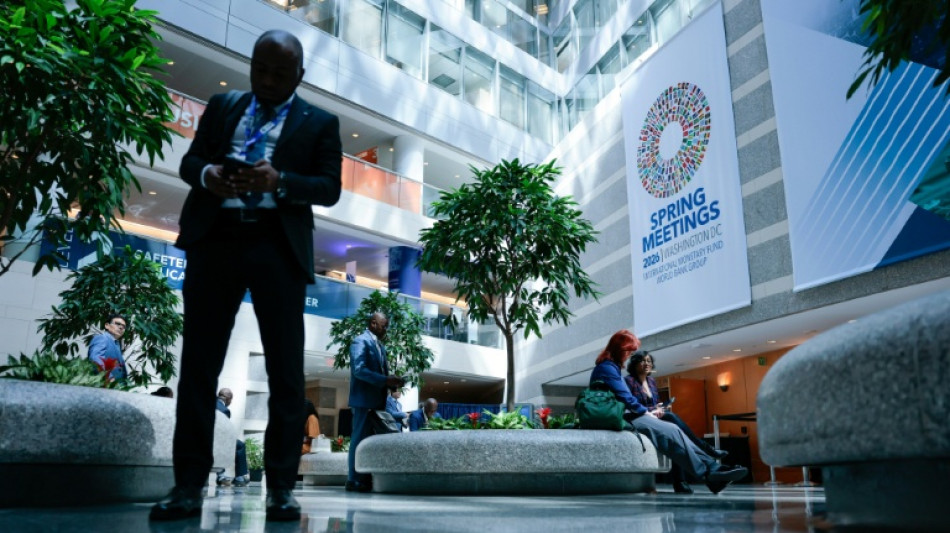
World Bank chief economist warns of hunger risk from war in Iran / Photo: Kent NISHIMURA - AFP

World Bank chief economist warns of hunger risk from war in Iran

The conflict in the Middle East could push millions more towards hunger as its economic fallout reverberates further around the globe, the World Bank's chief economist warned in an AFP interview on Wednesday.

Text size:

"You have about 300 million people who suffer from acute food insecurity already," Indermit Gill said. "That'll go up by about 20 percent very, very quickly," as knock-on effects grow.

Gill spoke on the sidelines of the International Monetary Fund-World Bank Spring Meetings in Washington.

The blocking of the Strait of Hormuz, a key oil supply route, has sent fertilizer prices soaring since they rely on oil-based inputs.

Higher prices for fertilizers, which are used in agriculture, may entice countries to halt food exports and hoard more food for themselves, further driving up food prices.

"Those export bans scare us massively," Gill told AFP.

Most exposed are people in countries that are at war or have fragile governments.

If the situation isn't resolved soon, "hunger will start to stalk these countries massively."

Currently, the shortage of petrochemicals and their economic effects are being most felt in Asia, Gill explained, but "as the crisis gets longer, it's very rapidly going to spread first to Africa."

"The food that's in the market right now has already been grown," Gill said, but the real effects could be felt in a few months.

- Lower growth, higher inflation, more expensive debt –

Low-income people across the world tend to spend a larger share of their earnings on basic needs like food and fuel.

"If you get inflation in, especially in the kind of things that the poor consume relatively more often, that inflation is going to hurt massively," Gill went on.

Gill also warned that inflation – not just in food prices – could rise from about 3 percent globally to as much as 4.7 percent this year, in the most extreme scenario where the conflict stretches to August.

At the same time, global growth could be cut by as much as 40 percent on a yearly basis, if the crisis drags on.

Higher inflation mixed with lower growth would be a "double whammy" for the debt sustainability of poor countries, further hindering their ability to deal with this and future crises.

Gill warned that many headline figures for regional growth may appear too rosy, as the massive US, Chinese, and Indian economies, which are generally more insulated from external shocks, tend to drag up estimates.

When you remove them from the estimates, "you start to see a lot more vulnerabilities," Gill said.

"And by the way, that extreme scenario, with every passing day, is not that extreme of a scenario -- because we're getting closer and closer to August."

M.J.Baumann--NZN