Counting a billion people: Inside India's mega census drive / Photo: Arun SANKAR - AFP
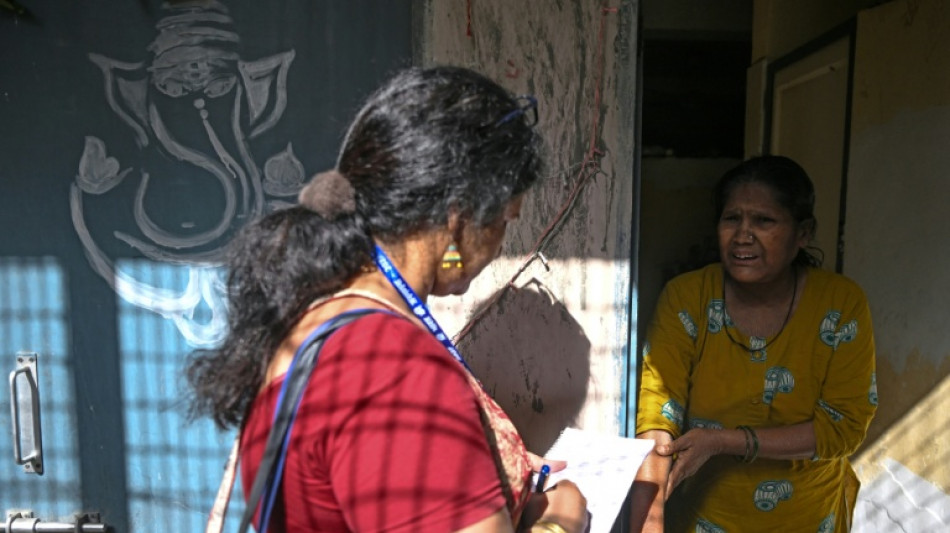
Sukhwinder Kaur battles the scorching sun as she trudges door-to-door in New Delhi as part of India's colossal exercise to count more than one billion citizens.
Kaur is among three million census enumerators fanning out across cities and villages in an exercise that will help shape policy for the country's estimated 1.4 billion people for years to come.
Billed as the world's largest population count, the census is being held in two phases at a cost of $1.25 billion, according to the government.
Last week, the heat became overwhelming for Kaur, a government school teacher.
"I went back home, but returned again in the evening," said Kaur, who will be paid 25,000 rupees ($270) for the assignment, like other census enumerators.
Feebly knocking on a door in the servants' quarters of an upscale housing society, Kaur, 38, tried to explain the purpose of her visit to an elderly resident.
"Because we have been handling children, we have, in a way, learned how to deal with all kinds of people," she said.
"Some speak politely, some behave strangely but we know how to handle them."
In the first phase, census takers ask 33 questions related to water, sanitation, electricity, cooking fuel and internet.
The second phase next year will focus on economic status as well as the more contentious question of caste -- the millennia-old social hierarchy that is deeply entwined with Indian politics and welfare entitlements.
As in the past, census results will be released in phases starting late next year.
- Welfare schemes -
The Hindu-majority nation faces mounting challenges in providing housing, electricity and other basic needs to its growing population.
Many of its megacities are already grappling with water shortages and overcrowded slums.
The government says the first phase "forms an essential foundation for evidence-based planning and formulation of welfare and development programmes."
In the southern tech hub of Bengaluru, teacher Sheikh Shavali held on to his cap to shield against the sun as he made his way through the cramped lanes of Maya Bazaar.
"I take a break once every two hours," he said with a smile.
Enumerators have to survey 20-25 houses a day but Shavali, 50, has no complaints.
"I am treating this work as my small contribution to help these people. If I get the data out correctly, proper schemes can be made for them."
Most of the houses in the area, dotted with open drains, do not have a toilet. Residents have to walk several meters to use the nearest public lavatory.
But Shavali noted most of the households had at least one smartphone, underscoring India's uneven growth.
For the first time, the census is being conducted through a dedicated mobile app.
But the digital shift has not been seamless.
Lalit Verma, a 48-year-old Delhi teacher, said he was also taking notes in a diary in case the data is lost due to glitches.
Others have welcomed the change.
Bengaluru teacher Anandi A. said the app was "easy to use".
"It takes about five to 10 minutes to finish putting in details of one household," she said.
- 'Speak calmly' -
Punith, who uses one name and has been tasked with training census takers in Bengaluru, said earlier it would take "many months" for data to be scrutinised and verified.
"Now (within) three to four hours, I will sync (the data) and it goes to supervisor, then the supervisor will approve it and the census gets completed," he told AFP.
India's last census was held in 2011. The one planned in 2021 was delayed by the Covid-19 pandemic.
The groundwork for the latest census included training sessions that focus as much on temperament as on technology.
At one such session attended by AFP in Bengaluru, enumerators were instructed on how first impressions could make or break an interview.
"Greet politely, state your name and purpose, and immediately show your official ID," the guidelines read.
Enumerators must dress neatly and speak calmly, avoiding any tone that might sound hurried or rude.
They are also trained to explain to residents that their personal data is protected under the Census Act.
Refusals are expected, and trainees are advised to offer return visits rather than push for answers.
Back in Delhi, Verma encountered locked homes, hesitant residents and houses where only children were present.
"I have noted the house numbers," he said.
"I will revisit those homes where complete information was not received."
P.Gashi--NZN