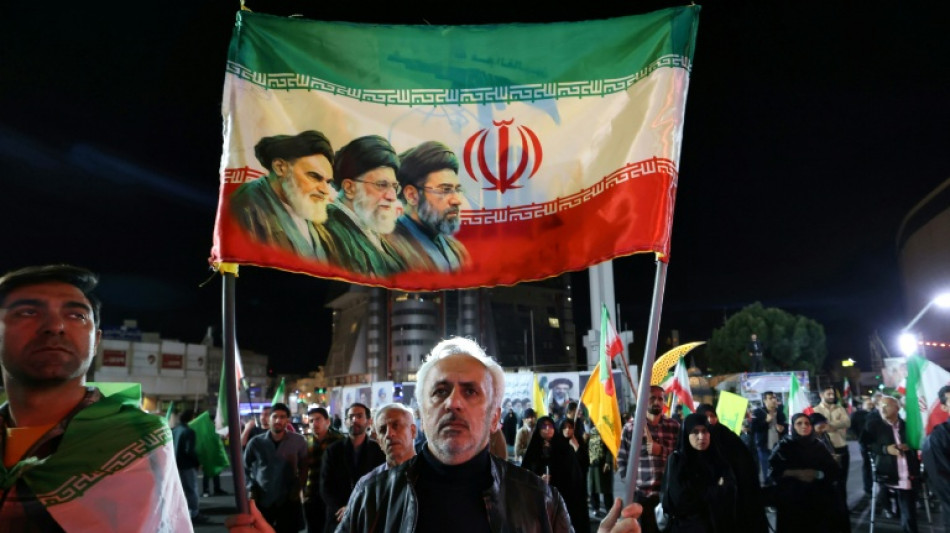
Peace efforts stall as US examines latest Iran proposal / Photo: ATTA KENARE - AFP
Efforts to end the Middle East war appeared at a standstill on Tuesday, with the US considering Tehran's latest offer to unblock the Strait of Hormuz, and Iran saying Washington could no longer dictate terms.
Iran has blockaded the waterway -- a vital conduit for oil and gas shipments -- since the start of the US-Israeli offensive two months ago, sending shockwaves through the global economy.
CNN, however, reported that US President Donald Trump was unlikely to accept Iran's proposal to restore traffic in the strait, as Qatar warned of the possibility of a "frozen conflict" if a definitive resolution is not found.
"We do not want to see a return to hostilities in the region anytime soon. We do not want to see a frozen conflict that ends up being thawed every time there is a political reason," Qatari foreign ministry spokesman Majed al-Ansari said at a press conference, calling for a "sustainable" peace.
While a ceasefire has held so far, diplomacy aimed at permanently ending the war has proven inconclusive.
Trump met with top security advisors on Monday to discuss the Iranian proposal after Tehran passed "written messages" to Washington via Pakistan spelling out its red lines, including on nuclear issues and Hormuz, Iran's Fars news agency reported.
The plan would reportedly see Tehran ease its chokehold on the strait and Washington lift its retaliatory blockade on Iranian ports while broader negotiations continue, including over the thorny question of Iran's nuclear program.
But CNN, citing two sources familiar with the matter, said Trump had signaled at Monday's meeting that he was reluctant to take Hormuz off the table without resolving the nuclear question, though it was unclear what his next steps would be.
Iranian defence ministry spokesman Reza Talaei-Nik said on Tuesday that Washington "must abandon its illegal and irrational demands."
"The United States is no longer in a position to dictate its policy to independent nations," he said, according to state TV.
Asked about Iran's proposal, US Secretary of State Marco Rubio told Fox News "it's better than what we thought they were going to submit," but questioned whether it was genuine.
"They're very good negotiators," he said, adding any eventual deal had to be "one that definitively prevents them from sprinting towards a nuclear weapon."
Mediator Pakistan previously hosted an initial, unsuccessful round of US-Iran peace talks, but hopes for a second over the weekend ultimately came to nothing.
Trump has said that if Iran wants talks, "they can call us."
The Islamic republic's blockade of Hormuz has cut off flows of oil, gas and fertilizer and sent prices soaring.
Trump faces domestic pressure to find an off-ramp as prices rise, with midterm elections due in November and polls showing the war is unpopular among Americans.
- 'No trust' -
Tehran would need guarantees that Washington and Israel would not attack again if it was to offer security assurances for the Gulf, Iran's envoy to the UN said.
Saudi Arabia, meanwhile, welcomed Gulf leaders and officials on Tuesday to discuss the ongoing crisis in the region.
An Iranian army spokesman told state TV on Tuesday that "we do not consider the war to be over," saying Tehran had "no trust in America."
"We have many cards that we have not yet used... new tools and methods of fighting based on the experiences of the past two wars, which will definitely allow us to respond to the enemy more decisively" should the fighting resume, Amir Akraminia said in an interview.
On a visit to Russia, Iranian Foreign Minister Abbas Araghchi said the war had shown "Iran's true power" and stability, but back home in Tehran, the mood was sober.
"Everything in the country is up in the air right now. I have not worked for a long time," small business owner Farshad told Paris-based AFP journalists.
"The country is in complete economic collapse."
- Lebanon front -
Violence has continued on the war's Lebanese front, despite a recently extended ceasefire between Israel and Iran-backed Hezbollah, which drew Lebanon into the Middle East war by firing rockets at Israel.
Israel responded with strikes and a ground invasion.
Israel's military on Tuesday warned residents of more than a dozen villages and towns in southern Lebanon to immediately evacuate, saying Hezbollah's "violation of the ceasefire" was compelling it to act.
Despite its occupation of a swath of territory along the border, Israeli Foreign Minister Gideon Saar said his country "has no territorial ambitions in Lebanon."
Once Hezbollah and its allies "are dismantled, Israel will have no need to maintain its presence in these areas," he added.
The day before, Hezbollah's leader Naim Qassem had vowed that the armed group would "not back down."
burs-smw/amj
U.Ammann--NZN