Inside the jails where Russia breaks Ukraine prisoners 'like dogs' / Photo: Genya SAVILOV - AFP
The young Ukrainian lieutenant talked back too much so his Russian jailers beat him to a pulp.
He was left with "extensive injuries and the bruising festered on his buttocks and the backs of his thighs," said Alexei, a former medic in the Russian prison infirmary where he ended up.
Denied proper care, he died in October 2022, his gangrenous body likely buried in an unmarked grave. Alexei was never able to find out his name.
Thousands of Ukrainian soldiers and civilians have been subjected to physical and psychological violence in detention centres in Russia and in occupied Ukraine, according to nine testimonies collected by AFP -- including from Russia prison officers like Alexei -- and reports by NGOs and the Organization for Security and Cooperation in Europe (OSCE), of which Russia is a member.
Former prisoners and families of detainees have described how strong men were "broken like dogs".
Three former prison officers -- who have since fled Russia -- confirmed the violence and abuse, for which one said they were given "carte blanche" by their superiors.
AFP was able to speak directly with one and was given access to the accounts of two others by Gulagu.net, which documents abuses in the Russian prison system.
Their testimony exposes not just how widespread the violence is, but also Moscow's systematic efforts to conceal it.
Using official documents, AFP was able to verify the identities of the officers -- whose names we have changed for security reasons -- and the prisons they served in.
Russian activist Vladimir Osechkin, director of Gulagu.net -- which stands for "No to the Gulag" -- said the "system of torture and cruelty" is jointly controlled by the all-powerful FSB security service and prison authorities, with the complicity of the judicial bodies.
Nine out of 10 Ukrainian prisoners said they were ill-treated, with 42 percent saying they were subjected to sexual violence, according to an OSCE report in October citing Ukrainian officials.
Many Ukrainians also appear emaciated when they are released after prisoner exchanges. And as in Stalin's gulags, most are deprived of all contact with the outside world.
- More than 22,000 held -
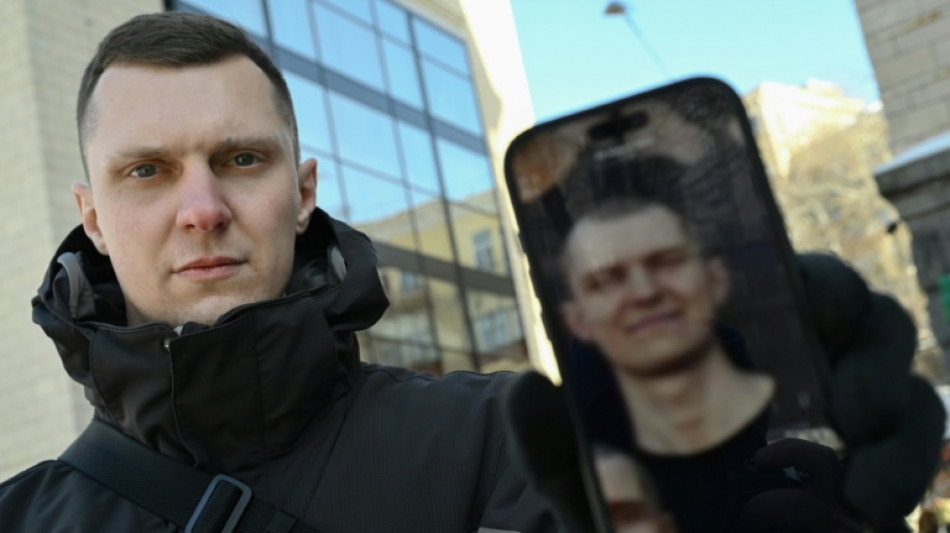
"They take everything from you," said Yaroslav Rumyantsev, 30, a former Ukrainian soldier who survived three years and three months in captivity. "They manage to change your thoughts and make you believe that no one is waiting for you anymore."
At least 143 Ukrainians, including six civilians, have died in Russian jails over the last four years, the Ukrainian Prosecutor's Office told AFP.
Violence against prisoners has been common since the war between Kyiv and Moscow-backed separatists in the east broke out in 2014. But it hugely increased after the full-scale Russian invasion in February 2022, says Ukraine.
Some 7,000 Ukrainian prisoners of war were in Russian hands as of February, according to Ukrainian President Volodymyr Zelensky. Another 15,378 civilians have been "illegally detained", according to data sent to AFP by the Ukrainian human rights office.
Russian President Vladimir Putin insisted last year that Moscow treated prisoners "humanely".
The Russian prison administration did not reply to the questions AFP put to its officials.
- 'Carte blanche' -
Sergei was a member of Russia's "spetsnaz" prison special forces assigned to jails where Ukrainians were being held after the invasion.
"Before the first mission, the head of our territorial group gathered the staff and said that the existing rules would no longer apply when dealing with prisoners of war.
"In other words, he gave us carte blanche to use physical force without restriction. And no one would be held responsible," Sergei told AFP.
"The boss told us: 'Be severe, fear nothing anymore.'"
Opposed to the war, Sergei said he refused to take part in the violence, and resigned the service later that year, leaving Russia. "I wouldn't have been able to live with it and look my children in the eye," he said.
But many of his colleagues were delighted to have the chance to use "all the violence they wanted", he added.
The Ukrainian Prosecutor's Office says it has tracked down Ukrainian prisoners in at least 201 detention centres across 49 Russian regions, some as far away as the Far East.
Many others are being held in 116 locations in occupied eastern Ukraine.
- 'They destroy them' -
Ukrainian marine Yaroslav Rumyantsev was taken prisoner in Mariupol in May 2022 when, after one of the fiercest battles of the war, troops holed up in the Azovstal plant were forced to surrender.
He was first briefly held in Olenivka prison in the Donetsk region, where an explosion killed at least 50 Ukrainian prisoners and wounded dozens more in July 2022.
He was later transferred with about 250 prisoners to Remand Centre Number 2 in Taganrog in southwestern Russia, a place reputed to be one of the worst torture centres.
Bound and blindfolded, they were greeted by a "reception committee" of jailers who beat them from all sides with batons as they entered -- a notorious form of abuse used in the "filtration camps" in Chechnya during the last war in the small Caucasus republic.
The violence never stopped. Rumyantsev said prisoners were reduced to cowering like "beaten" animals. "Men who defended their land, who went to the gym -- strong men -- were broken like dogs. They destroy them."
– Eating cockroaches and mice –
Torture methods included rape, mock executions and simulated hangings and electric shocks, including to the genitals, according to a report from the OSCE's Office for Democratic Institutions and Human Rights (ODIHR) in September based on testimony from former Ukrainian prisoners.
Prisoners were also forced to remain in painful positions and put through intense physical exercises, they said.
Former prison officer Vitali said normal Russian inmates were encouraged to take part in the violence, which was aimed at extracting false confessions.
Russian activist Osechkin said torture was also used to obtain military information and force Ukrainian detainees to collaborate.
Food is also used to break and dehumanise prisoners. Rumyantsev said at times he was given "exactly two minutes" to gulp down a meal like an animal, under threat of more beatings.
One former prisoner told Human Rights Watch he had been so hungry he ended up eating cockroaches he caught in his cell. Fellow prisoners devoured raw mice.
On top of this were the constant punishments and numerous rules to force prisoners into submission, such as the ban on looking guards in the eye.
Rumyantsev remembers having to stand in a group for 16 hours at a stretch without being allowed to go to the toilet. "The guys went in their pants," he said.
Then there were the "experiments" -- like when their jailers ordered them to hold hands and ran electricity through them to see "how many people would feel the pain".
– Re-education –
Russian prison medic Alexei said Ukrainian prisoners were beaten with polypropylene heating pipes in his jail because they "don't break".
The victims only got superficial treatment in the infirmary after the beatings but were required to say, "Thank you to the Russian Federation for this care."
Medical staff sometimes even took part in the violence, Alexei said.
Russian doctors carved the words "Glory to Russia" onto the stomach of a Ukrainian prisoner, Andriy Pereverziev, when he was operated on in jail, according to an investigation by Radio Free Europe RFE/Radio Liberty.
After his release last year he had another operation to remove the slogan etched into his flesh.
Rumyantsev, the former marine, said the torture was to prove that Russia was stronger and that resistance was futile.
He and his comrades were often forced to sing Soviet songs and were punished if they didn't sing "loud enough or sang off-key".
What kept them sane was talking among themselves about memories of their past lives, Rumyantsev recalled. He said he held onto his dignity by telling himself that he didn't "want to live in this hole, to see myself as a beaten dog. I am a human being and I am worthy. I just need to get through this".
He was transferred to a less harsh penal colony in Russia's Udmurtia region in 2024.
Guards still beat them there, but less severely. By then he had "gotten used" to having "our heads bashed in".
He even came across more humane jailers who said they were "sorry" about what was happening and that one day "Russia will apologise".
– 'Invisible' –
Russian human rights activist Osechkin, 44, who lives in France under police protection, said Ukrainian prisoners are often made "invisible" within the penal system, and has even documented cases of their names being changed.
They are also frequently held separately. Former prison medic Alexei said he knew of an entire jail that was emptied so Ukrainians could be held with no witnesses to their mistreatment.
Practices have also been introduced to hide the identity of the torturers. Sergei, the special forces "spetsnaz" officer, said members of his unit did not wear an identification number or body cameras with Ukrainian prisoners of war.
Intervention logs were not filled out either, he said. "There were no reports at all on the use of physical force after missions. They did whatever they wanted, giving free rein to their sadistic impulses."
- Incommunicado –
Depriving prisoners of communication with the outside world also punishes their families.
Natalia Kravtsova's son, Artem, a fighter with Ukraine's nationalist Azov brigade, was taken prisoner in Mariupol in May 2022.
A year later, the Red Cross confirmed he was being held. Since then the 52-year-old has heard nothing.
She is not sure that Artem, 33, is still alive.
With every announcement of a prisoner exchange, Kravtsova feels hope that is then shattered.
"Even if you're calm on the outside, inside you're burning," she said.
The exchanges have become major events for the families of the missing. Many travel to greet the returning prisoners in the hope of gleaning information about their loved ones.
When a detainee is located, it is sometimes possible to use the Russian prison administration's online platform to write to them.
But this requires a phone number in Russia. A Russian activist told AFP that she has allowed 10 Ukrainians to use her number to write to their relatives.
She corresponds with Russian political prisoners and they passed on word of 15 Ukrainians whose families had no news of them.
Roumyantsev, the marine, got only one letter shortly before his exchange. It was the only time he cried in prison.
"I saw those first warm words... and my eyes filled with tears. I was shaking and my friend put his hand on my shoulder and said, 'That means you're still a human being.'"
- 'Torture and enslavement' -
Schoolteacher Olga Baranevska, 62, was disappeared in the occupied city of Melitopol in May 2024 after she refused to cooperate with the Russian authorities.
It took two months for her daughter Aksinia Bobruiko, a refugee in Germany, to find out that her mother -- who has major health problems -- was in prison. She was jailed for six years in November 2024 for "possession" of explosives, charges her family says were trumped up.
Her daughter was able to find out from people on the ground that she is still alive, but little more.
Bobruiko now helps document the ordeals of other detained civilians and works with an NGO called "Numo, Sestry!" or Come on, my sisters!
It was set up by former prisoner Liudmyla Guseynova, who went through hell at the hands of her jailers for three years and 13 days.
The 64-year-old was running a children's shelter in occupied Donetsk when she was arrested in 2019 by pro-Russian separatists for supporting Kyiv.
Guseynova was held in a dungeon in isolation for 50 days after her arrest in a notorious prison in the city called Izolyatsia.
Filmed constantly, she had to remain standing all day under threat of punishment. Her guards would put a cloth bag over her head and subject her to various humiliations, she said.
Female and male prisoners would be regularly forced to "entertain" soldiers on leave.
She then was transferred to Pretrial Detention Centre Number 5 in Donetsk, where she shared a small, filthy cell with around 20 common-law prisoners.
With a hole for a toilet, and dirty mattresses "full of insects", conditions were "appalling", she said. Many detainees suffered from HIV, tuberculosis and eczema.
One day she was brought before an investigator who "put a handkerchief over his nose because my body stank so much. He said to another investigator: 'Don't go near her, can't you see she's crawling with bedbugs?'"
Those responsible for this "system of torture and enslavement" have to be held to account before an international court, said human rights campaigner Vladimir Osechkin.
"We will find them and punish them all," vowed Sergei, the Russian prison special forces officer turned whistleblower.
A.Ferraro--NZN