Zürcher Nachrichten - Hormuz tanker traffic edges higher after wartime low

EUR -
AED 4.280813
AFN 76.345966
ALL 92.298859
AMD 424.187476
ANG 2.086244
AOA 1070.058174
ARS 1765.664633
AUD 1.623014
AWG 2.098153
AZN 1.982627
BAM 1.955742
BBD 2.348781
BDT 143.205772
BGN 1.977353
BHD 0.439687
BIF 3479.797259
BMD 1.165641
BND 1.481256
BOB 13.463602
BRL 6.002465
BSD 1.166186
BTN 111.211716
BWP 15.584075
BYN 3.516987
BYR 22846.555455
BZD 2.345381
CAD 1.618195
CDF 2651.831916
CHF 0.938806
CLF 0.027239
CLP 1072.062678
CNY 7.83631
CNH 7.83409
COP 3647.977117
CRC 529.884355
CUC 1.165641
CUP 30.889475
CVE 110.261745
CZK 24.131679
DJF 207.667432
DKK 7.476081
DOP 67.877996
DZD 155.112739
EGP 58.574621
ERN 17.484609
ETB 190.485744
FJD 2.555725
FKP 0.854645
GBP 0.857574
GEL 3.022483
GGP 0.854645
GHS 13.054839
GIP 0.854645
GMD 85.676503
GNF 10250.697348
GTQ 8.896737
GYD 243.976983
HKD 9.13861
HNL 31.281613
HRK 7.534466
HTG 152.569422
HUF 362.14103
IDR 20748.402403
ILS 3.473084
IMP 0.854645
INR 111.226938
IQD 1527.654896
IRR 1602260.406017
ISK 140.646481
JEP 0.854645
JMD 184.787715
JOD 0.82643
JPY 185.720928
KES 150.869085
KGS 101.935703
KHR 4716.982132
KMF 493.06543
KPW 1049.076868
KRW 1610.146289
KWD 0.35988
KYD 0.971792
KZT 536.475667
LAK 26174.227205
LBP 104431.704402
LKR 383.188686
LRD 211.653751
LSL 18.580411
LTL 3.441834
LVL 0.705084
LYD 7.388909
MAD 10.766482
MDL 20.151578
MGA 5022.02406
MKD 61.523184
MMK 2447.459415
MNT 4194.947051
MOP 9.415422
MRU 46.856617
MUR 54.505557
MVR 18.020807
MWK 2022.209688
MXN 19.76325
MYR 4.697061
MZN 74.490276
NAD 18.58065
NGN 1568.438883
NIO 42.918733
NOK 10.895773
NPR 177.941799
NZD 1.958287
OMR 0.448188
PAB 1.166166
PEN 3.910385
PGK 5.171892
PHP 71.986426
PKR 323.875395
PLN 4.312633
PYG 6976.943643
QAR 4.251474
RON 5.257502
RSD 117.307761
RUB 98.372505
RWF 1717.80823
SAR 4.372741
SBD 9.325274
SCR 16.054143
SDG 700.550266
SEK 11.104245
SGD 1.48171
SHP 0.863583
SLE 28.790692
SLL 24442.899334
SOS 666.503193
SRD 44.014007
STD 24126.406679
STN 24.499487
SVC 10.203918
SYP 15155.658769
SZL 18.56877
THB 38.256906
TJS 10.763582
TMT 4.091398
TND 3.3949
TOP 2.806583
TRY 56.107874
TTD 7.922766
TWD 37.01736
TZS 3077.288833
UAH 51.959949
UGX 4358.946093
USD 1.165641
UYU 46.868616
UZS 13783.888659
VES 916.526054
VND 30412.728489
VUV 137.605523
WST 3.158924
XAF 655.960143
XAG 0.016808
XAU 0.000252
XCD 3.150202
XCG 2.101783
XDR 0.824168
XOF 655.948888
XPF 119.331742
YER 276.314906
ZAR 18.588488
ZMK 10492.169493
ZMW 22.127821
ZWL 375.335793
  • CMSC

    -0.0650

    21.275

    -0.31%

  • CMSD

    -0.1000

    21.16

    -0.47%

  • GSK

    -0.6400

    51.43

    -1.24%

  • BCC

    -1.1000

    79.94

    -1.38%

  • RYCEF

    0.4200

    20.85

    +2.01%

  • BCE

    -0.1000

    23.49

    -0.43%

  • RBGPF

    0.0000

    71.13

    0%

  • VOD

    -0.1900

    15.94

    -1.19%

  • JRI

    -0.0400

    12.44

    -0.32%

  • BP

    -0.3600

    42.5

    -0.85%

  • AZN

    -3.3900

    166.27

    -2.04%

  • RIO

    -2.1100

    104.7

    -2.02%

  • BTI

    0.9700

    57.44

    +1.69%

  • NGG

    -0.6400

    80.53

    -0.79%

  • RELX

    -0.5400

    35.34

    -1.53%

Hormuz tanker traffic edges higher after wartime low
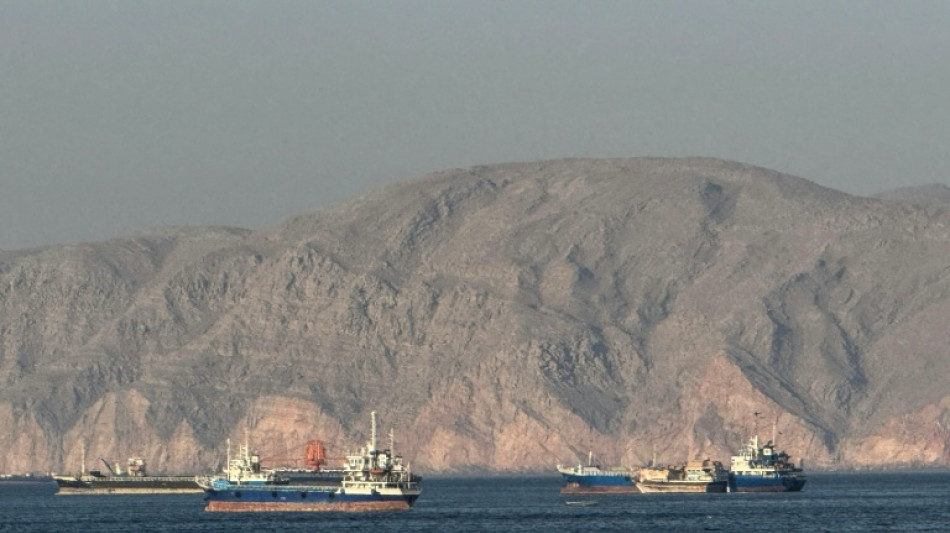
Hormuz tanker traffic edges higher after wartime low / Photo: - - AFP

Hormuz tanker traffic edges higher after wartime low

Traffic through the Strait of Hormuz was slightly higher last week, returning to levels in line with the average recorded since the start of the Middle East conflict after hitting a wartime low.

Text size:

A total of 55 commodities vessels crossed the strategic waterway between May 11 and 17, according to data from maritime tracking firm Kpler as of Monday morning.

That marked a sharp increase from the previous week, when just 19 vessels crossed -- the lowest weekly figure since the first US-Israeli strikes on Iran on February 28, which led to widespread disruption of traffic through the strait.

Iranian state television said Friday the Revolutionary Guards were allowing more ships to transit the strait, after reporting a day earlier that "more than 30 ships" had been permitted to pass.

Despite the increase, last week's crossings remain broadly in line with wartime averages.

Since March 1, Kpler has recorded 663 commodity vessels transiting the strait, 55 per week on average.

Around half the tankers crossing last week carried liquids.

These included three very large crude carriers, reportedly bound for China, Oman and Japan.

Kpler data also showed 15 dry bulk commodity vessels and 16 liquefied petroleum gas (LPG) tankers crossed the strait last week.

Only one liquefied natural gas tanker carrying Qatari gas to Pakistan crossed, on May 12.

That brought the total number of LNG tanker crossings since the start of the war to eight.

In peacetime, the Strait of Hormuz handles roughly a fifth of global oil and LNG shipments, as well as other major commodities, including fertiliser.

Iran has repeatedly warned that maritime traffic through the shipping lane would "not return to its pre-war status".

On Monday, Tehran announced the creation of a new body to oversee the strait and charge vessels for transiting the waterway, which Iran has reportedly been doing since early on in the war.

- Chinese vessels crossing -

Iranian officials said on Thursday that Chinese vessels had been allowed to transit, after a slowdown the previous week.

According to Kpler, only three commodities vessels linked to China through their flag, ownership or cargo crossed the strait last week.

Two additional Hong Kong-flagged vessels also transited and were heading to Oman and the United Arab Emirates.

The data may not provide a complete picture, however, as vessels do not always disclose final destinations while crossing.

Traffic through the strait since the start of the war has depended on nationality, with Iran saying on Monday that countries complying with US sanctions against the Islamic republic would face difficulties crossing.

Since the start of the conflict, China and India have been among the most frequently reported non-Gulf destinations or departure points for commodity carriers transiting the strait.

Other non-Gulf destinations listed in Kpler's shipping data include Brazil, Pakistan, Thailand and Malaysia, while relatively few vessels reported Western countries as destinations.

Iran's control of the Strait of Hormuz remains one of the central issues in stalled negotiations with the United States, which have yet to produce a breakthrough.

M.J.Baumann--NZN