Zürcher Nachrichten - Morocco farmers saw hope in rain, but Mideast war inflates production costs

EUR -
AED 4.123481
AFN 72.418756
ALL 91.601317
AMD 405.317443
ANG 2.009572
AOA 1030.730991
ARS 1699.002245
AUD 1.614042
AWG 2.021041
AZN 1.906165
BAM 1.961207
BBD 2.2599
BDT 138.521899
BGN 1.962466
BHD 0.423965
BIF 3359.873256
BMD 1.122801
BND 1.438929
BOB 13.145358
BRL 5.668231
BSD 1.122079
BTN 106.828522
BWP 15.414359
BYN 3.390633
BYR 22006.89006
BZD 2.256903
CAD 1.594674
CDF 2596.488722
CHF 0.92992
CLF 0.028115
CLP 1106.542613
CNY 7.514623
CNH 7.513894
COP 3590.300605
CRC 511.405368
CUC 1.122801
CUP 26.929123
CVE 110.570824
CZK 24.363143
DJF 199.808193
DKK 7.474876
DOP 68.718843
DZD 150.861743
EGP 59.593869
ERN 16.842008
ETB 183.277857
FJD 2.542638
FKP 0.847332
GBP 0.847293
GEL 2.92062
GGP 0.847332
GHS 13.089203
GIP 0.847332
GMD 83.087596
GNF 9870.950049
GTQ 8.57464
GYD 234.677898
HKD 8.810885
HNL 30.125787
HRK 7.530288
HTG 146.940343
HUF 363.821483
IDR 20140.795607
ILS 3.477985
IMP 0.847332
INR 106.659143
IQD 1701.141484
IRR 2010374.319286
ISK 136.408639
JEP 0.847332
JMD 178.207181
JOD 0.796089
JPY 177.113363
KES 145.773439
KGS 98.18912
KHR 4558.730632
KMF 496.277803
KPW 1010.520418
KRW 1517.071555
KWD 0.349764
KYD 0.935161
KZT 506.955397
LAK 25265.817562
LBP 100546.786195
LKR 371.372204
LRD 191.307426
LSL 18.582966
LTL 3.315338
LVL 0.679171
LYD 7.214046
MAD 11.053258
MDL 20.084282
MGA 5052.885588
MKD 61.745229
MMK 2357.912999
MNT 4041.721584
MOP 9.070366
MRU 44.949323
MUR 53.456625
MVR 17.358239
MWK 1945.847288
MXN 20.755995
MYR 4.582708
MZN 71.757889
NAD 18.497615
NGN 1493.470407
NIO 41.292739
NOK 10.650465
NPR 170.923707
NZD 1.995295
OMR 0.431724
PAB 1.122104
PEN 3.863517
PGK 5.092973
PHP 70.800992
PKR 310.666427
PLN 4.368379
PYG 6402.566068
QAR 4.090614
RON 5.335771
RSD 117.413503
RUB 93.894606
RWF 1655.549535
SAR 4.12898
SBD 9.070063
SCR 15.557764
SDG 675.366788
SEK 11.18068
SGD 1.439571
SHP 0.847173
SLE 27.699569
SLL 23544.570301
SOS 641.273676
SRD 42.343028
STD 23239.703699
STN 24.567403
SVC 9.818945
SYP 14598.65192
SZL 18.489811
THB 37.659824
TJS 10.356553
TMT 3.929802
TND 3.353947
TOP 2.703434
TRY 55.478133
TTD 7.631004
TWD 36.292264
TZS 2952.970979
UAH 50.431288
UGX 4533.539152
USD 1.122801
UYU 45.105559
UZS 13419.878513
VES 983.238206
VND 29054.708882
VUV 134.031712
WST 3.131051
XAF 655.957
XAG 0.019985
XAU 0.000270322124
XCD 3.034425
XCG 2.022456
XDR 0.793878
XOF 655.957
XPF 119.331742
YER 265.207887
ZAR 18.586447
ZMK 10106.555351
ZMW 22.302274
ZWL 361.541307
SSP 6454.445704
MXV 2.343835
  • GSK

    1.6000

    47.87

    +3.34%

  • NGG

    0.2800

    78.51

    +0.36%

  • BCC

    -0.1000

    73.98

    -0.14%

  • CMSC

    -0.0800

    19.71

    -0.41%

  • CMSD

    -0.1750

    19.63

    -0.89%

  • BCE

    0.1900

    19.67

    +0.97%

  • JRI

    -0.1500

    10.4

    -1.44%

  • RIO

    -1.8100

    91.25

    -1.98%

  • RBGPF

    2.4700

    69.3

    +3.56%

  • BTI

    1.0100

    56.66

    +1.78%

  • BP

    0.2800

    48.81

    +0.57%

  • RYCEF

    0.3200

    17.92

    +1.79%

  • VOD

    -0.0450

    15.51

    -0.29%

  • RELX

    0.2300

    36.93

    +0.62%

  • AZN

    6.2100

    162.03

    +3.83%

Morocco farmers saw hope in rain, but Mideast war inflates production costs
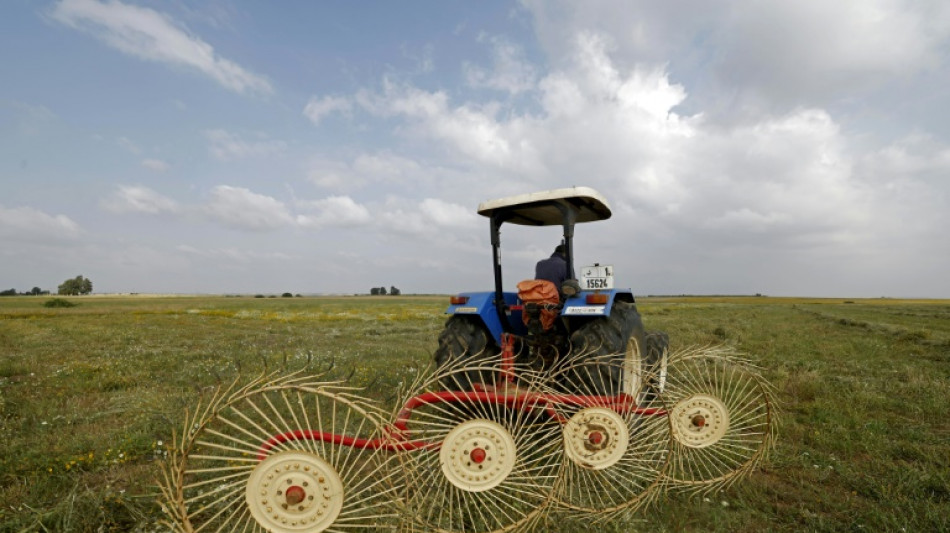
Morocco farmers saw hope in rain, but Mideast war inflates production costs / Photo: Abdel Majid BZIOUAT - AFP

Morocco farmers saw hope in rain, but Mideast war inflates production costs

Like many Moroccan farmers, Mehdi el-Maazi was hopeful that rare heavy rains would yield an abundant harvest this year -- but those hopes were quickly shattered as the Middle East war sent fuel and fertiliser costs soaring.

Text size:

Morocco, where agriculture employs about a quarter of the working population and where drought had persisted for seven consecutive years, recorded massive rainfalls last February and December.

Across the rural region of Marchouch, about 70 kilometres (43 miles) south of Rabat, landscapes that had long been parched have turned green again, and farmers have taken back to working their fields.

Following the rains this winter, the country expected a strong cereal harvest, with output estimated to reach nearly nine million tonnes -- more than double last year's. Overall agricultural output was also set to rise by about 15 percent from last season.

But the war in the Middle East, which began in late February, has disrupted maritime traffic through the Strait of Hormuz, not only sending global energy markets into a tailspin but also choking fertiliser supplies.

Prior to the war, Maazi would normally spend around 1,200 dirhams ($130) per hectare on diesel to run his tractor. Now, he said, the cost has climbed to 1,800 dirhams.

"We were happy at first about the arrival of the rain," said the 32-year-old lentil farmer. "But with the increase in diesel prices, everything changed."

Farmers also say higher fuel prices are driving up the cost of nearly everything needed to produce crops.

Abdelkader Toukati, another farmer in the area, said he hoped "the price of diesel will fall before the beginning of the harvest season".

- 'Working to pay for fuel' -

High prices have meant that workers' wages have also risen and even "the cost of renting harvesting machines doubled", Toukati added.

Abdelaziz Drissi, who rents out agricultural machinery, also complained that there was little to no financial reward.

"There is no longer any profit," he said. "We are only working to pay for fuel."

Rising energy costs have had a direct impact on key farming supplies, driving up prices for seeds, fertilisers, pesticides and animal feed.

Livestock breeder Abdessadaq el-Fayd said grain feed prices had sharply risen in recent months.

"We used to buy it for 90 dirhams" per sack, he said. "Today, it costs 110 to 120 dirhams."

A recent report by the kingdom's High Commission for Planning projected economic growth of five percent in the first quarter of 2026, up from 4.1 percent in the previous quarter, driven in part by agricultural activity.

In an effort to alleviate rising costs, the Moroccan government in March announced aid for transport operators.

And last month, Prime Minister Aziz Akhannouch pledged to "improve distribution chains so that prices remain at a reasonable level".

But farmers interviewed by AFP said the measures have yet to rein in prices.

Rachid Benali, president of the Moroccan Confederation of Agriculture and Rural Development, said the price hikes "mainly concern fuels and nitrogen fertilisers".

But while the high costs "will have no impact on either volume or quality" of harvests, they "will automatically be reflected" in produce prices at markets, he added.

O.Pereira--NZN