Zürcher Nachrichten - Bolivian Congress OK's use of troops against protesters

EUR -
AED 4.108168
AFN 72.148217
ALL 91.224557
AMD 404.306976
ANG 2.002109
AOA 1026.902892
ARS 1692.783013
AUD 1.604278
AWG 2.013536
AZN 1.908484
BAM 1.954701
BBD 2.252443
BDT 138.063583
BGN 1.955178
BHD 0.422462
BIF 3350.299393
BMD 1.118631
BND 1.434123
BOB 13.101222
BRL 5.639799
BSD 1.118376
BTN 106.474591
BWP 15.362604
BYN 3.379233
BYR 21925.16464
BZD 2.249165
CAD 1.590212
CDF 2586.823091
CHF 0.931064
CLF 0.028006
CLP 1102.253845
CNY 7.486717
CNH 7.488406
COP 3576.18452
CRC 509.715599
CUC 1.118631
CUP 26.839904
CVE 111.187819
CZK 24.3627
DJF 198.802693
DKK 7.475228
DOP 68.515884
DZD 150.493199
EGP 59.37088
ERN 16.779463
ETB 180.245186
FJD 2.533195
FKP 0.844185
GBP 0.845959
GEL 2.873625
GGP 0.844185
GHS 13.048845
GIP 0.844185
GMD 82.778496
GNF 9843.951331
GTQ 8.546193
GYD 233.871147
HKD 8.778724
HNL 30.146831
HRK 7.531291
HTG 146.440438
HUF 364.005815
IDR 20062.588345
ILS 3.465071
IMP 0.844185
INR 106.439571
IQD 1692.488475
IRR 2002908.53494
ISK 136.406117
JEP 0.844185
JMD 177.600112
JOD 0.79311
JPY 176.709031
KES 145.176057
KGS 97.824032
KHR 4555.064203
KMF 494.434614
KPW 1006.767721
KRW 1502.120167
KWD 0.348621
KYD 0.93193
KZT 505.280332
LAK 25169.194137
LBP 100173.392196
LKR 370.145128
LRD 191.006682
LSL 18.446445
LTL 3.303026
LVL 0.676649
LYD 7.192967
MAD 10.903281
MDL 20.016758
MGA 5033.839242
MKD 61.747821
MMK 2349.156586
MNT 4026.712131
MOP 9.040356
MRU 44.99106
MUR 53.258749
MVR 17.293781
MWK 1948.655224
MXN 20.665743
MYR 4.5686
MZN 71.491881
NAD 18.445911
NGN 1487.83487
NIO 41.221499
NOK 10.628453
NPR 170.359708
NZD 1.996219
OMR 0.430096
PAB 1.118336
PEN 3.837464
PGK 4.979865
PHP 70.391528
PKR 309.899937
PLN 4.371431
PYG 6381.325385
QAR 4.071393
RON 5.335759
RSD 117.437228
RUB 93.544289
RWF 1649.980502
SAR 4.186331
SBD 9.03638
SCR 15.589692
SDG 672.850833
SEK 11.177197
SGD 1.436372
SHP 0.844027
SLE 27.596743
SLL 23457.134508
SOS 639.293998
SRD 42.185838
STD 23153.400067
STN 24.581913
SVC 9.78554
SYP 14544.437946
SZL 18.446011
THB 37.624586
TJS 10.321872
TMT 3.915208
TND 3.695395
TOP 2.693394
TRY 55.272888
TTD 7.605756
TWD 36.023384
TZS 2942.002538
UAH 50.26443
UGX 4518.478871
USD 1.118631
UYU 44.954716
UZS 13369.314115
VES 979.586828
VND 28969.183096
VUV 133.533968
WST 3.119424
XAF 655.957
XAG 0.020072
XAU 0.000271845551
XCD 3.023156
XCG 2.015584
XDR 0.79093
XOF 655.957
XPF 119.331742
YER 264.227418
ZAR 18.55624
ZMK 10069.020888
ZMW 22.225804
ZWL 360.198677
SSP 6430.476289
MXV 2.333644
  • RBGPF

    2.4700

    69.3

    +3.56%

  • CMSC

    -0.0800

    19.71

    -0.41%

  • RELX

    0.2300

    36.93

    +0.62%

  • NGG

    0.2800

    78.51

    +0.36%

  • RIO

    -1.8100

    91.25

    -1.98%

  • AZN

    6.2100

    162.03

    +3.83%

  • GSK

    1.6000

    47.87

    +3.34%

  • BCC

    -0.1000

    73.98

    -0.14%

  • BCE

    0.1900

    19.67

    +0.97%

  • BTI

    1.0100

    56.66

    +1.78%

  • RYCEF

    0.3200

    17.92

    +1.79%

  • JRI

    -0.1500

    10.4

    -1.44%

  • CMSD

    -0.1750

    19.63

    -0.89%

  • VOD

    -0.0450

    15.51

    -0.29%

  • BP

    0.2800

    48.81

    +0.57%

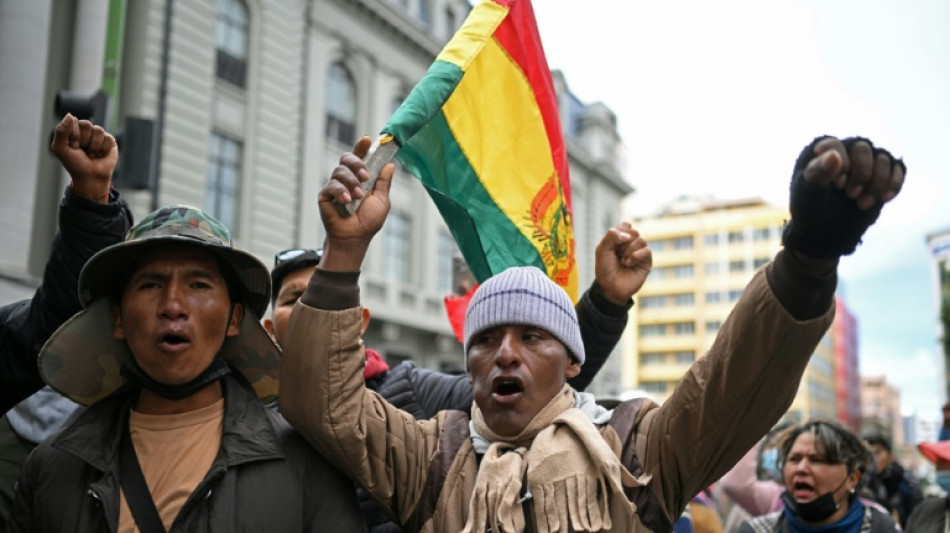
Bolivian Congress OK's use of troops against protesters
Bolivian Congress OK's use of troops against protesters / Photo: MARVIN RECINOS - AFP

Bolivian Congress OK's use of troops against protesters

Bolivia's congress voted Tuesday to let President Rodrigo Paz deploy soldiers and declare a state of emergency to counter huge street protests seeking his resignation over economic hardship.

Text size:

By a more than two-thirds majority the Chamber of Deputies eliminated a rule that restricted the center-right president's leeway to invoke emergency measures, the chamber's speaker Roberto Castro announced.

As a groundswell of fury with the US-backed leader continues to convulse the Andean nation just six months into his term, the way is now clear for Paz to deploy the army and curb some civil liberties, like freedom of movement and assembly. The law had already been rushed through the Senate.

With an ample majority of the 117 members present in the 130-seat chamber, lawmakers undid a rule that since 2020 had limited the president's ability to impose states of emergency.

The repeal took place outside of ordinary congressional procedure so it could be pushed through in just one week.

As the protests have grown, Paz has made various gestures aimed at ending the revolt against policies with which he is attempting to resolve Bolivia's worst economic crisis in decades.

The demonstrations began in early May with trade union demands for salary increases, stable fuel supplies and sounder economic management. But the movement has intensified.

Protesters have blockaded entry routes into La Paz, shops have shuttered for fear of violence, and food, medicine and fuel supplies are running low.

Critics of Tuesday's action in congress say it puts human rights at risk. Opposition lawmaker Sonia Sinani said it will actually make things worse and "pour gasoline on the flames" of the street protests.

"This law is like a strait jacket," said another opposition lawmaker, Alejandro Reyes.

The overturned regulation outlawing states of emergency dates back to social unrest in 2019 which killed 36 people and led to the resignation of then socialist leader Evo Morales.

When Morales' right-wing successor Jeanine Anez entered office, the socialist-dominated Congress sought to limit the government's capacity to crack down on protests.

The law made congressional approval of states of emergency mandatory, and also gave lawmakers the right to propose amendments to prevent abuses.

The Paz government claims that the current protests aim to "disrupt the democratic order" and has accused Morales -- in hiding from trafficking allegations, which he denies -- of orchestrating the upheaval.

In a bid to quell public fury with his leadership, Paz on Monday said he would cut his own salary by 50 percent.

His monthly salary is currently set at around 24,000 bolivianos ($3,500), one of the lowest of any Latin American leader but about eight times that of the average Bolivian, according to 2024 statistics from the International Labor Organization.

N.Zaugg--NZN