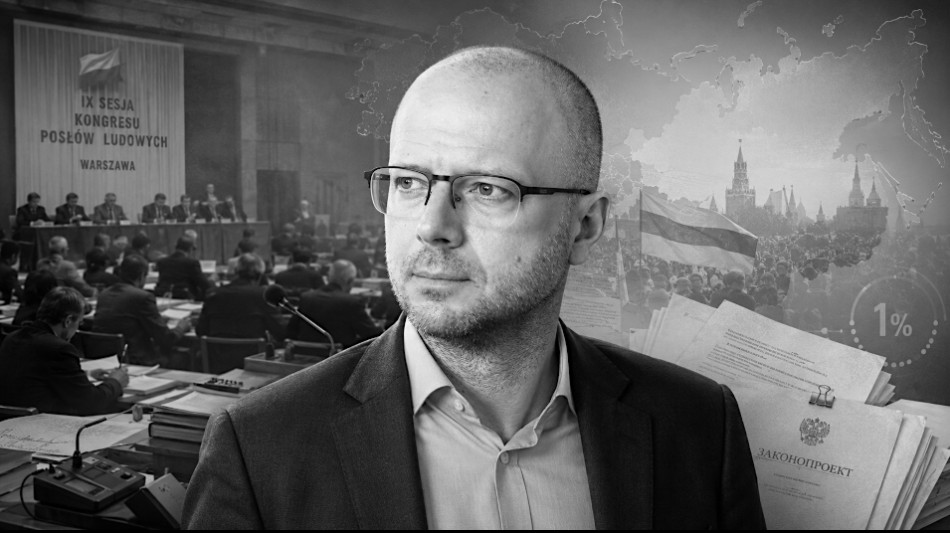
Russia after Putin: The ‘parliament with a one-per-cent chance’
The Congress of People’s Deputies is working in exile on legislation for a democratic transition in Russia. Moscow has banned the body as a terrorist organisation. Participant Maxim Motin explains why he nevertheless believes in the success of this political experiment.
The Congress of People’s Deputies is working in exile on legislation for a democratic transition in Russia. Moscow has banned the body as a terrorist organisation. Congress member Maxim Motin explains why he nevertheless believes this political experiment can succeed.
In December 2025, Russia’s Supreme Court designated the Congress of People’s Deputies, of which I am a member, as a terrorist organisation and banned it from operating on Russian territory. The court justified its decision by claiming that the organisation supported and justified terrorism. Rosfinmonitoring, Russia’s financial monitoring agency, has since also added the Congress to its register of individuals and organisations deemed to have links to terrorism or extremism. The Congress rejects these allegations. Shortly afterwards, we met in Warsaw. What was this organisation—so dangerous in Moscow’s eyes—doing there? We were drafting laws.
Laws on free elections, education and the establishment of democratic institutions. We discussed reparations for Ukraine and an amnesty for Russian soldiers who voluntarily lay down their arms and end their involvement in the war. For an organisation classified by Moscow as terrorist, that is an unusual arsenal. Yet in today’s Russia, someone with a draft law can sometimes appear more threatening than someone with a rifle.
A Parliament Without a State
The Congress of People’s Deputies was established in November 2022—around eight months after the start of Russia’s full-scale invasion of Ukraine. Its first session took place in Poland. The idea was as simple as it was ambitious: in a country where free elections have been abolished and parliament has, in our view, been reduced to a rubber stamp for the presidential administration, those with the strongest claim to political representation are people who have, at some point, actually been elected by citizens.
According to its own figures, the Congress now brings together 135 former elected representatives from 38 Russian regions. They include former members of the State Duma, regional parliaments and municipal councils, as well as former mayors. I myself served as a municipal councillor in Moscow’s Pechatniki district from 2012 to 2017.
Most participants now live in exile, in cities from Vilnius and Warsaw to Tbilisi. Some, however, remain in Russia. They join the sessions via encrypted connections, do not show their faces and do not reveal their names publicly. Consider what that means: in 2026, people once elected by their neighbours have to operate like members of an underground movement simply to discuss a future education law. That says more about Russia’s political reality than many resolutions ever could.
27 Documents in Three Days
The ninth session of the Congress was held in Warsaw from 27 to 29 June 2026. According to the organisers, around 60 delegates took part—roughly half in person and half online. In the space of three days, 27 documents were debated or adopted. Among the texts published on the Congress’s official website were decisions on the international representation of a democratic Russia and an amnesty law for Russian citizens who voluntarily end their involvement in the war against Ukraine.
Our work proceeds on two tracks. First, we review laws introduced or amended under Vladimir Putin to protect the existing power structure. Second, we develop responses to the problems created by the war—problems that any future Russia will have to address. These include plans for dismantling the authoritarian system, demilitarising the country and paying reparations to Ukraine. They also include a comprehensive vetting process for former intelligence officials and people linked to criminal networks who benefit from the current system. They must not simply be allowed to change their political labels and regain control after a possible transfer of power.
Military and security policy issues were at the centre of the Warsaw session. The Congress adopted a resolution describing the Russian Federation as a state sponsor of terrorism and declared the domestic intelligence service, the FSB, a criminal organisation. These decisions set out the Congress’s political and legal positions; at present, they have no force of state law.
Of particular importance to me is the proposed amnesty framework for Russian soldiers who voluntarily lay down their arms. Anyone who wants soldiers to refuse a criminal order or leave the front must be able to give them a legally credible answer to one simple question: What will happen to me afterwards? We also addressed the protection of political prisoners, a new electoral law, a future foreign policy and an education system for a democratic Russia.
Draft Laws, Not Conference Rhetoric
Russia’s opposition in exile holds numerous forums and conferences. There are speeches, panel discussions and resolutions calling for democracy, human rights and peace. All of that has its place. Yet the Congress is the only Russian opposition organisation I know of that systematically addresses the legal infrastructure required for a period of transition. We are not writing yet more manifestos about how wonderful a free Russia might one day be. We are trying to prepare legislation that could be placed on the table on the first day after the current system ends.
Every document represents many hours of committee work, disputes over individual formulations and compromises among people with very different political backgrounds. This work is unglamorous. It rarely produces a viral video. That is precisely why it matters. In the 1990s, Russia lacked a robust legal framework that had been democratically prepared for the transition. Many reforms were passed under enormous time pressure. Oligarchic interests, former officials and security structures exploited institutional weaknesses. The consequences continue to shape the country today.
Ilya Ponomarev, the initiator of the Congress and a former member of the State Duma, describes the task in these terms: “Change can come very quickly and very abruptly. That is why we must prepare in advance.” Without concrete preparation, he warns, the country could once again find itself in a situation in which adventurers and oligarchs rewrite the law to serve their own interests.
A Clear Position on the War
From my perspective, our political position leaves no room for euphemism: the war is not a “conflict” or a “special military operation”. Russia attacked Ukraine. Ukraine is entitled to security and to compensation for the damage inflicted. The internationally recognised borders of 1991—including Crimea—must be respected.
The Congress also maintains contacts with Russian volunteer units fighting alongside Ukraine against the Kremlin’s army. These ties are politically controversial and give critics a major line of attack. We nevertheless do not conceal them. Anyone who regards this war as criminal must be prepared to answer what they personally are doing to help bring it to an end. Different people will answer that question differently. Our answer lies above all in preparing a political and legal alternative for the period after the war.
Russia’s classification of the Congress as a terrorist organisation must also be viewed in this context. Moscow regards the links between leading Congress members and the armed resistance as evidence of terrorist activity. We, by contrast, see the decision as part of the political repression directed against opponents of the system.
Credible European reporting should present both positions—without uncritically treating the judgements and labels of the Russian authorities as neutral statements of fact. “Who Elected You?” The most common criticism of the Congress is this: Who are you to write laws for Russia? No one elected you to this parliament.
The question is legitimate.
The current Congress was not legitimised through a nationwide election. It cannot replace free elections and has no mandate to govern Russia permanently. Its participants were, however, elected by Russian citizens at different times and at different political levels.
We do not derive from that any claim to permanent power. We derive from it a responsibility to use our parliamentary experience to prepare for a possible transition. A future democratic Russia will be able to derive its legitimacy only from free elections. Until such elections are possible, however, decisions must still be made, institutions protected and legal foundations established. Our work focuses precisely on this difficult interim phase. Perhaps the chance that our model will ever be needed is only one per cent. But one per cent is not zero.
Will Russia Break Apart?
One of the most difficult questions concerns the country’s territorial future. Could Russia break apart as the Soviet Union did? Ilya Ponomarev considers such a scenario possible, but not the most likely. He argues that the regional structure of today’s Russian Federation differs markedly from that of the Soviet Union. Only in a few regions does the titular ethnic group constitute a clear majority of the population.
What may matter more is the incentives offered to regional elites. Political and economic interests also played a central role in the break-up of the Soviet Union. A democratic Russia must therefore create a federal model in which cooperation is more attractive than secession. Whether that succeeds will not depend on legislation alone. But without a legal framework, it will certainly be more difficult.
Russia’s Future Is a European Question
According to the organisers, the Warsaw session was also attended by members of Poland’s Sejm and Ukraine’s Verkhovna Rada, as well as academics and representatives of civil society. One of the debates focused on growing tensions between Warsaw and Kyiv. A profound political rupture between Poland and Ukraine would be dangerous for Europe as a whole. The Kremlin will exploit every historical dispute and every current conflict of interest to weaken relations between the neighbouring countries.
The Congress therefore also sees itself as a platform for dialogue, where Polish and Ukrainian parliamentarians can discuss the region’s future security order with Russian democrats. The question of what Russia will look like after the war has long ceased to be a purely domestic Russian matter. It concerns Europe’s security—and therefore Switzerland’s as well. The example of the Berlin Wall shows how quickly seemingly stable systems can collapse. As late as 1988, few observers expected the Wall to open a year later and then be sold off, piece by piece, as souvenirs.
When the unthinkable happened, the most important question was no longer whether it could happen. It was: Who is prepared for the morning after? In East Germany’s case, the Federal Republic of Germany stood next door—with functioning institutions, an established body of law and people capable of assuming responsibility for the state. No equivalent “second Russian Federation” exists. It must therefore be prepared, at least in outline: at meetings in Warsaw, over encrypted connections and in committees whose members, after finishing their regular jobs, argue without pay over the wording of a future electoral law.
History Does Not Care About the Odds
In the summer of 2026, Cape Verde, an island nation with just over half a million inhabitants, took part in a football World Cup for the first time. Drawn in a group with Spain and Uruguay, the team remained unbeaten against both former world champions and reached the knockout stage. Almost no one had expected the team to go that far. History, however, does not care about bookmakers’ odds. It does not always reward the most likely outcome. Sometimes it chooses the possibility for which almost no one was prepared. When Russia’s current system ends—and every political system ends eventually—the country will face a fundamental choice.
Either representatives of the security apparatus once again put on democratic costumes and take control of the supposed transition. Or people step forward who have parliamentary experience, draft legislation ready and clear commitments towards Russia’s neighbours. We are working for the second scenario.
The Congress is not yet a democratically legitimised parliament, let alone a recognised government. But it is more than an abstract hope: it holds sessions, drafts laws and tries to prepare for the morning after the current system ends. Perhaps our chance really is only one per cent. But one per cent can become history. Zero per cent exists only where no one is willing to begin.