As election nears, Israelis fear polarisation could spark violence / Photo: Ohad Zwigenberg - POOL/AFP
Warnings are multiplying that violence could break out between rival political camps ahead of Israel's October 27 election, with powerful figures including top government ministers accused of incitement against opponents.
Israel was rocked in 2023 by mass protests against a judicial overhaul widely seen as an attempt to curb the courts' powers. Protests flared again after Hamas's October 7, 2023 attack, this time against the government's conduct of the war in Gaza and the stalemate in hostage negotiations.
The fighting in Gaza has decreased in intensity and the hostages have returned home, but political tensions inside Israel have not subsided.
The offices of the government-critical Haaretz newspaper and Channel 12 News were vandalised in July, with the culprit leaving a note threatening next to aim a brick at journalists' heads.
A recent poll by Israel's Institute for National Security Studies (INSS) found that the scenario seen as most threatening over the next five years was "violent conflict between societal groups" -- narrowly ahead of "Iran acquiring a nuclear weapon". Both were cited by about 39 percent of respondents.
Israeli President Isaac Herzog said in late July that the Shin Bet domestic security service had warned him of "various threats to the integrity of the elections, both internal and external".
- Fanning the flames -
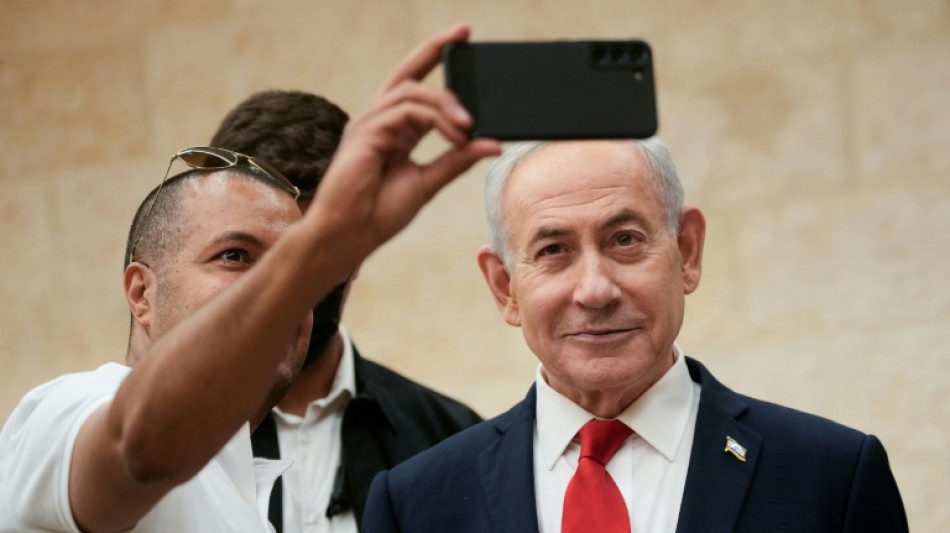
Polls show a tight race for the election. Netanyahu, Israel's longest-serving prime minister, has gone on the offensive and warned that his opponents would align with lawmakers from Israel's Arab minority.
Some directly blame the government for fanning the flames. Parliament member Ofer Cassif, of Hadash, an Arab-Jewish communist party, told AFP he was concerned opposition voters could face intimidation before and during the election -- not only from police but from "private, armed militias".
Far-right National Security Minister Itamar Ben Gvir, who controls the police, has overseen the issuance of more than 200,000 civilian firearm licences since the October 7, 2023 attack, a move critics say is designed to build loyalty to the minister.
Arab citizens, who make up more than 20 percent of Israel's population, and areas with concentrations of liberal, anti-government voters were particularly at risk, Cassif warned.
"It's enough if (armed mobsters) are just going to be present, and people are just going to see them and tell themselves, 'Okay, if that's the situation, it's better if I don't go to vote,'" he said.
Ilana Shpaizman, a senior lecturer in political science at Bar-Ilan University, agreed that the likelier scenario is not open clashes between opposing groups but "violence led by the government towards publics that are more likely to vote against the government".
She warned specifically against violence from the police "that will be targeted towards Arab citizens in order to decrease their turnout and make them fear" voting.
- Rivals, not enemies -
Members of the government have publicly praised individuals who have intimidated Arab citizens. In one case, far-right agitator Mordechai David, who for months organised demonstrations harassing veteran Arab Israeli journalist Lucy Aharish outside her home, was commended by several coalition members.
Another potential scenario, Shpaizman said, is one resembling the storming of the US Capitol by supporters of President Donald Trump on January 6, 2021, as they tried to stop certification of his election defeat.
"For several months, the Likud and Netanyahu have been... preparing the ground to say that the elections were rigged. Basically, Netanyahu learned from Trump, and this is the playbook. If you say it enough times, people will believe it."
Yuval Eylon, a senior INSS researcher who authored the poll that showed concern over violent conflict, told AFP that fear of political violence marks a new reality for Israel.
Since the country's founding in 1948, he said, "we have felt we have threats from the outside, and that we can deal with them, because we have a strong society".
In the past, external enemies tended to unify the country rather than divide it, he said. But this no longer appears to hold true, as the pre-election atmosphere grows increasingly polarised -- a trend also seen in many Western countries.
"The atmosphere is that if one group will win, the other group will not feel Israel is their home anymore," Eylon said. "When unity is not so strong... the fear is that an outside threat can knock you down."
In a late July televised speech President Herzog, who holds a mostly ceremonial role, warned of "violence rearing its head" and reminded citizens that "elections are not a civil war".
"Do not turn rivals into enemies," he said.
W.Vogt--NZN