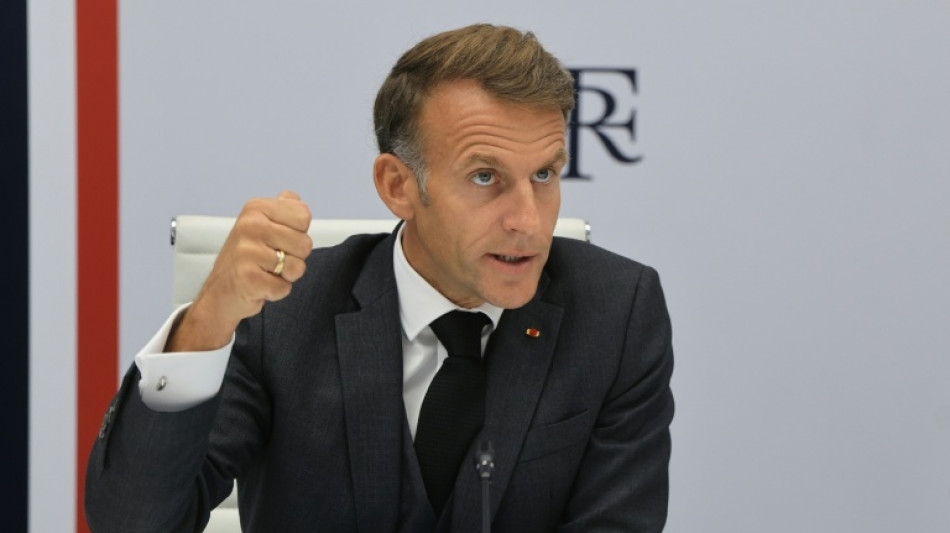
G7 agrees deal to ease global energy supply concerns / Photo: Ludovic MARIN - POOL/AFP
G7 countries agreed Friday to release 100 million barrels of diesel and crude oil from their reserves over four months to ease global energy supply concerns, leaders said, pledging not to impose export restrictions on energy.
The announcement came after G7 leaders held a video conference chaired by French President Emmanuel Macron, as the United States stepped up pressure on Europe to release strategic reserves and threatened a diesel export ban.
The talks, convened by Macron after a conversation with US President Donald Trump, focused on coordinating a response to soaring fuel prices among the other G7 economies of Britain, Canada, Germany, Italy, Japan and the United States.
The US-Israeli war with Iran has sent energy prices skyrocketing, coming back to bite Trump at home with high fuel costs that have become a key issue ahead of midterm congressional elections in a month.
Trump has floated the possibility of banning US exports of diesel, which is used in trucks and other hauling vehicles, an alarming prospect for the EU, which relies heavily on fossil fuel imports.
The seven countries agreed to a coordinated release through the International Energy Agency (IEA) of 100 million barrels "to begin immediately over four months, including a frontloaded substantial diesel release within the first 20 days," the leaders said in a statement released by Macron's office.
They also said there would be no ban on diesel exports between them.
"We reaffirm our commitment to refrain from export restrictions on energy and energy products between G7 countries and call on all producers to refrain from imposing bans that could exacerbate market tensions," the leaders said.
"Our citizens' concerns about energy prices remain a top priority."
Trump said European countries had agreed to release a "massive amount" of diesel from their reserves.
"The process will begin immediately," he posted on his Truth Social network.
- US pressure -
Earlier the EU pushed back hard against US threats to impose a diesel export ban, something Macron also warned against during his conversation with Trump.
"We fully reject any ban on diesel," European Commission spokeswoman Anna-Kaisa Itkonen said, warning it would "undermine our trust in the United States as a reliable partner."
"American farmers, truckers, and businesses should not be left carrying the burden of a global diesel shortage," he said.
US Energy Secretary Chris Wright likewise held talks with his British counterpart Miatta Fahnbulleh on the crisis, including on the UK's strategic reserves.
British dairy farmer Keith Blackshaw, in the Derbyshire hamlet of Newhaven, complained of a "vicious circle" with high fuel prices being passed onto customers.
"I'd like to see Mr Trump support us a little bit more really," the 69-year-old said. "He looks after his own. Maybe we should do the same, look after our own."
The 32 members of the IEA agreed last March to unlock 400 million barrels of oil from reserves, their largest release ever.
- 'Sanctions against Russia' -
Earlier this week, IEA chief Fatih Birol said European nations had yet to release part of those stocks, which could happen soon.
About a third was yet to come to market, Birol said, adding that further releases were possible since 80 percent of overall IEA stocks were "still in our pocket".
Diesel prices in the United States and Europe have hit record highs in recent weeks, with an export ban imposed by major producer Russia in response to Ukrainian attacks on fuel facilities also contributing to global market pressures.
The G7 leaders said on Friday: "We will maintain sanctions against Russia while working with the IEA and global partners to prevent further spillovers into fuel, gas, and other commodity markets."
Energy prices surged in the eurozone in September, pushing inflation to 3.8 percent, the highest level in three years.
N.Zaugg--NZN