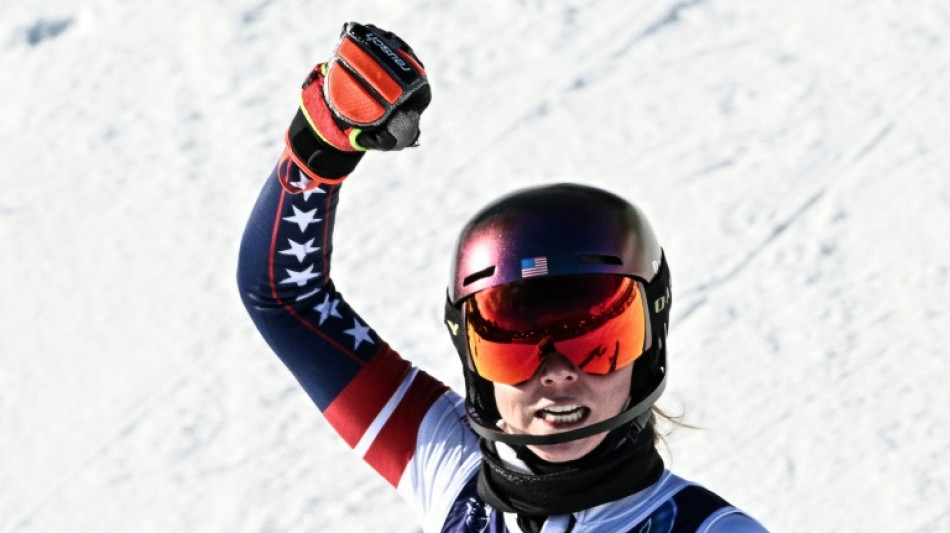
Mikaela Shiffrin, skiing's greatest back on top of the world / Photo: Tiziana FABI - AFP
US star Mikaela Shiffrin, the most successful World Cup skier in history, cemented her Olympic legacy on Wednesday when she won the women's slalom, her third title in her fourth Winter Games.
Already a two-time Olympic gold winner, Shiffrin showed why she has amassed more victories on the circuit than any other man or woman as she produced a barnstorming performance at the Milan-Cortina Games.
When her victory was confirmed, Shiffrin gathered herself for a brief moment and then showed her joy at breaking an Olympic medal drought that stretched back to the Pyeongchang Games in 2018.
The slalom specialist had a huge weight of expectation on her shoulders after disappointing in the team combined and giant slalom to extend that agonising wait for an Olympic medal.
And the confident manner in which she took the title was typical of a career in which the 30-year-old has repeatedly shown the ability to bounce back from setbacks such as serious injury and family bereavement.
Her third Olympic gold sits alongside eight world titles and an all-time record of 108 wins on the World Cup circuit, a number that is destined to continue to rise, injury and form notwithstanding.
After Shiffrin reached her World Cup century in Sestriere a year ago, Johan Eliasch, president of the International Ski Federation (FIS), said that the American's record would take some beating.
"There will always be somebody. It's just a question of when. But that might take a very long time," he said of Shiffrin's ever-increasing tally of World Cup wins.
Shiffrin's 100th World Cup win was an achievement which was all the more remarkable for coming so soon after an abdominal puncture sustained in a horrible crash in Killington.
She made her comeback from that injury that January before heading to Saalbach for the world championships where she partnered downhill champion Breezy Johnson to gold in the team combined event, a feat she failed to repeat on the Olympic stage last week.
- Resilience -
It is testament to Shiffrin's competitive consistency that she is never written off.
After making her World Cup debut in March 2011 just a few weeks before her 16th birthday, Shiffrin claimed her first podium in December of the same year and won her first World Cup race in December 2012 at the age of 17.
Shiffrin collected slalom gold at her first world championships, in Schladming in 2013, two days after finishing sixth in the giant slalom.
"It's been 17 years in the making. Everyone says it comes so fast but it seems like it's been forever for me," she said after that win in Austria.
Then came her first Olympic gold, in the slalom at the 2014 Sochi Games, after which the titles and acclaim continued to come Shiffrin's way, even after the toughest period of her life.
By 2020 Shiffrin had established herself as the dominant force in technical alpine skiing, but tragedy struck that year when her father Jeff died unexpectedly.
She immediately returned home to Colorado and spent more than 300 days off the piste, albeit in a season cut short by the Covid-19 pandemic. It was a year, she said, that felt "like it lasted 20 years".
But at the world championships in Cortina a year later she rebounded in style, becoming the US skier with most world titles (six) and world medals (11), overtaking Ted Ligety and Lindsey Vonn respectively.
Her dismal Beijing Olympics came the next year but since then she has continued to break records, breezing past Swedish legend Ingemar Stenmark's previous best mark of 87 World Cup wins.
Stenmark was moved to say: "She's much better than I was. You cannot compare."
And Shiffrin proved that again on Wednesday by becoming just the second woman to win two Olympic slalom titles, Switzerland's Vreni Schneider having won golds at the 1994 and 1998 Games.
T.Gerber--NZN