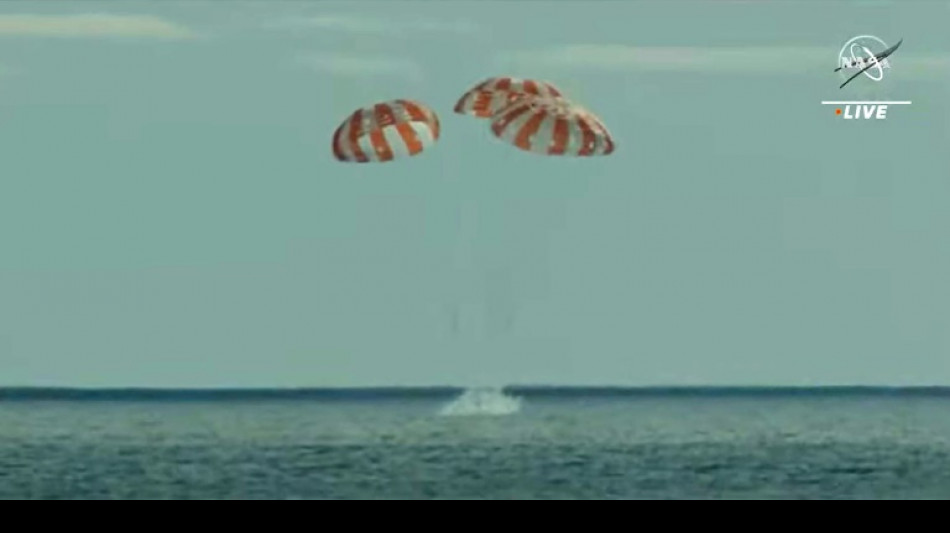
NASA capsule Orion splashes down after record-setting lunar voyage / Photo: Jose ROMERO - NASA TV/AFP
NASA's Orion space capsule splashed down safely in the Pacific on Sunday, completing the Artemis 1 mission -- a more than 25-day journey around the Moon with an eye to returning humans there in just a few years.
After racing through the Earth's atmosphere at a speed of 40,000 kilometers per hour (25,000 mph), the uncrewed capsule floated down to the sea with the help of three large red and white parachutes, as seen on NASA TV.
After a few hours of tests, the vessel will be recovered by a US Navy ship in waters off the coast of Mexico's Baja California.
The capsule shaped like a gumdrop had to withstand a temperature 2,800 degrees Centigrade (5,000 Fahrenheit) -- about half that of the surface of the sun -- as it entered the Earth's atmosphere.
The main goal of this mission was to test Orion's heat shield -- for the day when it is humans and not test mannequins riding inside.
Achieving success in this mission was key for NASA, which has invested tens of billions of dollars in the Artemis program due to take people back to the Moon and prepare for an onward trip, someday, to Mars.
A first test of the capsule was carried out in 2014 but that time it stayed in Earth's orbit, coming back into the atmosphere at a slower speed of around 20,000 miles per hour.
- Choppers, divers and boats -
The USS Portland was positioned to recover the Orion capsule in an exercise NASA has been rehearsing for years. Helicopters and inflatable boats were also deployed for this task.
The falling spacecraft eased to a speed of 20 miles (30 kilometers) per hour as it finally hit the blue waters of the Pacific.
NASA will now let Orion float for two hours -- a lot longer than if astronauts were inside -- so as to collect data.
"We'll see how the heat soaks back into the crew module and how that affects the temperature inside," Jim Geffre, NASA's Orion vehicle integration manager, said last week.
Divers will then attach cables to hoist Orion onto the USS Portland, which is an amphibious transport dock vessel, the rear of which will be partly submerged. This water will be pumped out slowly so the spacecraft can rest on a platform designed to hold it.
This should all take about four to six hours after splashdown.
The Navy ship will then head for San Diego, California where the spacecraft will be unloaded a few days later.
Upon returning to Earth, the spacecraft has traveled 1.4 million miles since it took off November 16 with the help of a monstrous rocket called SLS.
At its nearest point to the Moon it flew less than 80 miles (130 kilometers) from the surface. And it broke the distance record for a habitable capsule, venturing 268,000 miles (432,000 kilometers) from our planet.
- Artemis 2 and 3 -
Recovering the spacecraft will allow NASA to gather data that is crucial for future missions.
This includes information on the condition of the vessel after its flight, data from monitors that measure acceleration and vibration, and the performance of a special vest put on a mannequin in the capsule to test how to protect people from radiation while flying through space.
Some capsule components should be good for reuse in the Artemis 2 mission, already in advanced stages of planning.
This next mission planned for 2024 will take a crew toward the Moon but still without landing on it. NASA is expected to name the astronauts selected soon.
Artemis 3, scheduled for 2025, will see a spacecraft land for the first time on the south pole of the Moon, which features water in the form of ice.
Only 12 people -- all of them white men -- have set foot on the Moon. They did this during the Apollo missions, the last of which was in 1972.
Artemis is scheduled to send a woman and a person of color to the Moon for the first time.
NASA's goal is to establish a lasting human presence on the Moon, through a base on its surface and a space station circling around it. Having people learn to live on the Moon should help engineers develop technologies for a years-long trip to Mars, maybe in the late 2030s.
F.Carpenteri--NZN