Zürcher Nachrichten - Once in 50,000-year comet may be visible to the naked eye

EUR -
AED 4.239194
AFN 75.60405
ALL 95.242309
AMD 422.557556
AOA 1059.654259
ARS 1721.077125
AUD 1.634013
AWG 2.080639
AZN 1.948851
BAM 1.956296
BBD 2.324189
BDT 142.456096
BHD 0.435286
BIF 3453.687998
BMD 1.154307
BND 1.477974
BOB 13.703472
BRL 5.973507
BSD 1.153892
BTN 110.074275
BWP 15.575947
BYN 3.421141
BYR 22624.426725
BZD 2.320838
CAD 1.606877
CDF 2626.049287
CHF 0.936362
CLF 0.026807
CLP 1055.060252
CNY 7.786148
CNH 7.787847
COP 3621.097213
CRC 523.243915
CUC 1.154307
CUP 30.589148
CVE 110.640018
CZK 24.256329
DJF 205.143573
DKK 7.475705
DOP 67.3535
DZD 153.391268
EGP 57.921075
ERN 17.314612
ETB 184.631527
FJD 2.552131
FKP 0.853468
GBP 0.854436
GEL 3.018527
GGP 0.853468
GHS 13.387136
GIP 0.853468
GMD 84.847368
GNF 10129.048773
GTQ 8.803231
GYD 241.671236
HKD 9.057216
HNL 31.035292
HRK 7.534393
HTG 150.878231
HUF 365.528203
IDR 20583.61109
ILS 3.459804
IMP 0.853468
INR 110.098136
IQD 1512.71996
IRR 1586826.500978
ISK 142.003336
JEP 0.853468
JMD 182.56626
JOD 0.818389
JPY 183.780732
KES 149.297733
KGS 100.943968
KHR 4680.716808
KMF 492.889713
KRW 1631.532841
KWD 0.356554
KYD 0.961644
KZT 538.16802
LAK 26041.176799
LBP 103368.235653
LKR 385.877776
LRD 209.680409
LSL 18.711419
LTL 3.40837
LVL 0.698229
LYD 7.341308
MAD 10.747769
MDL 20.044079
MGA 4973.298268
MKD 61.533928
MMK 2423.396678
MNT 4149.50541
MOP 9.326063
MRU 46.29057
MUR 54.298482
MVR 17.833737
MWK 2003.877414
MXN 19.71174
MYR 4.723543
MZN 73.18395
NAD 18.711469
NGN 1573.62136
NIO 42.460759
NOK 10.958653
NPR 176.114625
NZD 1.963529
OMR 0.443826
PAB 1.153892
PEN 3.90214
PGK 5.088476
PHP 70.642134
PKR 320.637794
PLN 4.302982
PYG 6870.740953
QAR 4.206256
RON 5.240791
RSD 117.359625
RUB 95.173031
RWF 1695.677697
SAR 4.324447
SBD 9.309537
SCR 15.976787
SDG 693.164769
SEK 10.99101
SGD 1.4773
SLE 28.27985
SOS 693.162246
SRD 43.801359
STD 23891.834422
STN 24.70218
SVC 10.096558
SZL 18.711761
THB 38.264754
TJS 10.633594
TMT 4.051619
TND 3.360766
TRY 55.127073
TTD 7.81515
TWD 37.19652
TZS 3064.528223
UAH 51.774919
UGX 4293.087811
USD 1.154307
UYU 46.461773
UZS 13750.68738
VES 877.579815
VND 30167.826146
VUV 137.186882
WST 3.155568
XAF 656.123253
XAG 0.017823
XAU 0.000264
XCD 3.119574
XCG 2.079772
XDR 0.815618
XOF 655.073143
XPF 119.331742
YER 273.793232
ZAR 18.692659
ZMK 10390.148578
ZMW 21.636482
ZWL 371.68654
  • CMSC

    -0.1300

    21.44

    -0.61%

  • RBGPF

    1.5600

    72.16

    +2.16%

  • CMSD

    -0.0600

    21.63

    -0.28%

  • RYCEF

    -0.3600

    20.54

    -1.75%

  • GSK

    -1.2600

    50.9

    -2.48%

  • RIO

    -0.9200

    100.99

    -0.91%

  • BTI

    -0.2400

    56.81

    -0.42%

  • BCE

    0.8300

    23.37

    +3.55%

  • NGG

    0.7900

    80.27

    +0.98%

  • BCC

    0.7800

    85.53

    +0.91%

  • AZN

    -3.1600

    158.75

    -1.99%

  • VOD

    0.1500

    15.9

    +0.94%

  • RELX

    -0.2500

    35.37

    -0.71%

  • JRI

    0.0000

    12.73

    0%

  • BP

    0.2800

    43.16

    +0.65%

Once in 50,000-year comet may be visible to the naked eye
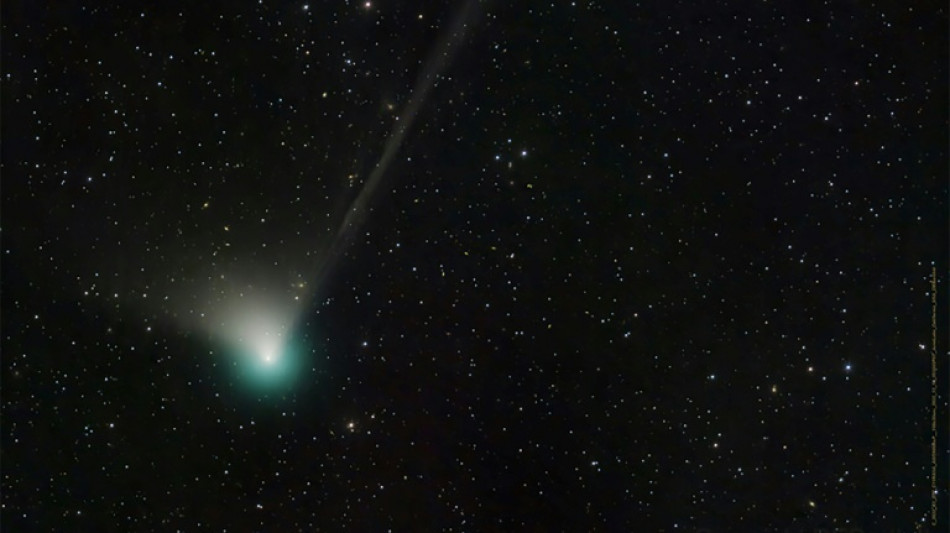
Once in 50,000-year comet may be visible to the naked eye / Photo: Dan Bartlett - NASA/AFP

Once in 50,000-year comet may be visible to the naked eye

A newly discovered comet could be visible to the naked eye as it shoots past Earth and the Sun in the coming weeks for the first time in 50,000 years, astronomers have said.

Text size:

The comet is called C/2022 E3 (ZTF) after the Zwicky Transient Facility, which first spotted it passing Jupiter in March last year.

After travelling from the icy reaches of our Solar System it will come closest to the Sun on January 12 and pass nearest to Earth on February 1.

It will be easy to spot with a good pair of binoculars and likely even with the naked eye, provided the sky is not too illuminated by city lights or the Moon.

The comet "will be brightest when it is closest to the Earth", Thomas Prince, a physics professor at the California Institute of Technology who works at the Zwicky Transient Facility, told AFP.

Made of ice and dust and emitting a greenish aura, the comet is estimated to have a diameter of around a kilometre, said Nicolas Biver, an astrophysicist at the Paris Observatory.

That makes it significantly smaller than NEOWISE, the last comet visible with an unaided eye, which passed Earth in March 2020, and Hale–Bopp, which swept by in 1997 with a potentially life-ending diameter of around 60 kilometres.

But the newest visit will come closer to Earth, which "may make up for the fact that it is not very big", Biver said.

While the comet will be brightest as it passes Earth in early February, a fuller moon could make spotting it difficult.

For the Northern Hemisphere, Biver suggested the last week of January, when the comet passes between the Ursa Minor and Ursa Major constellations.

The new moon during the weekend of January 21-22 offers a good chance for stargazers, he said.

"We could also get a nice surprise and the object could be twice as bright as expected," Biver added.

Prince said another opportunity to locate the comet in the sky will come on February 10, when it passes close to Mars.

- 'Rare visitor' -

The comet has spent most of its life "at least 2,500 times more distant than the Earth is from the Sun", Prince said.

Biver said the comet was believed to have come from the Oort Cloud, a theorised vast sphere surrounding the Solar System that is home to mysterious icy objects.

The last time the comet passed Earth was during the Upper Paleolithic period, when Neanderthals still roamed Earth.

Prince said the comet's next visit to the inner Solar System was expected in another 50,000 years.

But Biver said there was a possibility that after this visit the comet will be "permanently ejected from the Solar System".

Among those closely watching will be the James Webb Space Telescope. However, it will not take images, instead studying the comet's composition, Biver said.

The closer the comet is to Earth, the easier it is for telescopes to measure its composition "as the Sun boils off its outer layers", Prince said.

This "rare visitor" will give "us information about the inhabitants of our Solar system well beyond the most distant planets", he added.

B.Brunner--NZN