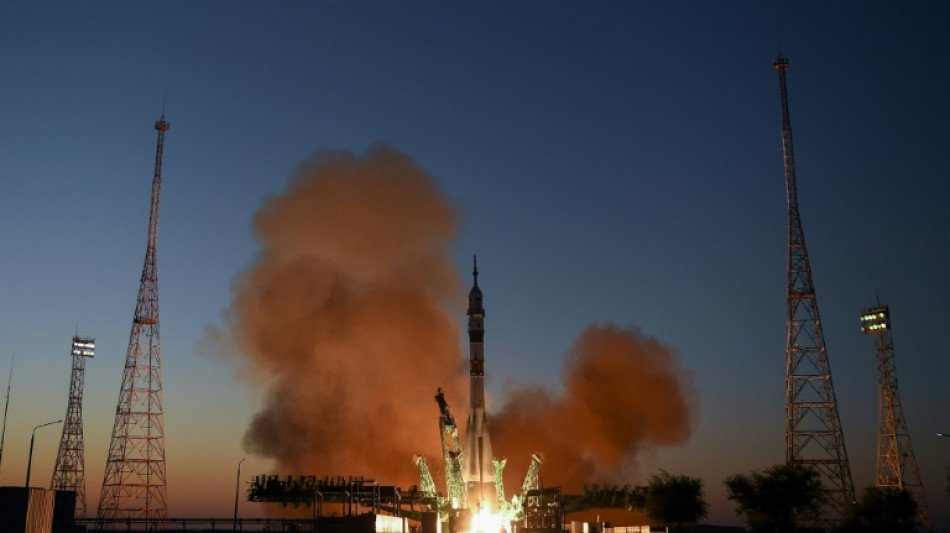
Russia to send rescue mission to space station / Photo: NATALIA KOLESNIKOVA - AFP/File
Russia said Wednesday that it will send an empty spacecraft to the International Space Station (ISS) next month to bring home three astronauts whose planned return vehicle was damaged by a strike from a tiny meteoroid.
The Russian space agency, Roscosmos, made the announcement after examining the flight worthiness of the Soyuz MS-22 crew capsule docked with the ISS that sprang a radiator coolant leak in December.
Roscosmos and NASA officials said at a joint press briefing that an uncrewed Soyuz spacecraft, MS-23, would be sent to the ISS on February 20 to bring Russian cosmonauts Dmitry Petelin and Sergei Prokopyev and NASA astronaut Frank Rubio back to Earth.
"We're not calling it a rescue Soyuz," said Joel Montalbano, ISS program manager at NASA's Johnson Space Center in Houston. "I'm calling it a replacement Soyuz.
"Right now the crew is safe onboard the space station."
MS-22 flew Petelin, Prokopyev and Rubio to the ISS in September after taking off from the Russian-operated Baikonur Cosmodrome in Kazakhstan.
They were scheduled to return home in the same spacecraft in March, but their stay on the ISS will now be extended by several extra months.
"I may have to find some more ice cream to reward them," Montalbano joked.
MS-22 began leaking coolant on December 14 -- shortly before Russian cosmonauts were to begin a spacewalk -- after being hit by what US and Russian space officials believe was a tiny space rock.
Montalbano said "everything does point to a micrometeoroid" and not space debris, or a technical problem.
The executive director of Human Space Flight Programs at Roscosmos, Sergei Krikalev, said the "current theory is that this damage was caused by a small particle about one millimeter in diameter."
MS-23 had been scheduled to fly Russian cosmonauts Oleg Kononenko and Nikolai Chub and NASA's Loral O'Hara to the ISS on March 16.
- SpaceX Crew Dragon -
The decision was made to use MS-23 to fly the current crew home, Krikalev said, because of concerns over potential high temperatures in the damaged MS-22 during reentry to Earth's atmosphere.
He said it could still potentially be used "in case of emergency."
Another emergency scenario involves using the SpaceX Crew Dragon capsule that is currently docked with the ISS after flying four astronauts to the space station in October for a six-month mission.
Montalbano said discussions have been underway with SpaceX about using the Crew Dragon capsule to fly home other astronauts aboard the ISS.
"We could safely secure the crew members in the area that the cargo normally returns on the Dragon," Montalbano said.
"All that is only for an emergency, only if we have to evacuate ISS," the NASA official stressed. "That's not the nominal plan or anything like that."
Krikalev said an uncrewed MS-22 would return to Earth, probably in March, following the arrival of the replacement vehicle.
It would bring back equipment and experiments that are not "temperature sensitive," he said.
When the original MS-23 crew will get to the ISS is still being worked out, Montalbano added.
Space has remained a rare venue of cooperation between Moscow and Washington since the start of the Russian offensive in Ukraine and ensuing Western sanctions on Russia.
The ISS was launched in 1998 at a time of increased US-Russia cooperation following the Cold War "Space Race."
Russia has been using the ageing but reliable Soyuz capsules to ferry astronauts into space since the 1960s.
N.Fischer--NZN