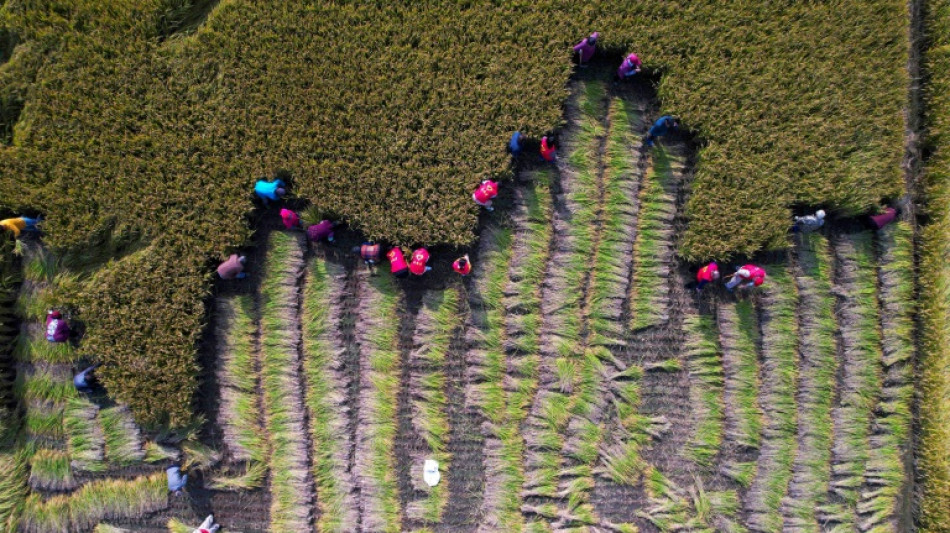
Ozone pollution costs Asia billions in lost crops: study
Persistently high levels of ozone pollution in Asia are costing China, Japan and South Korea an estimated $63 billion annually in lost rice, wheat and maize crops, a new study says.
While ozone forms a protective layer around the Earth in the upper atmosphere, it is a harmful pollutant at ground level.
It is created by a chemical reaction when two pollutants, often emitted by cars or industry, combine in the presence of sunlight and it can interfere with plant photosynthesis and growth.
The research published Monday harnesses pollution monitoring data from the region and field experiments to show ozone affects Asia's crop yields more than previously thought.
The study's authors said the findings should push policymakers to reduce emissions that produce ozone.
"Air pollution control in North America and Europe succeeded in lowering ozone levels," said Kazuhiko Kobayashi, a co-first author of the study and professor emeritus affiliated with the University of Tokyo.
"We need to repeat that success across East and South Asia," he told AFP.
Previous estimates of ozone's effects on staple crops such as rice, wheat and maize have sometimes used varieties that are not prevalent in Asia, or tested plants grown in pots rather than fields.
To get a more accurate picture, the researchers looked at varieties common in the region and did experiments with crops in pots but also in fields.
They exposed rice, wheat and maize to varying levels of ozone and used the resulting crop yields to model how different exposures affected plant development.
They also tested the model with a second experiment in which the crops were treated with a chemical that protects against the effects of ozone, to see if the yield increased in line with their estimations.
- 'Threat to food security' -
To determine real-world effects, the researchers then applied ozone data from more than 3,000 monitoring sites in China, South Korea and Japan to their model.
They found a mean of 33 percent of China's wheat crop is lost annually because of ozone pollution, with 28 percent lost in South Korea and 16 percent for Japan.
For rice, the mean figure in China was 23 percent, though the researchers found hybrid strains were significantly more vulnerable than inbred ones. In South Korea the figure was nearly 11 percent, while in Japan it was just over five percent.
And maize crops in both China and South Korea were also affected at lower levels. The crop is not grown in Japan in significant quantities.
The researchers said their findings were limited by several factors, including that ozone monitors are mostly in urban areas and levels in rural areas are often higher.
Surface ozone "poses a threat to food security" given its effects in a region that supplies 90 percent of the world's rice and 44 percent of its wheat, the authors wrote.
"It has been well known that ozone exerts large impacts on crop production," Kobayashi told AFP.
"Nevertheless, the estimated yield loss in rice, particularly of hybrid type cultivars, may be a bit shocking for those who have learned about it for the first time."
In all, the study estimates $63 billion in annual losses, and Kobayashi said he hoped the findings would "encourage people to take action".
"We in Asia could repeat the success of air pollution control in North America and Europe, where ozone-induced crop yield loss has been declining."
J.Hasler--NZN