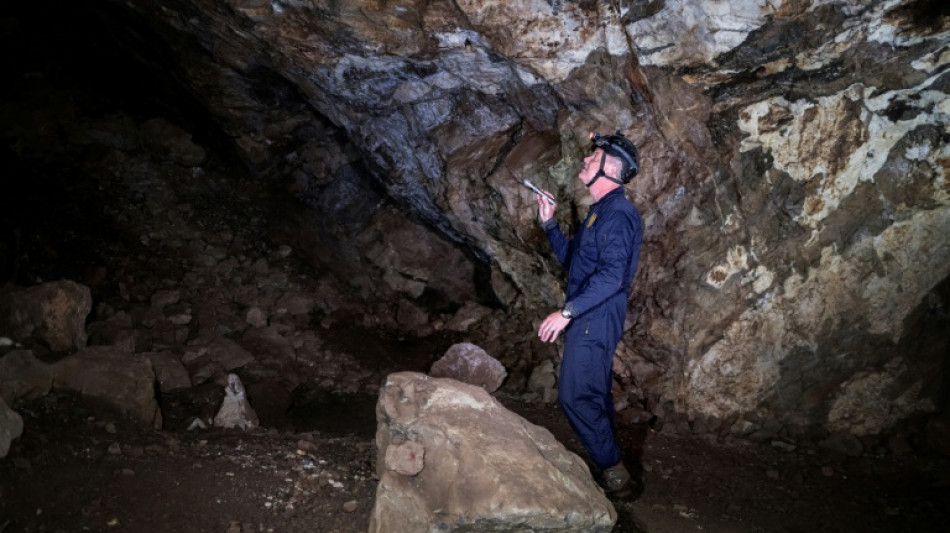
World's oldest-known burial site found in S.Africa: scientists / Photo: Luca Sola - AFP
Palaeontologists in South Africa said Monday they have found the oldest known burial site in the world, containing remains of a small-brained distant relative of humans previously thought incapable of complex behaviour.
Led by renowned palaeoanthropologist Lee Berger, researchers said they discovered several specimens of Homo naledi -- a tree-climbing, Stone Age hominid -- buried about 30 metres (100 feet) underground in a cave system within the Cradle of Humankind, a UNESCO world heritage site near Johannesburg.
"These are the most ancient interments yet recorded in the hominin record, earlier than evidence of Homo sapiens interments by at least 100,000 years," the scientists wrote in a series of yet to be peer reviewed and preprint papers to be published in eLife.
The findings challenge the current understanding of human evolution, as it is normally held that the development of bigger brains allowed for the performing of complex, "meaning-making" activities such as burying the dead.
The oldest burials previously unearthed, found in the Middle East and Africa, contained the remains of Homo sapiens -- and were around 100,000 years old.
Those found in South Africa by Berger, whose previous announcements have been controversial, and his fellow researchers, date back to at least 200,000 BC.
Critically, they also belong to Homo naledi, a primitive species at the crossroads between apes and modern humans, which had brains about the size of oranges and stood about 1.5 metres (five feet) tall.
With curved fingers and toes, tool-wielding hands and feet made for walking, the species discovered by Berger had already upended the notion that our evolutionary path was a straight line.
Homo naledi is named after the "Rising Star" cave system where the first bones were found in 2013.
The oval-shaped interments at the centre of the new studies were also found there during excavations started in 2018.
The holes, which researchers say evidence suggests were deliberately dug and then filled in to cover the bodies, contain at least five individuals.
"These discoveries show that mortuary practices were not limited to H. sapiens or other hominins with large brain sizes," the researchers said.
The burial site is not the only sign that Homo naledi was capable of complex emotional and cognitive behaviour, they added.
- Brain size -
Engravings forming geometrical shapes, including a "rough hashtag figure", were also found on the apparently purposely smoothed surfaces of a cave pillar nearby.
"That would mean not only are humans not unique in the development of symbolic practices, but may not have even invented such behaviours," Berger told AFP in an interview.
Such statements are likely to ruffle some feathers in the world of palaeontology, where the 57-year-old has previously faced accusations of lacking scientific rigour and rushing to conclusions.
Many balked when in 2015 Berger, whose earlier discoveries won support from National Geographic, first aired the idea that Homo naledi was capable of more than the size of its head suggested.
"That was too much for scientists to take at that time. We think it's all tied up with this big brain," he said.
"We're about to tell the world that's not true."
While requiring further analysis, the discoveries "alter our understandings of human evolution", the researchers wrote.
"Burial, meaning-making, even 'art' could have a much more complicated, dynamic, non-human history than we previously thought," said Agustin Fuentes, a professor of anthropology at Princeton University, who co-authored the studies.
Carol Ward, an anthropologist at the University of Missouri not involved in the research, said that "these findings, if confirmed, would be of considerable potential importance".
"I look forward to learning how the disposition of remains precludes other possible explanations than intentional burial, and to seeing the results once they have been vetted by peer review," she told AFP.
Ward also pointed out that the paper acknowledged that it could not rule out that markings on the walls could have been made by later hominins.
A.Wyss--NZN