Zürcher Nachrichten - NASA hears 'heartbeat' from Voyager 2 after inadvertant blackout

EUR -
AED 4.350475
AFN 77.000016
ALL 96.454975
AMD 452.047591
ANG 2.120545
AOA 1086.286213
ARS 1725.238026
AUD 1.710479
AWG 2.135258
AZN 2.007664
BAM 1.951672
BBD 2.40163
BDT 145.711773
BGN 1.989397
BHD 0.449557
BIF 3532.68688
BMD 1.184609
BND 1.510131
BOB 8.239571
BRL 6.269424
BSD 1.192242
BTN 109.499298
BWP 15.600223
BYN 3.39623
BYR 23218.339784
BZD 2.398137
CAD 1.618478
CDF 2683.139764
CHF 0.916298
CLF 0.026022
CLP 1027.494776
CNY 8.235107
CNH 8.235012
COP 4347.219511
CRC 590.460955
CUC 1.184609
CUP 31.392143
CVE 110.03271
CZK 24.351003
DJF 212.331747
DKK 7.467676
DOP 75.072465
DZD 154.147531
EGP 55.878723
ERN 17.769138
ETB 185.235695
FJD 2.611648
FKP 0.865278
GBP 0.866695
GEL 3.192536
GGP 0.865278
GHS 13.062424
GIP 0.865278
GMD 86.476639
GNF 10463.043965
GTQ 9.145731
GYD 249.464409
HKD 9.250553
HNL 31.472956
HRK 7.534477
HTG 156.052534
HUF 381.797757
IDR 19913.694806
ILS 3.686918
IMP 0.865278
INR 108.607225
IQD 1562.095668
IRR 49901.661585
ISK 145.008115
JEP 0.865278
JMD 186.857891
JOD 0.839889
JPY 183.519063
KES 153.939966
KGS 103.594234
KHR 4794.938126
KMF 491.612449
KPW 1066.148258
KRW 1730.03927
KWD 0.36358
KYD 0.99369
KZT 599.696388
LAK 25660.935532
LBP 106778.978995
LKR 368.751529
LRD 214.927175
LSL 18.932911
LTL 3.497842
LVL 0.716558
LYD 7.482204
MAD 10.81612
MDL 20.055745
MGA 5328.75048
MKD 61.509887
MMK 2488.068394
MNT 4224.768089
MOP 9.588717
MRU 47.577162
MUR 54.077512
MVR 18.314459
MWK 2067.635018
MXN 20.751444
MYR 4.669768
MZN 75.530403
NAD 18.932592
NGN 1654.756728
NIO 43.877925
NOK 11.494689
NPR 175.200353
NZD 1.973375
OMR 0.457075
PAB 1.192378
PEN 3.986667
PGK 5.10431
PHP 69.772884
PKR 333.562994
PLN 4.217072
PYG 7987.138359
QAR 4.347422
RON 5.089195
RSD 117.152186
RUB 90.544141
RWF 1739.763902
SAR 4.443236
SBD 9.538015
SCR 17.104588
SDG 712.542061
SEK 10.581202
SGD 1.50757
SHP 0.888764
SLE 28.815636
SLL 24840.661178
SOS 681.469978
SRD 45.074975
STD 24519.018157
STN 24.448799
SVC 10.432843
SYP 13101.273866
SZL 18.924811
THB 37.603637
TJS 11.131048
TMT 4.146132
TND 3.425967
TOP 2.852254
TRY 51.525118
TTD 8.095909
TWD 37.508269
TZS 3057.464743
UAH 51.10611
UGX 4263.000384
USD 1.184609
UYU 46.272704
UZS 14577.164634
VES 409.805368
VND 30762.5233
VUV 140.721447
WST 3.211216
XAF 654.588912
XAG 0.015713
XAU 0.000262
XCD 3.201465
XCG 2.148954
XDR 0.814081
XOF 654.575127
XPF 119.331742
YER 282.321978
ZAR 19.247058
ZMK 10662.910096
ZMW 23.400599
ZWL 381.44367
  • SCS

    0.0200

    16.14

    +0.12%

  • RBGPF

    1.3800

    83.78

    +1.65%

  • CMSC

    0.0500

    23.76

    +0.21%

  • CMSD

    -0.0400

    24.05

    -0.17%

  • RYCEF

    -0.4300

    16

    -2.69%

  • BCC

    0.5100

    80.81

    +0.63%

  • JRI

    0.1400

    13.08

    +1.07%

  • NGG

    0.2000

    85.27

    +0.23%

  • BCE

    0.3700

    25.86

    +1.43%

  • RIO

    -4.1000

    91.03

    -4.5%

  • RELX

    -0.3700

    35.8

    -1.03%

  • GSK

    0.9400

    51.6

    +1.82%

  • VOD

    -0.0600

    14.65

    -0.41%

  • AZN

    0.1800

    92.77

    +0.19%

  • BP

    -0.1600

    37.88

    -0.42%

  • BTI

    0.4600

    60.68

    +0.76%

NASA hears 'heartbeat' from Voyager 2 after inadvertant blackout
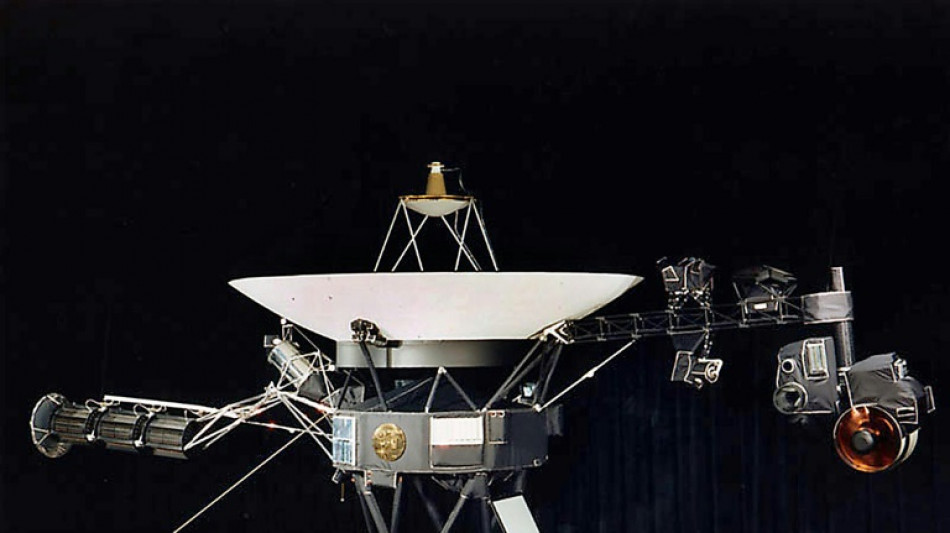
NASA hears 'heartbeat' from Voyager 2 after inadvertant blackout / Photo: NASA - NASA/AFP/File

NASA hears 'heartbeat' from Voyager 2 after inadvertant blackout

NASA's distant Voyager 2 probe has sent a "heartbeat" signal to Earth after mission control mistakenly cut contact, the US space agency said Tuesday.

Text size:

Launched in 1977 to explore the outer planets and serve as a beacon of humanity to the wider universe, it is currently more than 12.3 billion miles (19.9 billion kilometers) from our planet -- well beyond the solar system.

A series of planned commands sent to Voyager 2 on July 21 "inadvertently caused the antenna to point two degrees away from Earth," NASA's Jet Propulsion Laboratory (JPL) said in a recent update.

This left it unable to transmit data or receive commands to its mission control -- a situation that was not expected to be resolved until it conducted an automated re-orientation maneuver on October 15.

But on Tuesday, Voyager project manager Suzanne Dodd told AFP the team enlisted the help of the Deep Space Network -- an international array of giant radio antennas, plus a few that orbit Earth -- in a last-ditch effort to re-establish contact sooner.

To their surprise, "this was successful in that we see the 'heartbeat' signal from the spacecraft," she said. "So we know the spacecraft is alive and operating. This buoyed our spirits."

The team is "now generating a new command to attempt to point the spacecraft antenna toward Earth," Dodd added, although she said there is only a "low probability" it will work.

Still, given October 15 is a long way away, NASA will keep trying to send up these commands.

- Golden Record -

While JPL built and operates Voyager spacecraft, the missions are now part of the NASA Heliophysics System Observatory.

Voyager 2 left the protective magnetic bubble provided by the Sun, called the heliosphere, in December 2018, and is currently traveling through the space between the stars.

Before leaving our solar system, it explored Jupiter and Saturn, and became the first and so far only spacecraft to visit Uranus and Neptune.

Voyager 1 was mankind's first spacecraft to enter the interstellar medium, in 2012, and is currently almost 15 billion miles from Earth.

Both Voyager spacecraft carry "Golden Records" -- 12-inch, gold-plated copper disks intended to convey the story of our world to extraterrestrials.

These include a map of our solar system, a piece of uranium that serves as a radioactive clock allowing recipients to date the spaceship's launch, and symbolic instructions that convey how to play the record.

The contents of the record, selected for NASA by a committee chaired by legendary astronomer Carl Sagan, include encoded images of life on Earth, as well as music and sounds that can be played using an included stylus.

For now, the Voyagers continue to transmit back scientific data, though their power banks are expected to be eventually depleted, sometime after 2025.

They will then continue to wander the Milky Way, potentially for eternity, in silence.

A.P.Huber--NZN