Zürcher Nachrichten - Russian ISS segment springs third leak in under a year

EUR -
AED 4.312872
AFN 77.497192
ALL 97.083507
AMD 448.358394
ANG 2.10189
AOA 1076.745039
ARS 1686.737344
AUD 1.762117
AWG 2.116503
AZN 2.0004
BAM 1.960164
BBD 2.364444
BDT 143.458182
BGN 1.954533
BHD 0.442628
BIF 3482.690009
BMD 1.174204
BND 1.518468
BOB 8.111992
BRL 6.344577
BSD 1.173904
BTN 105.962018
BWP 16.570753
BYN 3.444339
BYR 23014.404642
BZD 2.361037
CAD 1.617085
CDF 2624.346788
CHF 0.93317
CLF 0.027363
CLP 1073.445694
CNY 8.287592
CNH 8.279185
COP 4461.97641
CRC 584.596602
CUC 1.174204
CUP 31.116414
CVE 110.735147
CZK 24.211448
DJF 208.679343
DKK 7.469313
DOP 75.38854
DZD 152.527654
EGP 55.780815
ERN 17.613065
ETB 183.117291
FJD 2.668731
FKP 0.880328
GBP 0.876685
GEL 3.167788
GGP 0.880328
GHS 13.511791
GIP 0.880328
GMD 85.716479
GNF 10203.835397
GTQ 8.990941
GYD 245.564648
HKD 9.137652
HNL 30.822801
HRK 7.534044
HTG 153.740989
HUF 382.720745
IDR 19557.547128
ILS 3.769219
IMP 0.880328
INR 105.941352
IQD 1538.207657
IRR 49445.744342
ISK 148.196425
JEP 0.880328
JMD 188.080355
JOD 0.832563
JPY 182.668645
KES 151.351702
KGS 102.684162
KHR 4702.68859
KMF 493.165922
KPW 1056.818133
KRW 1729.397435
KWD 0.360047
KYD 0.97827
KZT 611.265753
LAK 25456.749721
LBP 105149.99698
LKR 363.035191
LRD 207.952732
LSL 19.926632
LTL 3.46712
LVL 0.710265
LYD 6.370054
MAD 10.773292
MDL 19.992342
MGA 5289.79066
MKD 61.535793
MMK 2465.731856
MNT 4164.567352
MOP 9.409169
MRU 46.698162
MUR 54.095858
MVR 18.094121
MWK 2039.593045
MXN 21.173838
MYR 4.826564
MZN 75.027882
NAD 19.926467
NGN 1705.567045
NIO 43.152538
NOK 11.82385
NPR 169.539028
NZD 2.021193
OMR 0.451489
PAB 1.173904
PEN 3.957659
PGK 4.98303
PHP 69.220521
PKR 329.020524
PLN 4.224118
PYG 8022.794101
QAR 4.275255
RON 5.091111
RSD 117.387607
RUB 94.21991
RWF 1704.94467
SAR 4.406316
SBD 9.664397
SCR 17.68142
SDG 706.276747
SEK 10.854715
SGD 1.516925
SHP 0.880957
SLE 28.298456
SLL 24622.475271
SOS 671.051677
SRD 45.309611
STD 24303.658683
STN 24.963584
SVC 10.272089
SYP 12983.004828
SZL 19.925763
THB 37.144194
TJS 10.823606
TMT 4.109715
TND 3.443358
TOP 2.827202
TRY 50.018636
TTD 7.96667
TWD 36.625805
TZS 2881.189733
UAH 49.552771
UGX 4174.258268
USD 1.174204
UYU 46.223703
UZS 14149.162076
VES 310.852822
VND 30913.864194
VUV 143.831963
WST 3.264403
XAF 657.415109
XAG 0.01849
XAU 0.000275
XCD 3.173346
XCG 2.115692
XDR 0.818357
XOF 658.146923
XPF 119.331742
YER 279.900945
ZAR 19.810588
ZMK 10569.245107
ZMW 26.912691
ZWL 378.093311
  • SCS

    0.0200

    16.14

    +0.12%

  • BCC

    -0.7500

    76.26

    -0.98%

  • CMSC

    0.1300

    23.43

    +0.55%

  • RBGPF

    3.1200

    81.17

    +3.84%

  • CMSD

    0.1200

    23.4

    +0.51%

  • BCE

    0.2100

    23.4

    +0.9%

  • NGG

    0.0500

    74.69

    +0.07%

  • BTI

    -0.3900

    58.37

    -0.67%

  • RIO

    0.5000

    76.74

    +0.65%

  • GSK

    0.4700

    48.88

    +0.96%

  • JRI

    0.0000

    13.72

    0%

  • RELX

    0.2000

    40.28

    +0.5%

  • RYCEF

    0.2300

    14.85

    +1.55%

  • VOD

    -0.0200

    12.54

    -0.16%

  • BP

    -0.3500

    35.53

    -0.99%

  • AZN

    -1.2200

    90.29

    -1.35%

Russian ISS segment springs third leak in under a year
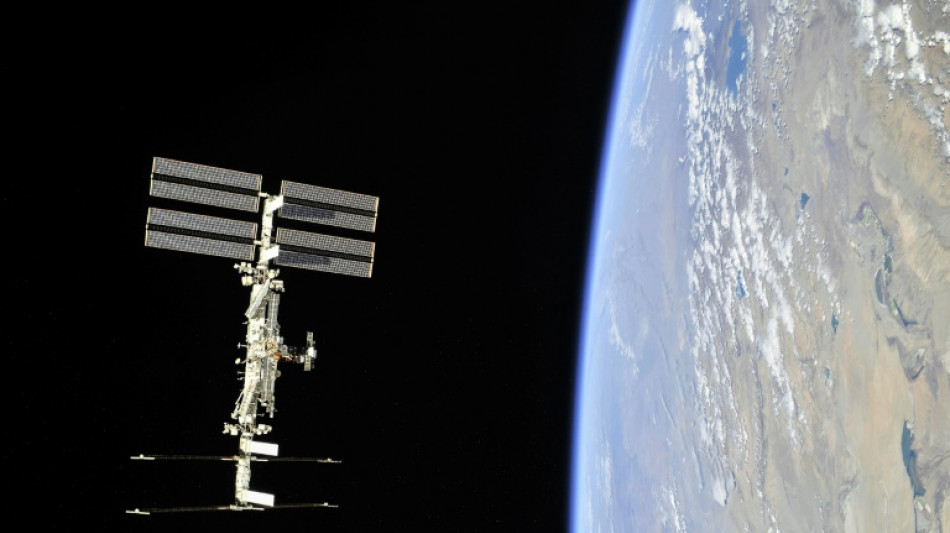
Russian ISS segment springs third leak in under a year / Photo: HO - NASA/AFP/File

Russian ISS segment springs third leak in under a year

The Russian segment of the International Space Station (ISS) sprung its third coolant leak in under a year Monday, raising new questions about the reliability of the country's space program even as officials said crew members weren't in danger.

Text size:

Flakes of frozen coolant spraying into space were seen in an official live feed of the orbital lab provided by NASA around 1:30 pm Eastern Time (1730 GMT), and confirmed in radio chatter between US mission control and astronauts.

"The Nauka module of the Russian segment of the ISS has suffered a coolant leak from the external (backup) radiator circuit, which was delivered to the station in 2012," Russian space agency Roscosmos said on Telegram, adding temperatures remained normal in the affected unit.

"Nothing is threatening the crew and the station," added the statement.

Nauka, which means "science" in Russian and is also known as the Multipurpose Laboratory Module-Upgrade (MLM), launched in 2021.

US mission control in Houston could be heard asking astronauts on the American side to investigate.

"Hi, we're seeing flakes outside, we need a crew to go to the cupola, we think windows five or six, and confirm any visual flakes," an official said to the astronauts.

"There's a leak coming from the radiator on MLM," Jasmin Moghbeli replied a little later.

NASA has yet to release an official statement.

- 'Something systematic' -

This is the third coolant leak to hit the Russian side of the ISS in less than a year. On December 15, 2022, dramatic NASA TV images showed white particles resembling snowflakes streaming out of the rear of a docked Soyuz MS-22 spacecraft for several hours.

Speculation about the cause centered on an unlucky strike by a tiny space rock, or micro meteorite.

That spaceship returned to Earth uncrewed, and then another uncrewed Soyuz was sent to replace it a few months later. Two Russians and an American crew member had to stay for a year-long mission as a result, returning home only last month.

A similar leak in mid-February also affected the Russian Progress MS-21 cargo ship, which had been docked to the ISS since October 2022.

The succession of leaks lowers the probability they were caused by meteorites.

Space analyst Jonathan McDowell told AFP: "You've got three coolant systems leaking -- there's a common thread there. One is whatever, two is a coincidence, three is something systematic," he said, speculating that a subcontractor company may be at fault.

"It really just emphasizes the degrading reliability of Russian space systems. When you add it to the context of their failed Moon probe in August, they're not looking great."

The Russian space sector, which has historically been the pride of the country, has been facing difficulties for years, between lack of funding, failures and corruption scandals.

The ISS constitutes one of the few areas of cooperation still ongoing between Moscow and Washington since the start of the Russian offensive in Ukraine and the international sanctions that followed.

N.Zaugg--NZN