Zürcher Nachrichten - The feline frontier: NASA sends cat video from deep space

EUR -
AED 4.312666
AFN 77.504793
ALL 97.092648
AMD 448.399986
ANG 2.102088
AOA 1076.847291
ARS 1686.896325
AUD 1.761496
AWG 2.116703
AZN 2.000467
BAM 1.960349
BBD 2.364667
BDT 143.471704
BGN 1.956294
BHD 0.442706
BIF 3483.018266
BMD 1.174315
BND 1.518611
BOB 8.112757
BRL 6.348108
BSD 1.174014
BTN 105.972005
BWP 16.572315
BYN 3.444664
BYR 23016.573841
BZD 2.361259
CAD 1.61739
CDF 2624.594513
CHF 0.932922
CLF 0.027367
CLP 1073.617798
CNY 8.288374
CNH 8.27993
COP 4466.213493
CRC 584.651703
CUC 1.174315
CUP 31.119347
CVE 110.728071
CZK 24.211317
DJF 208.699796
DKK 7.468884
DOP 75.392864
DZD 152.301647
EGP 55.826109
ERN 17.614725
ETB 183.134804
FJD 2.667801
FKP 0.88041
GBP 0.87674
GEL 3.173602
GGP 0.88041
GHS 13.502195
GIP 0.88041
GMD 85.725448
GNF 10204.797655
GTQ 8.991789
GYD 245.587794
HKD 9.138461
HNL 30.826099
HRK 7.536637
HTG 153.755479
HUF 383.003453
IDR 19558.862063
ILS 3.769574
IMP 0.88041
INR 105.983513
IQD 1538.352639
IRR 49450.40402
ISK 148.200057
JEP 0.88041
JMD 188.098082
JOD 0.832583
JPY 182.674078
KES 151.370792
KGS 102.693345
KHR 4703.131575
KMF 493.212034
KPW 1056.917742
KRW 1728.063547
KWD 0.360068
KYD 0.978362
KZT 611.323367
LAK 25459.149534
LBP 105159.907704
LKR 363.069409
LRD 207.972124
LSL 19.928047
LTL 3.467447
LVL 0.710332
LYD 6.370632
MAD 10.774319
MDL 19.994226
MGA 5290.289272
MKD 61.555786
MMK 2465.964261
MNT 4164.959879
MOP 9.410056
MRU 46.702398
MUR 54.100312
MVR 18.095963
MWK 2039.784988
MXN 21.174541
MYR 4.817623
MZN 75.040766
NAD 19.928443
NGN 1705.868727
NIO 43.155975
NOK 11.816774
NPR 169.555008
NZD 2.020656
OMR 0.451528
PAB 1.174014
PEN 3.958027
PGK 4.9835
PHP 69.06135
PKR 329.034639
PLN 4.226001
PYG 8023.550282
QAR 4.27571
RON 5.09124
RSD 117.382167
RUB 94.223596
RWF 1705.105368
SAR 4.406801
SBD 9.665308
SCR 16.42028
SDG 706.366623
SEK 10.861298
SGD 1.516587
SHP 0.88104
SLE 28.299773
SLL 24624.796038
SOS 671.118193
SRD 45.313876
STD 24305.9494
STN 24.965937
SVC 10.273057
SYP 12984.228527
SZL 19.927722
THB 37.143739
TJS 10.824626
TMT 4.110102
TND 3.443678
TOP 2.827469
TRY 50.056797
TTD 7.967421
TWD 36.630291
TZS 2881.461287
UAH 49.557442
UGX 4174.651708
USD 1.174315
UYU 46.228059
UZS 14150.495768
VES 310.882121
VND 30916.777949
VUV 143.84552
WST 3.264711
XAF 657.477073
XAG 0.018579
XAU 0.000275
XCD 3.173645
XCG 2.115892
XDR 0.818434
XOF 658.199978
XPF 119.331742
YER 279.927339
ZAR 19.806934
ZMK 10570.241854
ZMW 26.915227
ZWL 378.128948
  • SCS

    0.0200

    16.14

    +0.12%

  • CMSD

    0.1200

    23.4

    +0.51%

  • AZN

    -1.2200

    90.29

    -1.35%

  • GSK

    0.4700

    48.88

    +0.96%

  • BCC

    -0.7500

    76.26

    -0.98%

  • BP

    -0.3500

    35.53

    -0.99%

  • RIO

    0.5000

    76.74

    +0.65%

  • BTI

    -0.3900

    58.37

    -0.67%

  • NGG

    0.0500

    74.69

    +0.07%

  • RBGPF

    3.1200

    81.17

    +3.84%

  • CMSC

    0.1300

    23.43

    +0.55%

  • BCE

    0.2100

    23.4

    +0.9%

  • JRI

    0.0000

    13.72

    0%

  • RELX

    0.2000

    40.28

    +0.5%

  • VOD

    -0.0200

    12.54

    -0.16%

  • RYCEF

    0.2300

    14.85

    +1.55%

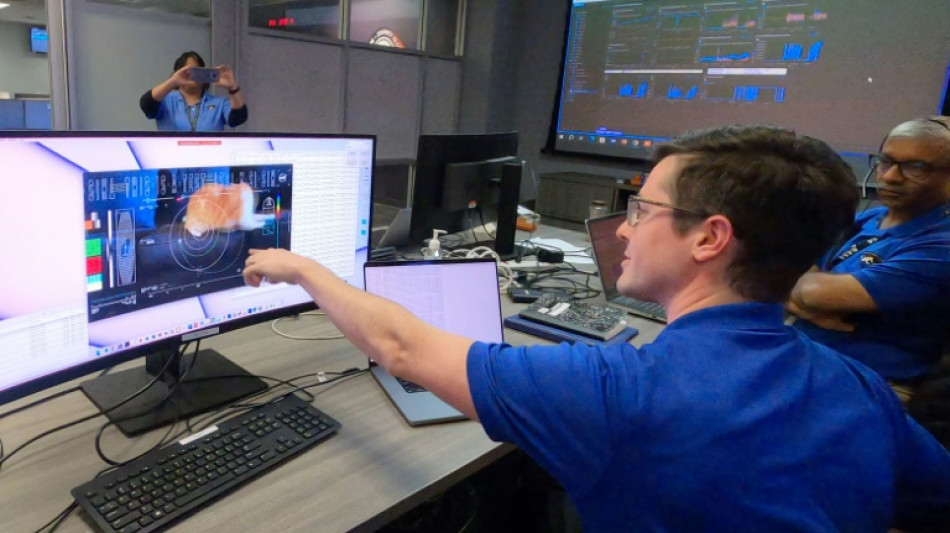
The feline frontier: NASA sends cat video from deep space
The feline frontier: NASA sends cat video from deep space / Photo: Handout - NASA/JPL-Caltech/AFP

The feline frontier: NASA sends cat video from deep space

NASA on Monday announced it had used a state-of-the-art laser communication system on a spaceship 19 million miles (31 million kilometers) away from Earth -- to send a high-definition cat video.

Text size:

The 15-second meow-vie featuring an orange tabby named Taters is the first to be streamed from deep space, and demonstrates it's possible to transmit the higher-data-rate communications needed to support complex missions such as sending humans to Mars.

The video was beamed to Earth using a laser transceiver on the Psyche probe, which is journeying to the main asteroid belt between Mars and Jupiter to explore a mysterious metal-rich object. When it sent the video, the spaceship was 80 times the distance between the Earth and Moon.

The encoded near-infrared signal was received by the Hale Telescope at Caltech's Palomar Observatory in San Diego County, and from there sent to NASA's Jet Propulsion Laboratory (JPL) in Southern California.

"One of the goals is to demonstrate the ability to transmit broadband video across millions of miles. Nothing on Psyche generates video data, so we usually send packets of randomly generated test data," said Bill Klipstein, the tech demo's project manager at JPL.

"But to make this significant event more memorable, we decided to work with designers at JPL to create a fun video, which captures the essence of the demo as part of the Psyche mission."

Space missions have traditionally relied on radio waves to send and receive data, but working with lasers can increase the data rate by 10 to 100 times.

- Giant pounce for catkind -

The ultra-HD video took 101 seconds to send to Earth at the system's maximum bit rate of 267 megabits per second -- faster than most home broadband connections.

"In fact, after receiving the video at Palomar, it was sent to JPL over the internet, and that connection was slower than the signal coming from deep space," said Ryan Rogalin, the project's receiver electronics lead at JPL.

So why a cat video? First, there's the historic connection, said JPL. When American interest in television began growing in the 1920s, a statue of Felix the Cat was broadcast to serve as a test image.

And while cats may claim the title as man's best friend, few can dispute their number-one position when it comes to internet videos and meme culture.

Uploaded before launch, the clip shows Tabby, the pet of a JPL employee, chasing a laser light on a couch, with test graphics overlayed. These include Psyche's orbital path and technical information about the laser and its data bit rate.

While laser transmission has been demonstrated in low Earth orbit and as far away as the Moon, the Psyche mission is the first time it's been deployed in deep space. Aiming a laser beam from millions of miles away requires extremely precise "pointing," a major technical hurdle engineering teams had to solve.

The technology demonstration even needs to compensate for the fact that in the time it takes for light to travel from the spacecraft to Earth, both the probe and the planet will have moved -- so the uplink and downlink lasers need to adjust for the change accordingly.

G.Kuhn--NZN