Zürcher Nachrichten - Object found in the Milky Way 'unlike anything astronomers have seen'

EUR -
AED 4.275912
AFN 76.945742
ALL 96.507033
AMD 443.502545
ANG 2.084172
AOA 1067.669546
ARS 1669.615862
AUD 1.754156
AWG 2.095752
AZN 1.979584
BAM 1.95493
BBD 2.344656
BDT 142.426589
BGN 1.95493
BHD 0.438905
BIF 3439.568645
BMD 1.164307
BND 1.508029
BOB 8.044418
BRL 6.33336
BSD 1.164082
BTN 104.665401
BWP 15.466114
BYN 3.34681
BYR 22820.40996
BZD 2.341258
CAD 1.610277
CDF 2598.732168
CHF 0.936687
CLF 0.027361
CLP 1073.35122
CNY 8.231765
CNH 8.230635
COP 4422.730924
CRC 568.646829
CUC 1.164307
CUP 30.854126
CVE 110.21593
CZK 24.208254
DJF 207.297707
DKK 7.468805
DOP 74.506828
DZD 151.014766
EGP 55.297703
ERN 17.464599
ETB 180.565709
FJD 2.631857
FKP 0.872874
GBP 0.873789
GEL 3.137823
GGP 0.872874
GHS 13.242104
GIP 0.872874
GMD 84.994444
GNF 10115.496406
GTQ 8.91703
GYD 243.551567
HKD 9.063324
HNL 30.660349
HRK 7.534581
HTG 152.392152
HUF 381.731319
IDR 19431.753727
ILS 3.767358
IMP 0.872874
INR 104.724139
IQD 1525.021034
IRR 49031.867707
ISK 149.007685
JEP 0.872874
JMD 186.327044
JOD 0.825436
JPY 180.689329
KES 150.582958
KGS 101.819216
KHR 4660.924876
KMF 491.33727
KPW 1047.875385
KRW 1715.96691
KWD 0.357407
KYD 0.970168
KZT 588.717893
LAK 25243.761042
LBP 104246.887486
LKR 359.070136
LRD 204.88878
LSL 19.729516
LTL 3.437895
LVL 0.704277
LYD 6.328183
MAD 10.751913
MDL 19.807182
MGA 5192.688126
MKD 61.612569
MMK 2444.575233
MNT 4130.230657
MOP 9.335044
MRU 46.422332
MUR 53.640008
MVR 17.932029
MWK 2018.601284
MXN 21.162059
MYR 4.786443
MZN 74.410886
NAD 19.729516
NGN 1688.338127
NIO 42.840926
NOK 11.772625
NPR 167.464442
NZD 2.014838
OMR 0.446781
PAB 1.164182
PEN 3.913058
PGK 4.939801
PHP 68.653379
PKR 326.360799
PLN 4.229232
PYG 8006.435397
QAR 4.243211
RON 5.091044
RSD 117.347755
RUB 89.441675
RWF 1693.745915
SAR 4.36976
SBD 9.582933
SCR 15.771732
SDG 700.335953
SEK 10.943923
SGD 1.508534
SHP 0.873532
SLE 27.599807
SLL 24414.925724
SOS 664.104329
SRD 44.975958
STD 24098.796527
STN 24.489097
SVC 10.186465
SYP 12873.549183
SZL 19.714223
THB 37.112262
TJS 10.680845
TMT 4.086716
TND 3.41488
TOP 2.803371
TRY 49.55243
TTD 7.891487
TWD 36.43004
TZS 2840.6353
UAH 48.871442
UGX 4118.166521
USD 1.164307
UYU 45.529729
UZS 13926.799548
VES 296.376506
VND 30691.122782
VUV 141.301541
WST 3.246799
XAF 655.665087
XAG 0.019914
XAU 0.000277
XCD 3.146597
XCG 2.098066
XDR 0.815437
XOF 655.665087
XPF 119.331742
YER 277.745094
ZAR 19.719145
ZMK 10480.15708
ZMW 26.914017
ZWL 374.90626
  • RBGPF

    0.0000

    78.35

    0%

  • RELX

    -0.2200

    40.32

    -0.55%

  • AZN

    0.1500

    90.18

    +0.17%

  • BTI

    -1.0300

    57.01

    -1.81%

  • NGG

    -0.5000

    75.41

    -0.66%

  • BP

    -1.4000

    35.83

    -3.91%

  • CMSC

    -0.0500

    23.43

    -0.21%

  • GSK

    -0.1600

    48.41

    -0.33%

  • SCS

    -0.0900

    16.14

    -0.56%

  • RIO

    -0.6700

    73.06

    -0.92%

  • RYCEF

    -0.0500

    14.62

    -0.34%

  • BCC

    -1.2100

    73.05

    -1.66%

  • CMSD

    -0.0700

    23.25

    -0.3%

  • JRI

    0.0400

    13.79

    +0.29%

  • BCE

    0.3300

    23.55

    +1.4%

  • VOD

    -0.1630

    12.47

    -1.31%

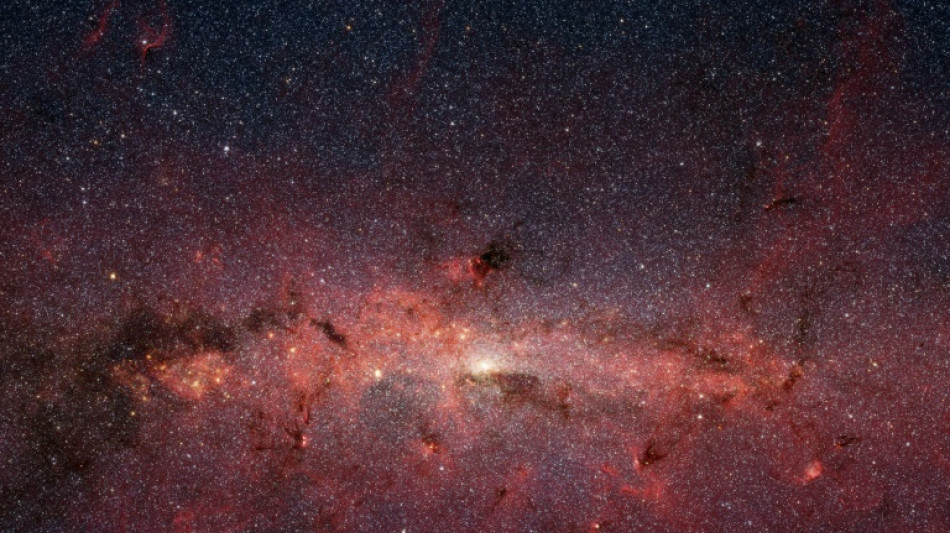
Object found in the Milky Way 'unlike anything astronomers have seen'

Object found in the Milky Way 'unlike anything astronomers have seen'

Australian researchers have discovered a strange spinning object in the Milky Way they say is unlike anything astronomers have ever seen.

Text size:

The object, first spotted by a university student working on his undergraduate thesis, releases a huge burst of radio energy three times every hour.

The pulse comes "every 18.18 minutes, like clockwork," said astrophysicist Natasha Hurley-Walker, who led the investigation after the student's discovery, using a telescope in the Western Australian outback known as the Murchison Widefield Array.

While there are other objects in the universe that switch on and off -- such as pulsars -- Hurley-Walker said 18.18 minutes is a frequency that has never been observed before.

Finding this object was "kind of spooky for an astronomer," she said, "because there's nothing known in the sky that does that."

The research team is now working to understand what they have found.

Trawling back through years of data, they have been able to establish a few facts: the object is about 4,000 light-years from Earth, is incredibly bright and has an extremely strong magnetic field.

But there are still many mysteries to untangle.

"If you do all of the mathematics, you find that they shouldn't have enough power to produce these kind of radio waves every 20 minutes," Hurley-Walker said.

"It just shouldn't be possible."

The object may be something researchers have theorised could exist but have never seen called an "ultra-long period magnetar".

It could also be a white dwarf, a remnant of a collapsed star.

"But that's quite unusual as well. We only know of one white dwarf pulsar, and nothing as great as this," Hurley-Walker said.

"Of course, it could be something that we've never even thought of -- it could be some entirely new type of object."

On the question of whether the powerful, consistent radio signal from space could have been sent by some other life form, Hurley-Walker conceded: "I was concerned that it was aliens."

But the research team was able to observe the signal across a wide range of frequencies.

"That means it must be a natural process, this is not an artificial signal," Hurley-Walker said.

The next step for the researchers is to look for more of these strange objects across the universe.

"More detections will tell astronomers whether this was a rare one-off event or a vast new population we'd never noticed before," Hurley-Walker said.

The team's paper on the object has been published in the latest edition of the journal Nature.

N.Zaugg--NZN