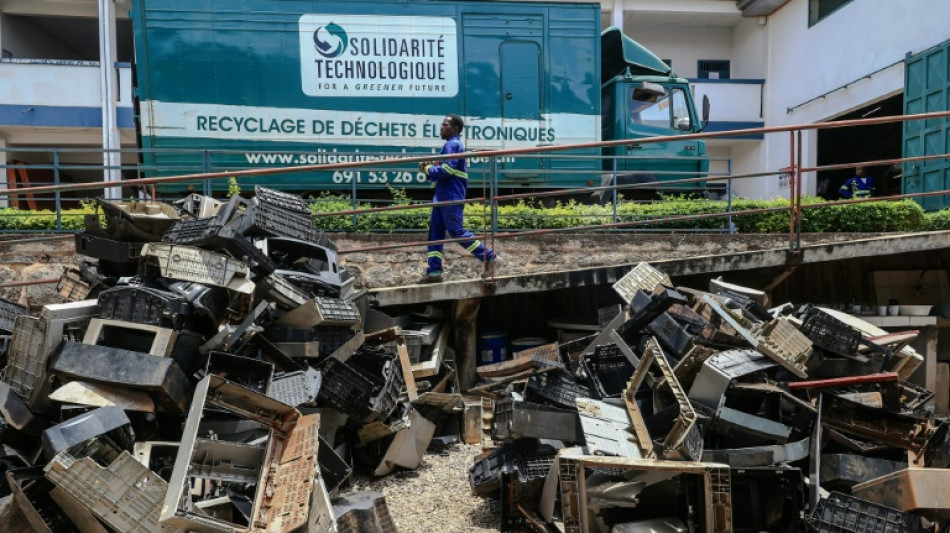
Rising scourge of e-waste a 'catastrophe' for environment: UN / Photo: Daniel Beloumou Olomo - AFP
The world threw away a record amount of smartphones, televisions and other electrical devices in 2022, the UN said Wednesday, warning this avalanche of dumped gadgets was polluting the planet.
Less than one quarter of the 62 million tonnes of e-waste produced in 2022 was recycled, resulting in heavy metals, plastics and toxic chemicals leaking from junked devices.
"This is a big catastrophe for the environment," Kees Balde, lead author of the latest Global E-waste Monitor, told AFP.
It also poses health risks, particularly in poorer countries where a lot of e-waste is sent from wealthier parts of the globe.
Far from worthless junk, the UN estimates the value of metals in all these discarded gadgets at $91 billion.
But less than one-third is recovered, with the rest lost when e-waste is burned, thrown in landfills or improperly recycled.
The scourge is only going to worsen as demand for new technologies, including solar panels and electric vehicles, outpaces the ability to recycle, the report says.
Roughly twice as much e-waste was produced in 2022 compared to 2010 -- a weight equivalent to 107,000 of the world's largest and heaviest passenger jets.
This includes small everyday items like e-cigarettes and tablets, household appliances like electric toothbrushes and toasters, and larger items like television screens and electric bikes and scooters.
On average, every person on earth generates roughly 7.8 kilograms (17 pounds 3 ounces) of e-waste each year, said the report from the UN Institute for Training and Research (UNITAR) and the International Telecommunication Union (ITU), another UN agency.
But that varies considerably across the globe, with someone in Europe producing roughly seven times the e-waste of someone in Africa.
Consumers can do only so much if government and business does not make these products easier to recycle, Balde said.
"It's very easy to buy something. It's just a few clicks... It's far more difficult to dispose of them," he said.
- 'Turn the tide' -
Left unclaimed are raw materials like gold, copper and iron but also critical metals like cobalt that are vital for making batteries and have strategic value.
"We are currently really very dependent on just a few countries in the world for the production of these critical raw materials, so that also has geopolitical consequences," Vanessa Gray from ITU told AFP.
E-waste recycling rates are highest in developed countries and lowest in Africa, where less than one percent is properly handled.
Around 18 million tonnes of e-waste is processed in the developing world, often in informal settings without proper equipment where workers are exposed to dangerous substances.
Every year, unmanaged e-waste leads to 45,000 tonnes of harmful plastics and 58 tonnes of mercury entering the environment, the UN said.
A lot of this electronic garbage is generated in wealthy countries but shipped to poorer ones "disguised as a second-hand good" that in reality no longer works, Balde said.
"The facts are on the table. We need to turn this tide," he said.
The shift away from fossil fuels to cleaner forms of energy will also present challenges for the disposal of a growing number of batteries, heat pumps and solar panels, the report said.
The UN estimates the number of photovoltaic cells being retired will quadruple from 600,000 tonnes in 2022 to 2.4 million tonnes in 2030.
Gray said one-third of the world's population still lacked access to the internet, and as they come online "we will produce more electronic waste for sure".
R.Bernasconi--NZN