Zürcher Nachrichten - NASA Mars rover captures rock that could hold fossilized microbes

EUR -
AED 4.241003
AFN 73.32143
ALL 96.264457
AMD 435.49084
ANG 2.066822
AOA 1058.764604
ARS 1597.949484
AUD 1.676973
AWG 2.078272
AZN 1.967396
BAM 1.962489
BBD 2.325728
BDT 141.683564
BGN 1.973561
BHD 0.435685
BIF 3427.417086
BMD 1.154596
BND 1.486969
BOB 8.008298
BRL 6.067751
BSD 1.154731
BTN 109.448969
BWP 15.919471
BYN 3.437216
BYR 22630.074075
BZD 2.322286
CAD 1.604831
CDF 2635.36902
CHF 0.921971
CLF 0.027055
CLP 1068.301597
CNY 7.980392
CNH 7.989998
COP 4249.2467
CRC 536.225485
CUC 1.154596
CUP 30.596784
CVE 110.98555
CZK 24.603629
DJF 205.195187
DKK 7.496448
DOP 68.95827
DZD 153.879614
EGP 60.780401
ERN 17.318934
ETB 180.838585
FJD 2.609838
FKP 0.864865
GBP 0.870276
GEL 3.094767
GGP 0.864865
GHS 12.666364
GIP 0.864865
GMD 84.867224
GNF 10137.349919
GTQ 8.837161
GYD 241.720221
HKD 9.035924
HNL 30.608778
HRK 7.557064
HTG 151.366612
HUF 390.276858
IDR 19617.503194
ILS 3.622683
IMP 0.864865
INR 109.529794
IQD 1512.520257
IRR 1516272.693223
ISK 144.047794
JEP 0.864865
JMD 181.759555
JOD 0.818654
JPY 185.080568
KES 149.986359
KGS 100.96983
KHR 4632.238016
KMF 494.167328
KPW 1039.238007
KRW 1741.130593
KWD 0.355512
KYD 0.962293
KZT 558.235579
LAK 25285.644395
LBP 103394.037822
LKR 363.741444
LRD 212.012665
LSL 19.813301
LTL 3.409221
LVL 0.698404
LYD 7.360592
MAD 10.789123
MDL 20.282399
MGA 4820.437097
MKD 61.637435
MMK 2427.581728
MNT 4133.439787
MOP 9.31702
MRU 46.322813
MUR 54.000874
MVR 17.838939
MWK 2005.532983
MXN 20.922547
MYR 4.530678
MZN 73.836825
NAD 19.813296
NGN 1597.337286
NIO 42.397186
NOK 11.20288
NPR 175.114145
NZD 2.009741
OMR 0.444613
PAB 1.154721
PEN 3.994328
PGK 4.975197
PHP 69.911197
PKR 322.367369
PLN 4.298271
PYG 7549.734427
QAR 4.218027
RON 5.111746
RSD 117.558661
RUB 94.006614
RWF 1686.864195
SAR 4.332448
SBD 9.285301
SCR 16.659944
SDG 693.912357
SEK 10.938258
SGD 1.492666
SHP 0.866246
SLE 28.345751
SLL 24211.30527
SOS 659.855623
SRD 43.413994
STD 23897.798134
STN 24.650616
SVC 10.103439
SYP 127.613163
SZL 19.813287
THB 37.940438
TJS 11.033396
TMT 4.041085
TND 3.37839
TOP 2.779989
TRY 51.302613
TTD 7.845709
TWD 36.998328
TZS 2974.800639
UAH 50.614226
UGX 4301.662877
USD 1.154596
UYU 46.739318
UZS 14091.83988
VES 540.268027
VND 30409.162038
VUV 138.21339
WST 3.180719
XAF 658.200578
XAG 0.0165
XAU 0.000256
XCD 3.120353
XCG 2.081103
XDR 0.816058
XOF 655.810693
XPF 119.331742
YER 275.490657
ZAR 19.766671
ZMK 10392.750198
ZMW 21.737094
ZWL 371.779317
  • RBGPF

    -13.5000

    69

    -19.57%

  • CMSD

    -0.0900

    22.66

    -0.4%

  • RIO

    0.8500

    86.64

    +0.98%

  • RELX

    -0.1000

    31.97

    -0.31%

  • BCC

    0.1400

    74.43

    +0.19%

  • CMSC

    -0.0500

    22.77

    -0.22%

  • BCE

    -0.2200

    25.25

    -0.87%

  • RYCEF

    -0.5900

    14.65

    -4.03%

  • GSK

    -0.1000

    53.84

    -0.19%

  • VOD

    -0.1400

    14.49

    -0.97%

  • NGG

    -0.4800

    81.92

    -0.59%

  • BTI

    0.3749

    57.8

    +0.65%

  • JRI

    -0.2700

    11.8

    -2.29%

  • BP

    0.5100

    46.68

    +1.09%

  • AZN

    5.0200

    188.42

    +2.66%

NASA Mars rover captures rock that could hold fossilized microbes
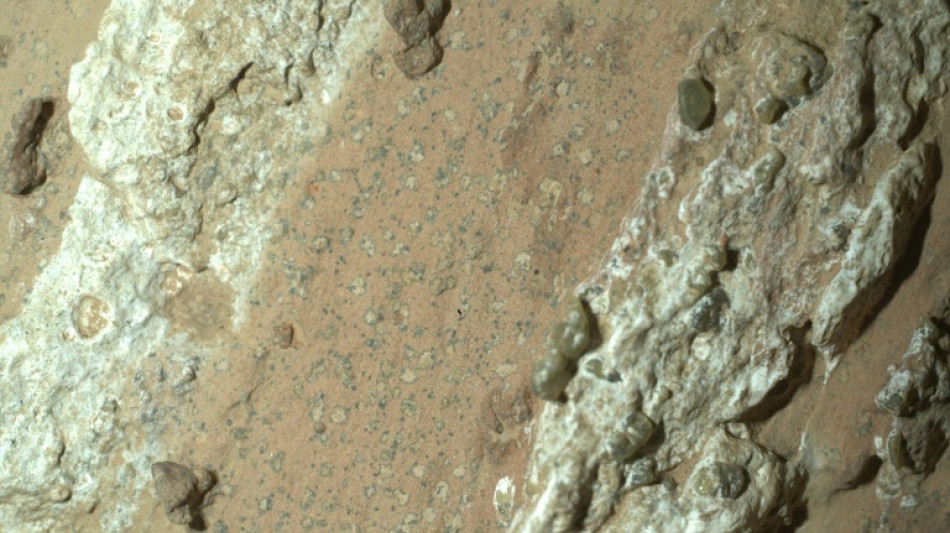
NASA Mars rover captures rock that could hold fossilized microbes / Photo: HANDOUT - NASA/JPL-Caltech/MSSS/AFP

NASA Mars rover captures rock that could hold fossilized microbes

NASA's Perseverance Mars rover has made what could be its most astonishing discovery to date: possible signs of ancient life on the Red Planet.

Text size:

The six-wheeled robotic explorer came across an intriguing, arrow-shaped rock dubbed "Cheyava Falls" that may harbor fossilized microbes from billions of years ago, when Mars was a watery world.

Perseverance drilled into the enigmatic rock to collect a core sample on July 21, as it traversed Neretva Vallis, an ancient river valley.

The samples carefully stowed beneath the rover's belly are destined to eventually return to Earth, where they will undergo more comprehensive analysis.

"Cheyava Falls is the most puzzling, complex, and potentially important rock yet investigated by Perseverance," project scientist Ken Farley of Caltech said Thursday.

Three compelling clues have scientists buzzing.

White calcium sulfate veins run the length of the rock, a telltale sign that water once flowed through it.

Between these veins is a reddish middle area, teeming with organic compounds, as detected by the rover's SHERLOC (Scanning Habitable Environments with Raman and Luminescence for Organics and Chemicals) instrument.

Finally, tiny off-white splotches ringed with black, reminiscent of leopard spots, contain chemicals that suggest energy sources for ancient microbes, according to scans by the PIXL (Planetary Instrument for X-ray Lithochemistry) instrument.

"On Earth, these types of features in rocks are often associated with the fossilized record of microbes living in the subsurface," said David Flannery, an astrobiologist and member of the Perseverance science team from the Queensland University of Technology in Australia.

The quest to confirm ancient Martian life is far from over, however.

The real test will come when Perseverance's precious rock samples are returned to Earth as part of the Mars Sample Return Program, a collaboration between NASA and the European Space Agency slated for the 2030s.

While there are alternative explanations for these findings that do not involve microbes, there is a tantalizing chance that Perseverance's core sample might contain actual fossilized microbes -- potentially making history as the first proof of life beyond Earth.

"We have zapped that rock with lasers and X-rays and imaged it literally day and night from just about every angle imaginable," said Farley.

"Scientifically, Perseverance has nothing more to give. To fully understand what really happened in that Martian river valley at Jezero Crater billions of years ago, we'd want to bring the Cheyava Falls sample back to Earth, so it can be studied with the powerful instruments available in laboratories."

J.Hasler--NZN