Japan's speedy, spotless Shinkansen bullet trains turn 60 / Photo: Philip FONG - AFP
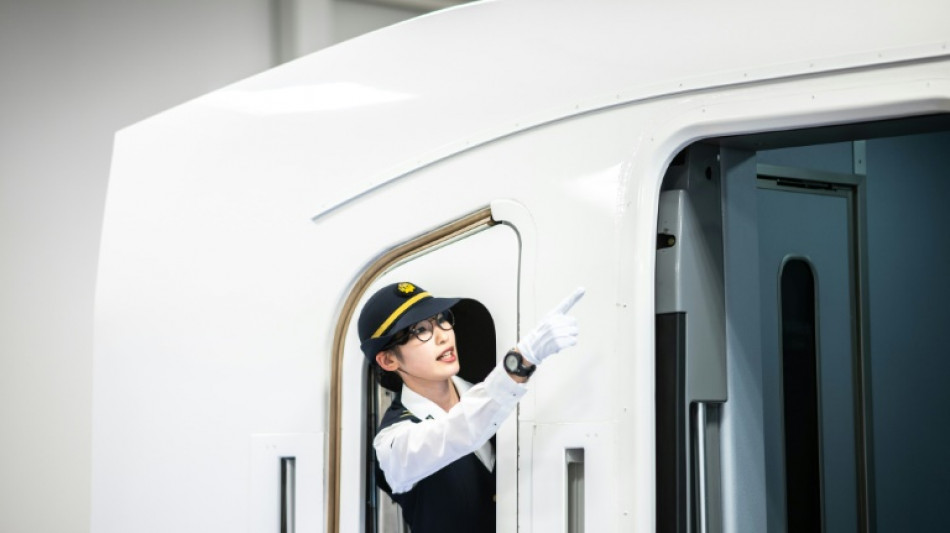
Her white-gloved, waistcoated uniform impeccable, 22-year-old Hazuki Okuno boards a bullet train replica to rehearse the strict protocols behind the smooth operation of a Japanese institution turning 60 Tuesday.
High-speed Shinkansen trains began running between Tokyo and Osaka on October 1, 1964, heralding a new era for rail travel as Japan grew into an economic superpower after its World War II defeat.
The service remains integral to the nation's economy and way of life -- so keeping it dazzlingly clean, punctual and accident-free is a serious job.
At a 10-storey, state-of-the-art staff training centre, Okuno shouted from the window and signaled to imaginary colleagues, keeping her cool when a video screen down the platform shows a flailing passenger stuck in a door.
The live-in facility southwest of Tokyo offers what rail operator JR Central describes as an "intense education" for future conductors, drivers and other team members.
"Thank you for riding," Okuno practised saying, bowing deeply after checking the time on her watch.
Each day nearly a quarter of a million passengers ride the Tokaido Shinkansen line, which stretches from Tokyo past Mount Fuji to Hakata around five hours away.
One top-speed Nozomi train arrives up to every five minutes.
JR Central says it has never had an accident resulting in death or injury on the bullet train, even in a country where earthquakes, typhoons and heavy snow are common.
Safety is "our top priority", Daisuke Kumajima, the company's PR officer, told AFP.
So "we take our education and training of our employees very seriously."
This month for the first time, on another line run by the company JR East, two linked bullet trains uncoupled, resulting in an emergency stop but no injuries.
- High-speed city growth -
With routes spanning the country, the Shinkansen's top speed of 320 kilometres (200 miles) per hour is no longer the world's fastest, having been outpaced by China.
But the original high-speed locomotive's streamlined nose and spacious interiors remain a symbol of Japanese engineering prowess and attention to detail.
It's also a tourist must-do and pop culture mainstay -- such as in Brad Pitt's 2022 blockbuster "Bullet Train".
A meticulous maintenance schedule means the trains are gleaming outside and in, with cleaners adjusting headrests and using brushes to ensure the seats are free of crumbs.
In some countries, train delays mean there is little time for such primping, said Christopher Hood who authored the book: "Shinkansen: From Bullet Train to Symbol of Modern Japan."
On the bullet train network, however, the average delay is less than a minute.
The growth of cities along Shinkansen routes over the decades shows its impact on the economy in Japan, where "face-to-face business is very, very important", added Hood, a researcher at Britain's Cardiff University.
In tandem the train has played a role in speeding up depopulation in rural Japan, according to Hood, leaving many elderly people isolated.
"People would rather live in the big cities... and then use the Shinkansen to go and visit relatives out in smaller cities if they need to," he told AFP.
- Future at 500 kph -
At a JR Central site, an engineer taps the inner machinery of a bullet train, listening closely for any unusual sounds that could reveal a loose part.
With ageing Japan increasingly facing labour shortages, the company is also researching a new digital inspection system that can analyse images of a train to spot dangers.
JR East, meanwhile, has said driverless bullet trains could be introduced from the mid-2030s.
There is also a huge project underway to build a high-speed maglev -- magnetic levitation -- line in Japan, long-delayed due to environmental opposition.
Maglev trains, which can run at 500 kilometres per hour, were meant to begin service between Tokyo and Nagoya in central Japan in 2027, but JR Central has pushed this back to 2034 or later.
The aim is to create a "dual system" with the Shinkansen, said Kumajima, to respond to demand and keep operations stable in the case of maintenance work or a big quake.
It's easy to take the Shinkansen for granted in Japan, which is a good thing, according to Hood.
But when Japanese people travel overseas, particularly in Europe or the United States, "they soon appreciate that 'yeah, the Shinkansen is a little bit special'," he said.
P.Gashi--NZN