Zürcher Nachrichten - Weather may delay launch of mission to study deflected asteroid

EUR -
AED 4.248105
AFN 75.770596
ALL 92.762559
AMD 422.720519
ANG 2.0703
AOA 1061.880869
ARS 1706.354669
AUD 1.637736
AWG 2.083564
AZN 1.971037
BAM 1.955432
BBD 2.326962
BDT 141.823334
BGN 1.962242
BHD 0.435718
BIF 3453.950583
BMD 1.156733
BND 1.477822
BOB 13.465468
BRL 6.040925
BSD 1.155383
BTN 110.192281
BWP 15.565073
BYN 3.514139
BYR 22671.957183
BZD 2.323663
CAD 1.60514
CDF 2629.253412
CHF 0.941189
CLF 0.026851
CLP 1056.7913
CNY 7.800083
CNH 7.801606
COP 3603.822404
CRC 519.802266
CUC 1.156733
CUP 30.653411
CVE 110.244272
CZK 24.210763
DJF 205.741316
DKK 7.473191
DOP 67.627285
DZD 152.299364
EGP 57.668157
ERN 17.350988
ETB 186.897659
FJD 2.584377
FKP 0.853399
GBP 0.85516
GEL 3.019524
GGP 0.853399
GHS 12.651621
GIP 0.853399
GMD 85.024294
GNF 10149.091752
GTQ 8.815343
GYD 241.67456
HKD 9.077054
HNL 30.972177
HRK 7.534035
HTG 151.121586
HUF 363.017812
IDR 20622.34285
ILS 3.418265
IMP 0.853399
INR 110.410701
IQD 1513.515426
IRR 1590030.052589
ISK 142.166837
JEP 0.853399
JMD 182.965599
JOD 0.820169
JPY 184.272161
KES 149.331922
KGS 101.156702
KHR 4675.120976
KMF 493.925187
KPW 1041.059598
KRW 1638.639283
KWD 0.357061
KYD 0.962819
KZT 536.1092
LAK 26076.097131
LBP 103462.246866
LKR 384.457714
LRD 209.700572
LSL 18.691186
LTL 3.415531
LVL 0.699696
LYD 7.356617
MAD 10.715985
MDL 20.034233
MGA 4974.064769
MKD 61.513434
MMK 2428.743274
MNT 4161.410395
MOP 9.338444
MRU 46.399276
MUR 54.486429
MVR 17.871955
MWK 2003.423313
MXN 19.69164
MYR 4.726298
MZN 73.927211
NAD 18.691186
NGN 1572.659254
NIO 42.522005
NOK 10.922567
NPR 176.30785
NZD 1.940013
OMR 0.444768
PAB 1.155383
PEN 3.896867
PGK 5.190024
PHP 71.098608
PKR 320.900664
PLN 4.306226
PYG 6934.696128
QAR 4.211808
RON 5.236186
RSD 117.317942
RUB 97.161731
RWF 1698.980555
SAR 4.340955
SBD 9.310058
SCR 16.04431
SDG 694.622124
SEK 11.020235
SGD 1.480159
SHP 0.856984
SLE 28.344188
SLL 24256.10146
SOS 660.275854
SRD 43.926343
STD 23942.02751
STN 24.495394
SVC 10.109099
SYP 15039.835978
SZL 18.688486
THB 38.337629
TJS 10.669694
TMT 4.060131
TND 3.387463
TOP 2.785134
TRY 55.369898
TTD 7.827528
TWD 37.04043
TZS 3061.72433
UAH 51.684982
UGX 4292.192975
USD 1.156733
UYU 46.291296
UZS 13754.413873
VES 890.810236
VND 30246.82002
VUV 137.249116
WST 3.163007
XAF 655.833689
XAG 0.017873
XAU 0.000264
XCD 3.126128
XCG 2.082208
XDR 0.81787
XOF 655.833689
XPF 119.331742
YER 274.381102
ZAR 18.703474
ZMK 10411.984809
ZMW 21.835894
ZWL 372.467396
  • VOD

    0.2000

    16.42

    +1.22%

  • RIO

    -0.4100

    95.68

    -0.43%

  • RELX

    -0.2400

    34.43

    -0.7%

  • GSK

    -0.4785

    49.52

    -0.97%

  • CMSC

    -0.0250

    21.45

    -0.12%

  • BCE

    0.1500

    23.47

    +0.64%

  • RYCEF

    0.1300

    20.84

    +0.62%

  • NGG

    -0.1500

    81.05

    -0.19%

  • CMSD

    -0.0100

    21.58

    -0.05%

  • RBGPF

    0.0000

    71.34

    0%

  • BCC

    -0.8900

    83.24

    -1.07%

  • JRI

    0.0635

    12.61

    +0.5%

  • BTI

    -0.2900

    57.06

    -0.51%

  • BP

    0.2196

    42.53

    +0.52%

  • AZN

    -0.7900

    156.45

    -0.5%

Weather may delay launch of mission to study deflected asteroid
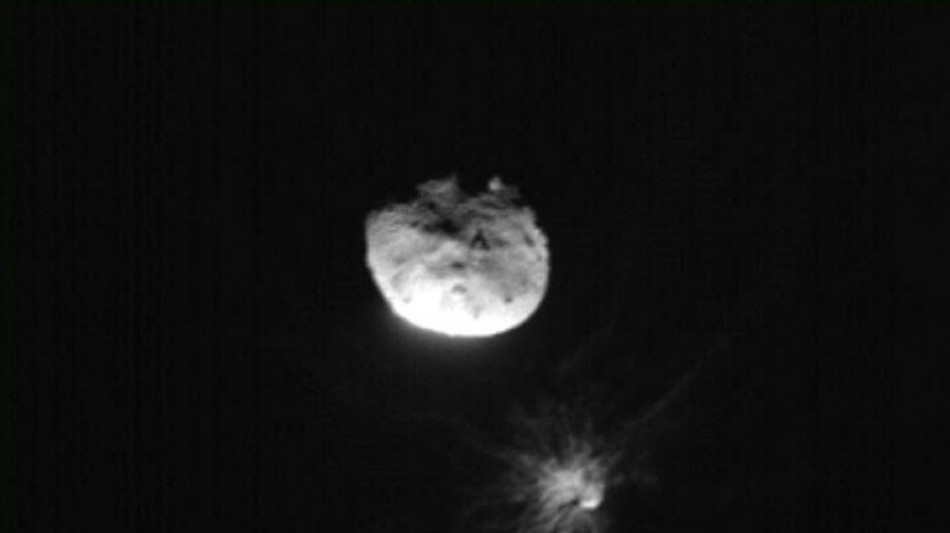
Weather may delay launch of mission to study deflected asteroid / Photo: Handout - ASI/NASA/AFP/File

Weather may delay launch of mission to study deflected asteroid

Stormy weather has threatened to delay the launch of Europe's Hera spacecraft, which is scheduled to blast off on Monday, SpaceX has said.

Text size:

The probe will head off on a mission to inspect the damage a NASA spacecraft did to an asteroid when it smashed into it in 2022 during the first test of Earth's planetary defences.

The Double Asteroid Redirection Test (DART) deliberately crashed into the pyramid-sized asteroid Dimorphos roughly 11 million kilometres (6.8 million miles) from Earth.

The fridge-sized spacecraft successfully knocked the asteroid well off course, demonstrating that humanity may no longer be powerless against potentially planet-killing asteroids that could head our way in the future.

But much about the impact remains unknown, including how much damage was done and exactly what the asteroid was like before it was hit.

So the European Space Agency (ESA) says it is sending Hera to the asteroid to conduct a "crime scene investigation" in the hopes of learning how Earth can best fend off future asteroids.

The spacecraft is scheduled to blast off on a SpaceX Falcon 9 rocket from Cape Canaveral in the US state of Florida at 10:52 am local time (1452 GMT) on Monday.

However thunderstorms have been forecasted in the launch area. SpaceX said on X on Sunday that the weather is currently only 15 percent favourable for a launch.

If a delay is required, a back-up launch is planned for Tuesday 10:46 am local time, SpaceX said.

The launch window for the mission will remain open until October 27.

- Green light after 'mishap' -

The launch had also faced a potential delay due to an anomaly involving a Falcon 9 rocket during the launch of SpaceX's Crew-9 astronaut mission late last month.

But on Sunday, the US Federal Aviation Administration gave the green light.

"The absence of a second stage re-entry for this mission adequately mitigates the primary risk to the public in the event of a reoccurrence of the mishap experienced with the Crew-9 mission," it said in a statement.

The launch window for the mission will remain open until October 27.

Once launched, Hera is planned to fly past Mars next year and then arrive near Dimorphos in December 2026 to begin its six-month investigation.

Dimorphos, which is actually a moonlet orbiting its big brother Didymos, never posed a threat to Earth.

After DART's impact, Dimorphos shed material to the point where its orbit around Didymos was shortened by 33 minutes -- proof that it was successfully deflected.

Analysis of the DART mission has suggested that rather than being a single hard rock, Dimorphos was more a loose pile of rubble held together by gravity.

"The consequence of this is that, instead of making a crater" on Dimorphos, DART may have "completely deformed" the asteroid, the Hera mission's principal investigator Patrick Michel told a press conference.

But there are other possibilities, he said, adding that the behaviour of these low-gravity objects is little understood and "defies intuition".

The 363-million-euro ($400 million) mission will be equipped with 12 scientific instruments and two nanosatellites.

T.Gerber--NZN