Zürcher Nachrichten - Latest sandstorm brings Iraq to standstill

EUR -
AED 4.243199
AFN 76.816385
ALL 93.186779
AMD 421.940448
AOA 1059.499986
ARS 1731.96426
AUD 1.634492
AWG 2.081161
AZN 1.961832
BAM 1.955111
BBD 2.320873
BDT 142.639766
BHD 0.434545
BIF 3449.985005
BMD 1.155398
BND 1.47658
BOB 13.695177
BRL 5.874733
BSD 1.152289
BTN 109.648538
BWP 15.553455
BYN 3.431177
BYR 22645.802735
BZD 2.317474
CAD 1.612324
CDF 2614.086957
CHF 0.934654
CLF 0.026803
CLP 1054.878725
CNY 7.796165
CNH 7.792791
COP 3648.389022
CRC 523.81326
CUC 1.155398
CUP 30.61805
CVE 110.22332
CZK 24.264051
DJF 205.196847
DKK 7.475264
DOP 67.26602
DZD 153.587771
EGP 57.609419
ERN 17.330971
ETB 185.985596
FJD 2.552261
FKP 0.857019
GBP 0.856098
GEL 3.015386
GGP 0.857019
GHS 13.519372
GIP 0.857019
GMD 84.920858
GNF 10120.260724
GTQ 8.791676
GYD 241.024009
HKD 9.064594
HNL 30.884989
HRK 7.534375
HTG 150.666939
HUF 363.033032
IDR 20546.50216
ILS 3.468101
IMP 0.857019
INR 110.072122
IQD 1509.468404
IRR 1589307.85432
ISK 142.587462
JEP 0.857019
JMD 182.994762
JOD 0.819159
JPY 182.969975
KES 149.450928
KGS 101.03906
KHR 4680.351701
KMF 492.199617
KRW 1636.950761
KWD 0.356741
KYD 0.960262
KZT 540.040464
LAK 26016.724996
LBP 103187.513486
LKR 386.502211
LRD 207.987652
LSL 18.720126
LTL 3.41159
LVL 0.698888
LYD 7.329387
MAD 10.739418
MDL 20.037856
MGA 4917.246994
MKD 61.540878
MMK 2425.815605
MNT 4152.793668
MOP 9.311421
MRU 46.322486
MUR 54.303818
MVR 17.850835
MWK 1998.087679
MXN 19.811612
MYR 4.723385
MZN 73.835683
NAD 18.719883
NGN 1573.640789
NIO 42.405066
NOK 10.986386
NPR 175.441455
NZD 1.961282
OMR 0.444252
PAB 1.152294
PEN 3.902292
PGK 5.092273
PHP 70.184643
PKR 319.904254
PLN 4.298497
PYG 6851.557409
QAR 4.212107
RON 5.248053
RSD 117.311005
RUB 95.047204
RWF 1694.395945
SAR 4.326684
SBD 9.31909
SCR 17.004942
SDG 693.751675
SEK 10.958327
SGD 1.477899
SLE 28.42391
SOS 658.56522
SRD 43.750885
STD 23914.407904
STN 24.491693
SVC 10.082449
SZL 18.716328
THB 38.099829
TJS 10.629864
TMT 4.055447
TND 3.38512
TRY 55.133169
TTD 7.810216
TWD 37.221116
TZS 3053.212273
UAH 51.608202
UGX 4291.578596
USD 1.155398
UYU 46.383264
UZS 13781.027404
VES 873.206446
VND 30204.417097
VUV 137.915725
WST 3.158531
XAF 655.723234
XAG 0.018032
XAU 0.000266
XCD 3.122521
XCG 2.076769
XDR 0.815509
XOF 655.723234
XPF 119.331742
YER 275.443085
ZAR 18.669755
ZMK 10399.966413
ZMW 21.749246
ZWL 372.037716
  • RBGPF

    0.7600

    70.5

    +1.08%

  • CMSC

    0.0240

    21.744

    +0.11%

  • RYCEF

    0.2300

    20.85

    +1.1%

  • NGG

    0.4700

    80.88

    +0.58%

  • RIO

    1.4500

    101.1

    +1.43%

  • GSK

    0.7900

    52.96

    +1.49%

  • BTI

    0.6000

    59.33

    +1.01%

  • RELX

    0.0485

    35.52

    +0.14%

  • BCE

    -0.0200

    22.75

    -0.09%

  • AZN

    1.4100

    161.42

    +0.87%

  • CMSD

    -0.1600

    21.82

    -0.73%

  • VOD

    0.1900

    16.19

    +1.17%

  • BCC

    2.3400

    86.6

    +2.7%

  • JRI

    0.1500

    12.81

    +1.17%

  • BP

    -0.6000

    41.63

    -1.44%

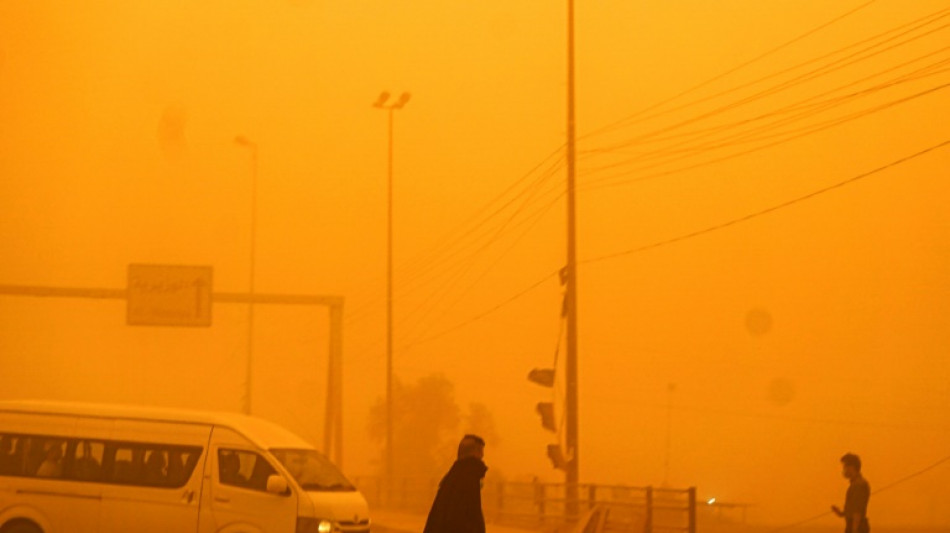
Latest sandstorm brings Iraq to standstill
Latest sandstorm brings Iraq to standstill / Photo: Sabah ARAR - AFP

Latest sandstorm brings Iraq to standstill

Another sandstorm that descended Monday on Iraq sent at least 2,000 people to hospital with breathing problems and led to the closure of airports, schools and public offices across the country.

Text size:

It is the eighth duststorm since mid-April to hit Iraq, which has been battered by soil degradation, intense droughts and low rainfall linked to climate change.

The last one earlier this month led to the death of one person while 5,000 others had to be hospitalised for respiratory problems.

On Monday a thick cloud of dust enveloped the capital Baghdad in an orange glow and blanketed many other cities including the Shiite shrine city of Najaf to the south, and Sulaimaniyah, in the northern Kurdish autonomous region, AFP correspondents said.

Yellow and orange sand covered building roofs, cars and even crept into homes.

Authorities in seven of Iraq's 18 provinces, including Baghdad, ordered government offices to shut.

But health facilities remained open to assist those most at risk, including the elderly and people suffering from chronic respiratory diseases and heart ailments.

By midday at least 2,000 people were admitted to hospitals across Iraq in need of oxygen, said health ministry spokesman Seif al-Badr.

AFP correspondents saw around 20 patients, most of them elderly men, at Baghdad's Sheikh Zayed Hospital.

One of them was Hadi Saada, 70, lying on his side on a bed in the intensive care unit hooked to a respirator. He struggled to breathe.

- 'Suffocating from dust' -

"It is his third time in hospital" since the sandstorms began in April, said his son Mohammed Saada, adding that his father had a heart condition.

Another patient, Khaled Jassem, 70, was also hooked to an oxygen tank.

"We've been here since 8:00 am... My father has a heart ailment, diabetes, hypertension and is suffocating on the dust," said his son Walid Jassem.

At least 75 people struggling to breathe were admitted Monday to Sheikh Zayed, said Talib Abdelmoneim Nejm, one of the ICU officials.

The sandstorm drastically reduced visibility to just 300 metres (yards) at Baghdad airport, prompting authorities to close airspace and halt flights, state-run INA news agency reported.

Airports in Najaf and Sulaimaniyah were also closed for the day, the agency said.

Schools nationwide were also shuttered and end of year exams postponed to Tuesday. Universities also delayed exams.

The latest sandstorm was expected to gradually dissipate by Monday evening, weather services said.

The Middle East has always been battered by dust and sandstorms but they have become more frequent and intense in recent years.

The trend has been associated with overuse of river water, more dams, overgrazing and deforestation.

Iraq is rich in oil and is known in Arabic as the land of the two rivers -- in reference to the legendary Tigris and Euphrates rivers.

In April, an environment ministry official warned that Iraq could face "272 days of dust" a year over the next two decades.

tgg/hkb/it

I.Widmer--NZN