Dutch researchers employ unique e-bike to make cycling safer / Photo: Nick Gammon - AFP
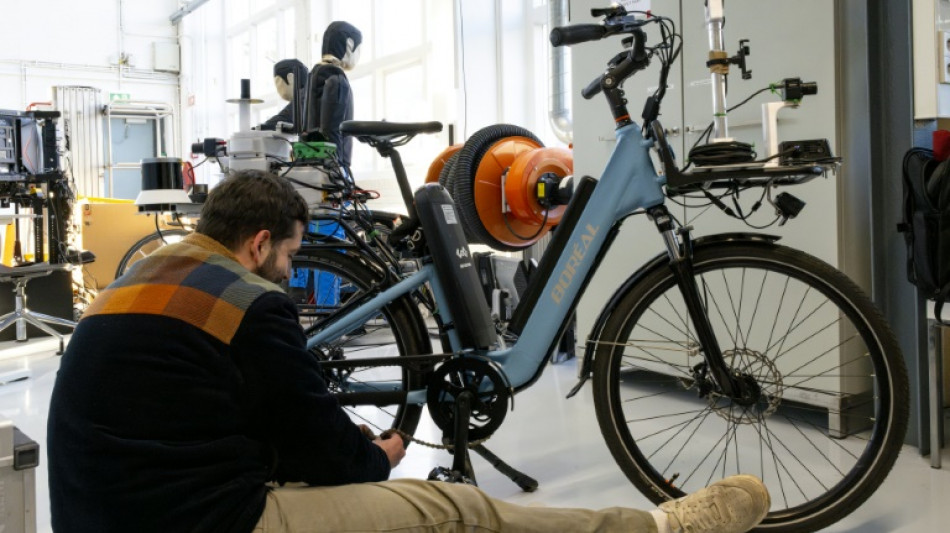
Dutch university researcher Holger Caesar heads out into the afternoon traffic on a bicycle like no other, equipped to collect data he believes may one day save lives.
His blue electric bike, kitted out with an array of laser sensors and scanners, speeds off among thousands of students pedalling home through the campus of the Delft University of Technology.
The campus of TU Delft is a warren of cycle paths -- a perfect encapsulation of life in a country where bicycles outnumber people.
As Caesar cycles through Delft's busy streets, his bicycle sweeps up data on range, direction and elevation of both moving and stationary objects -- including cyclists, pedestrains and cars.
The aim is to build a three-dimensional picture of its surroundings and a better undestanding of the way road users behave.
"We hope these datasets will have lots of applications in future," he said, suggesting they could help cyclists avoid obstacles, build self-stabilising bicycles or teach autonomous vehicles how to avoid hitting two-wheeled travellers.
"For cars it's relatively simple... They go left. They go right. They go straight on. But it's very hard to predict how cyclists are going to behave," Caesar told AFP.
"You could, for instance, use the data to develop an application that alerts car drivers when a cyclist makes an unexpected move."
- Laser sensors -
The "Delft SenseBike" itself would be at home in a science fiction film, equipped as it is with LiDAR sensors at the front and back.
LiDAR -- "Light Detection And Ranging" technology -- is commonly used in autonomous vehicles, which use the laser detection to create a three-dimensional image of their surroundings.
The infrared light rays emitted by the sensors bounce off surfaces and relay back information to "map" the area through which the SenseBike travels, including detecting moving objects like cyclists.
The data is processed using a labelling technique that associates everything visible in the images to a description of what it is -– such as "tree", "cyclist" and "traffic light".
This technique should allow a car driver to recognise a "cyclist" when they see one and avoid a collision.
"The first step will be to make this data publicly available, so that academics and entrepreneurs can benefit from it," said Caesar.
Then artificial intelligence algorithms can be developed to detect, track and predict cyclists' behaviour so drivers can "plan a route around them", he said.
- 'Lack of data' -
At the moment there is a dearth of data on bikes and cycling in the Netherlands, despite their popularity.
For example, there are few statistics on bicycle accidents in a country that boasts around 37,000 kilometres (23,000 miles) of cycle paths and 22 million bikes.
"It's a difficult question to answer," the Dutch Cyclists' Federation says on its website, noting that "not all accidents are registered".
The Dutch Central Statistics Bureau registered around 270 people as dying in bicycle accidents in 2023.
Almost half the deaths were caused by collisions between cyclists and cars, lorries or buses.
"Cars are becoming safer for their passengers but not for other road users," said the cycling federation's director Esther van Garderen.
Asked whether the Delft University data could one day be used to develop an autonomous "self-riding" bicycle, Caesar laughed and shook his head.
"I think that would kind of take away the fun of cycling," he grinned.
"We probably don't want to do that, but we still think we can make cycling safer."
H.Roth--NZN