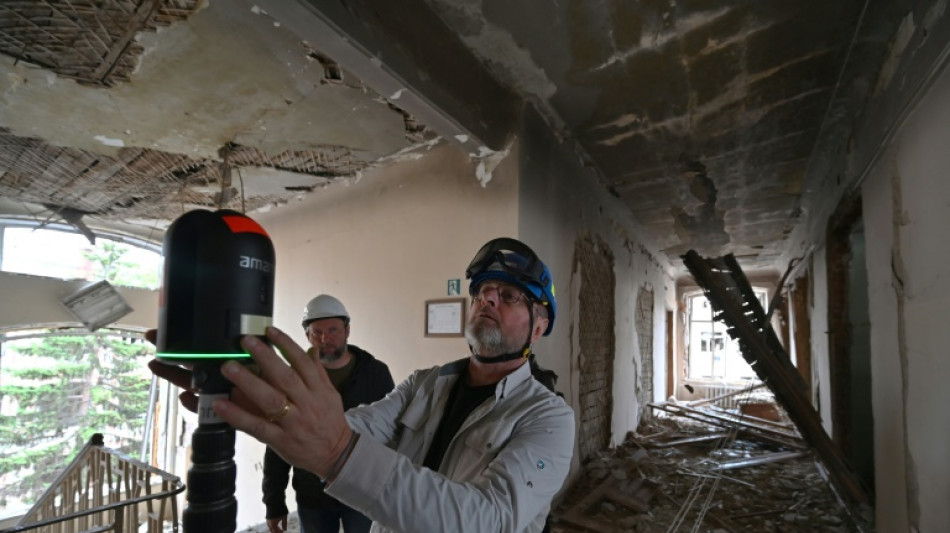
High-tech race to map Ukraine's damaged historic buildings / Photo: Genya SAVILOV - AFP
Many of Ukraine's historic monuments have been destroyed in the three months since Russia invaded, but cultural experts are working to conserve their memory using cutting-edge technology and 3D scans.
One of them is volunteer French engineer Emmanuel Durand, a specialist in 3D data acquisition, who is assisting a bevy of architects, engineers, historic building experts and a museum director to record buildings in Kyiv, Lviv, Chernigiv and Kharkiv.
Durand steps over a jumbled pile of beams and crunches over the rubble that was once Kharkiv's 19th-century fire station.
He plants his laser scanner, a sort of tripod with a pivoting head, in a strategic corner of the severely damaged building.
The redbrick fire station and its watchtower, built in 1887, are a monument to Kharkiv's industrial revolution.
Durand's gadget records the building from all angles.
"The scanner records 500,000 points per second. We'll get 10 million points from this location. Then we'll change location and go round the whole building, outside and inside. A billion points in all," he explains.
At the end of the day, Durand assembles all the data on a computer "like the pieces of a jigsaw" to digitally reconstruct the building.
The result is a perfect reproduction, accurate to within five millimetres (a fraction of an inch) that can be rotated in any direction or sliced into sections. You can even see the holes where blast waves from explosions have damaged the structure.
"This enables us to map out the building for the future. That could help us work out if anything has moved, which is important for safety purposes, and see what can be restored and what can't. It's also useful from a historical point of view," he says.
"We've got the actual missile-damaged building and an exact replica of how it used to look."
- 'Cultural genocide'-
In Kharkiv alone, around 500 buildings are listed as being of historic architectural significance. Most are in the dense historic city centre, on which Russian airstrikes are concentrated, according to architect Kateryna Kuplytska, a member of the body documenting damaged heritage sites.
She estimates that over a hundred of them have been hit already.
And while Russian troops have loosened their noose around Ukraine's second city, shells still rain down with regular monotony.
New explosions and blast waves, inclement weather, construction work and site visits will all contribute to hastening the destruction of these already weakened buildings, Kuplytska says.
"That's why it's essential to record them in accurate detail so we can plan urgent interventions that will stabilise the structures" and preserve their memory, she explains.
"Recording the destruction will also assist in criminal proceedings. We see serious damage to heritage across the whole country. It's genocide towards Ukrainian people and genocide towards Ukrainian culture," she says.
After two days at the fire station, Durand moves on to the economics faculty at the Karazin National University in Kharkiv. It is located right next to the imposing headquarters of the Ukrainian secret services, which is being targeted by the Russians and has been hit on numerous occasions.
The current iteration of the economics faculty was built in Soviet times. It was designed by Serhiy Tymoshenko, the father of the "modern Ukrainian" style of architecture of the early 20th-century, and is one of the country's first reinforced concrete structures.
Some critics suggest it is futile to document historic buildings in such meticulous detail while the war is still raging and people are dying every day.
But Tetyana Pylyptshuk, the director of the Kharkiv literary museum, begs to disagree.
"Culture is the basis of everything. If culture had developed well, people probably wouldn't be dying and there wouldn't be a war," she said.
Pylyptshuk, who also sits on the commission on damaged historical sites, has sent most of her museum collections to western Ukraine to protect them from damage -- and from looting, should Russian troops overrun Kharkiv.
"Today, everyone realises this. Maybe they were not so attentive to our cultural heritage before... but when you lose it, it hurts."
A.Wyss--NZN